
Do you remember your child’s first toy?
Toys for kids are often seen as simple gifts, but they play a much bigger role in a child’s life. Maybe it was a soft teddy bear, a colorful rattle, or a simple plastic car. At that moment, it may have seemed like just a small gift—but in reality, it was much more than that.
Table of Contents
ToggleToys are not just for fun. They are powerful tools that shape your child’s brain, emotions, creativity, and overall development. From the very first months of life, the right toys can help children explore the world, learn new skills, and express themselves.
In today’s fast-changing world, choosing the right toys has become more important than ever. With so many options available, parents often feel confused about what to buy, when to introduce it, and why it matters.
This complete 2026 guide will help you understand everything in a simple and practical way.
Quick Answer: What Are the Best Toys for Kids?
The best toys for kids are age-appropriate, safe, and development-focused.
Quick summary
- Toys help in brain development, creativity, and emotional growth
- Start giving toys from newborn stage (0 months)
- Choose toys based on age, safety, and learning value
- Best types include:
- Educational toys
- Sensory toys
- Pretend play toys
- Building blocks
- Outdoor toys
The right toy at the right age = better learning + happier child
Basic Understanding – What Are Toys?
Learn what sensory toys are and how they help in your child’s brain development, focus, and learning. This video explains everything in simple terms with real examples—perfect for parents who want to choose the right toys for their kids.
Toys are objects designed for children to play with—but their role goes far beyond entertainment.
They are tools that help children:
- Learn new skills
- Improve memory and focus
- Develop emotions
- Build creativity
From simple rattles to advanced STEM kits, every toy plays a role in shaping a child’s development.
In modern parenting, toys are considered an essential part of early childhood education.
Main Topic – Must-Have Toys for Kids
Types of Toys
Here are the most important categories of toys every parent should know:
1. Educational Toys for kids
- Puzzles, flashcards, shape sorters
- Improve thinking and problem-solving
2. Sensory Toys for kids
- Rattles, textured balls, sensory boards
- Develop touch, sight, and hearing
3. Soft Toys for kids
- Teddy bears, plush animals
- Provide emotional comfort
4. Pretend Play Toys for kids
- Kitchen sets, doctor kits, dolls
- Boost imagination and creativity
5. Building Toys for kids
- Blocks, LEGO-type toys
- Improve motor skills and creativity
6. Musical Toys for kids
- Drums, keyboards, sound toys
- Enhance listening and rhythm
7. Outdoor Toys for kids
- Balls, cycles, swings
- Support physical development
Benefits of Toys for Kids
Toys are essential for overall child development:
1. Brain Development
Toys like puzzles and blocks improve memory, logic, and thinking skills.
2. Motor Skills
Stacking toys, walkers, and balls improve coordination and movement.
3. Emotional Growth
Soft toys help children express feelings and build attachment.
4. Creativity Boost
Pretend play toys allow children to imagine and create their own world.
5. Social Skills
Group play and board games teach sharing, communication, and teamwork.
Best Toys by Age (Examples & Suggestions)
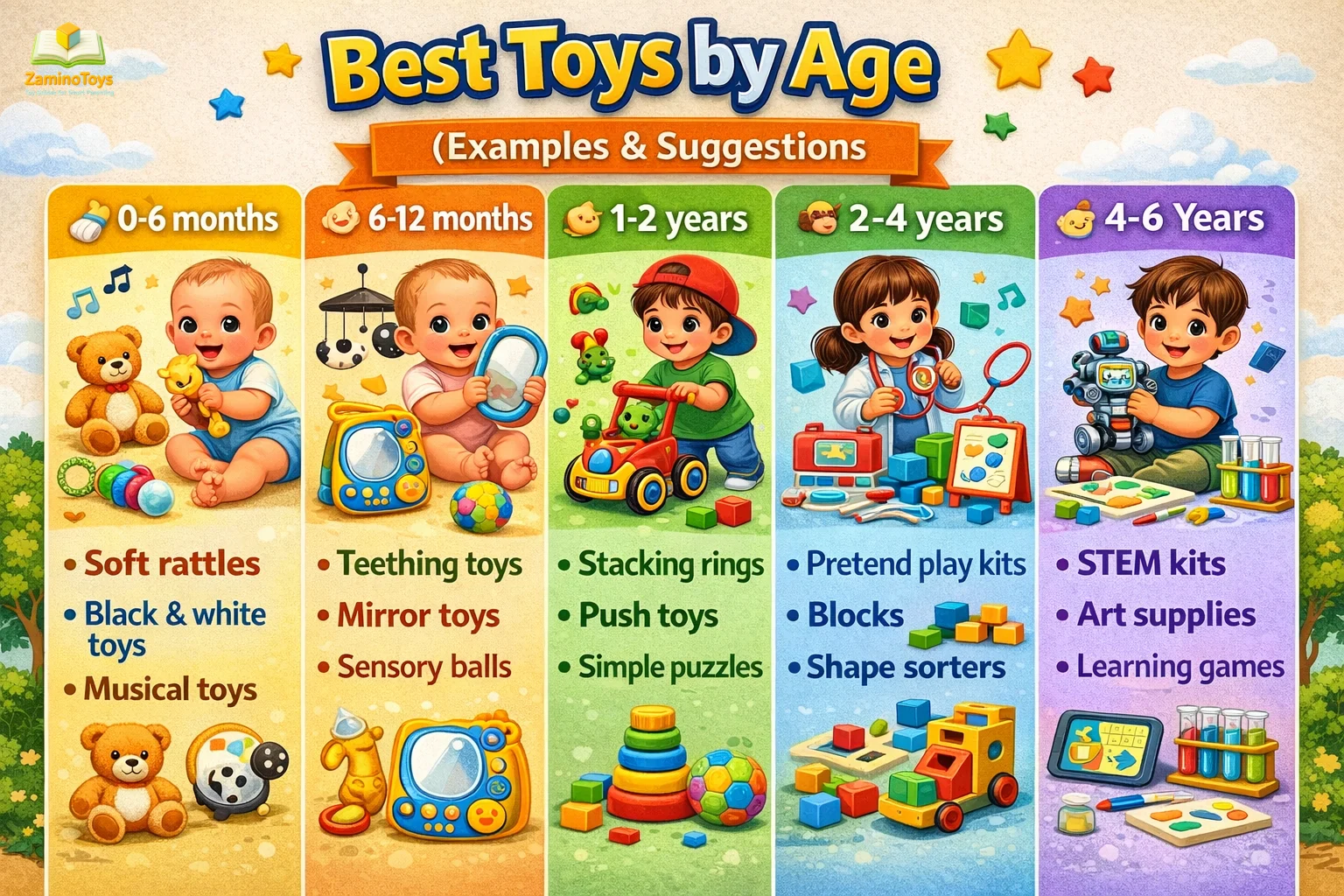
0–6 Months
- Soft rattles
- Black & white toys
- Musical toys
6–12 Months
- Teething toys
- Mirror toys
- Sensory balls
1–2 Years
- Stacking rings
- Push toys
- Simple puzzles
2–4 Years
- Pretend play kits
- Blocks
- Shape sorters
4–6 Years
- STEM kits
- Art supplies
- Learning games
Practical Guidance – How to Choose the Right Toys
Discover the best toys for kids by age in this simple and helpful guide. This video explains what toys to choose, when to introduce them, and why they are important for your child’s brain development, creativity, and learning. Perfect for parents looking for age-appropriate and educational toy ideas.
Follow these simple steps to choose the best toys for your child:
Step 1: Check Age Suitability
The first and most important step in choosing toys for kids is checking whether the toy is suitable for your child’s age.
Every toy is designed keeping a specific age group in mind. A toy that is perfect for a 4-year-old may not be safe or useful for a 1-year-old baby.
For example:
- Babies (0–1 year) need soft, sensory toys that stimulate touch and sound
- Toddlers (1–3 years) need toys that help with movement and coordination
- Older kids (3+ years) benefit from creative and problem-solving toys
Age labels on toys are not just suggestions—they are based on safety standards and developmental needs. Ignoring them can lead to safety risks or reduced learning benefits.
Always check:
- Recommended age on packaging
- Size of toy parts
- Complexity level
Choosing age-appropriate toys for kids ensures that your child stays safe while also learning effectively.
Step 2: Focus on Safety
Safety should always be your top priority when selecting toys for kids.
Children, especially babies and toddlers, tend to explore toys by touching, biting, and even putting them in their mouths. This makes it extremely important to choose toys that are safe and non-toxic.
Here are some important safety tips:
- Avoid toys with small parts (choking hazard)
- Choose BPA-free and non-toxic materials
- Check for sharp edges or loose parts
- Ensure toys meet safety standards (ISI mark in India)
- Avoid cheap plastic toys with strong chemical smells
For infants, always choose:
- Soft toys
- Rounded edges
- Lightweight materials
For older kids:
- Ensure durability
- Avoid easily breakable toys
Safe toys for kids not only protect your child but also give you peace of mind as a parent.
Step 3: Prefer Learning Toys
Not all toys are created equal. Some are designed just for entertainment, while others help children learn and grow.
When choosing toys for kids, always prefer toys that offer learning value along with fun.
Learning toys help in:
- Improving memory
- Enhancing problem-solving skills
- Developing language abilities
- Boosting concentration
Examples of learning toys:
- Puzzles
- Shape sorters
- Flashcards
- STEM kits
- Educational board games
For younger kids:
- Sensory toys improve brain development
For older kids:
- STEM toys encourage logical thinking
The best toys for kids are those that combine fun + learning.
Step 4: Encourage Open-Ended Play
One of the most powerful types of toys for kids is open-ended toys.
These are toys that can be used in multiple ways, allowing children to use their imagination and creativity.
Unlike fixed-function toys (like battery-operated toys), open-ended toys do not have a single purpose. This means children can explore, create, and invent their own ways of playing.
Examples:
- Building blocks
- Clay or playdough
- Wooden toys
- Magnetic tiles
Benefits of open-ended toys:
- Boost creativity
- Improve problem-solving
- Encourage independent thinking
- Increase attention span
For example, a set of blocks can become:
- A house
- A tower
- A road
- Anything the child imagines
This type of play is extremely important for brain development.
Always include open-ended toys for kids in your child’s toy collection.
Step 5: Avoid Too Many Toys
Many parents believe that giving more toys means more happiness. But in reality, too many toys can actually reduce a child’s focus and creativity.
When children have too many options:
- They get easily distracted
- They lose interest quickly
- They become overwhelmed
Instead, it is better to follow the “less is more” approach.
Tips:
- Keep a limited number of toys available
- Rotate toys every few weeks
- Store unused toys and reintroduce them later
This makes old toys feel new again and keeps children engaged.
Quality is more important than quantity when it comes to toys for kids.
Step 6: Choose Easy-to-Clean Toys
Hygiene is an important factor, especially for babies and toddlers.
Young children often:
- Put toys in their mouth
- Drop toys on the floor
- Play with toys everywhere
This makes it essential to choose toys for kids that are easy to clean and maintain.
Best options:
- Washable plastic toys
- Silicone toys
- Machine-washable soft toys
Avoid:
- Toys that absorb dirt and are hard to clean
- Toys with too many small gaps
Cleaning tips:
- Wash toys regularly
- Use mild soap or baby-safe disinfectant
- Dry toys properly before reuse
Clean toys help prevent infections and keep your child safe.
Common Mistakes Parents Make When Choosing Toys for Kids
Choosing the right toys for kids is not always easy. Many parents, without realizing it, make small mistakes that can affect their child’s learning, safety, and overall development. Avoiding these common mistakes can help you make better decisions and give your child a more meaningful play experience.
Buying Toys Without Checking Age Suitability
One of the most common mistakes is ignoring the recommended age on the toy packaging. Toys that are too advanced can frustrate children, while toys meant for younger kids may not challenge them enough. More importantly, some toys may include small parts that can be dangerous for babies and toddlers. Always choose toys for kids that match your child’s age and developmental stage.
Choosing Only Flashy or Noisy Toys
Bright lights and loud sounds may grab attention, but they don’t always support learning. Overstimulating toys can reduce creativity and make children dependent on passive entertainment. Instead, choose simple and engaging toys for kids like blocks, puzzles, and pretend play sets that encourage active thinking and imagination.
Ignoring Safety Standards
Safety should never be compromised when selecting toys for kids. Cheap or low-quality toys may contain harmful materials or break easily. Always check for non-toxic materials, smooth edges, and proper safety certifications. A safe toy ensures both fun and peace of mind.
Giving Too Many Toys at Once
Having too many toys can overwhelm children and reduce their ability to focus. Instead of playing deeply, they may jump quickly from one toy to another. It’s better to provide a few meaningful toys for kids and rotate them regularly to keep the interest alive.
Not Playing with the Child
Toys alone cannot replace the value of parent-child interaction. When parents actively play with their children, it strengthens bonding, improves communication, and enhances learning. The best toys for kids become even more valuable when shared with parents.
F.A.Q.
Soft rattles, high-contrast black & white toys, and musical toys are best for newborns.
Yes, they improve memory, problem-solving skills, and early learning abilities.
A few meaningful toys are better than many unused ones.
You can start from birth with simple sensory toys.
Non-toxic, BPA-free, and age-appropriate toys are the safest options.
Conclusion
Toys are not just playthings—they are the building blocks of your child’s future.
The right toys help children learn faster, think better, and grow emotionally stronger. Whether it’s a simple rattle or a creative building set, every toy plays an important role in shaping your child’s journey.
At ZaminoToys, we believe in choosing toys with purpose—because every playtime is a learning opportunity.
Choose smart. Play better. Grow stronger.
Author Bio
Author: ZaminoToys Editorial Team
Reviewed By: Child Development Research Insights (based on pediatric and psychology studies)
We provide trusted parenting tips, toy reviews, and child development guides to help you raise happy and smart children.


Pingback: 10 Perfect Toys for Every Age: A Joyful Guide to Childhood Growth (2025) - zaminotoys
Pingback: Toys for 0–6 Months: Sensory & Brain Development Guide for New Parents - zaminotoys
Pingback: Best Toys for 6 to 12 Months – Montessori & Milestone Play
Pingback: 5 Gentle Parenting Tips That Work – Indian Parenting Advice
Pingback: Brilliant DIY Sensory Toys at Home for Babies (0–12 Months