Pregnancy

Signs of Labor Pain in Pregnancy: Symptoms, Stages & When Labor Starts
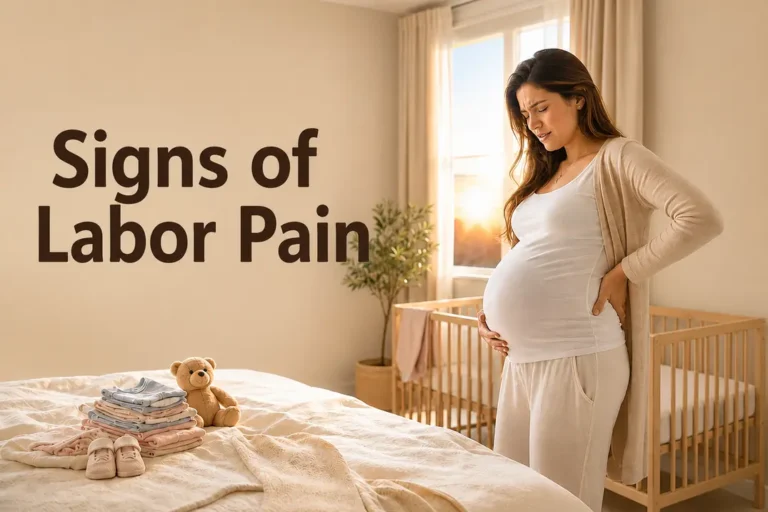
Pregnant woman going to the hospital after signs of labor pain begin

Signs of Labor Pain in Pregnancy: Symptoms, Stages & When Labor Starts If you are in your final weeks of pregnancy, you have probably found yourself wondering when it will actually happen. Every twinge, every ache, every strange feeling in your belly can suddenly feel important. Learning the signs of labor pain is one of the best ways to feel calm and confident as your due date approaches, instead of anxious and unsure. Here is the reassuring truth: there is no single, universal way the signs of labor pain unfold for every mother. Some mothers feel gentle, gradual changes over several days. For some women, labor begins gradually over several days, while others may transition from feeling completely normal to experiencing regular, strong contractions within just a few hours. Both are completely normal. This guide will walk you through everything you need to know about the signs of labor pain, so you can recognize what your body is telling you and know exactly when it is time to head to the hospital. What Is Labour? Understanding the Birth Process Labour is the natural process through which your body prepares for and carries out the birth of your baby. It involves rhythmic tightening and relaxing of the uterine muscles, known as contractions, which gradually open the cervix and help move your baby down through the birth canal. Labour typically begins on its own once your baby and your body are ready. A complex combination of hormonal signals, including rising oxytocin and prostaglandins, triggers the uterus to start contracting in a coordinated way. These hormones also help soften and thin the cervix so it can open for delivery. In the weeks and days leading up to labour, your body quietly gets to work. The cervix begins to soften, your baby may shift into a lower position, and your uterus practices with mild tightening. All of this prepares the pathway for birth, even before you notice the more obvious signs of labor pain. No two labours look exactly the same, even for the same woman across different pregnancies. Genetics, your baby’s position, your pelvic shape, and even your stress levels can all influence how your labour unfolds. This is why comparing your experience to a friend’s story is rarely helpful. Your body will follow its own timeline. 📘 External Reference: Normal Labor: Physiology, Evaluation, and Management The Three Stages of Labour Explained Stage 1: Early Labour and Active Labour The first stage of labour is the longest and is divided into phases. Early labour is when contractions begin, usually mild and irregular, and the cervix starts to dilate slowly, often up to around four to five centimetres. Many women spend this phase at home, resting, moving around, and timing their contractions. Active labour follows, marked by stronger, more frequent, and more regular contractions. This is when the signs of labor pain become impossible to ignore, as the intensity increases and contractions typically arrive every three to five minutes. Cervical Dilation & Effacement Cervical dilation is the gradual opening of the cervix, measured in centimetres from zero to ten. Effacement refers to the thinning of the cervix, expressed as a percentage. Both need to progress together for birth to happen safely. The transition phase is the final and most intense part of stage one, where the cervix completes dilation to ten centimetres. Contractions are close together, powerful, and often the hardest part of labour to cope with, but it also tends to be the shortest phase. Stage 2: Baby’s Birth Once the cervix is fully dilated, stage two begins. This is the pushing stage, where you actively work with your contractions to help your baby move down and through the birth canal. Your healthcare team will guide you on when and how to push, coordinating your efforts with each contraction. This stage can last anywhere from a few minutes to a couple of hours, depending on factors like your baby’s position and whether this is your first birth. During the Pushing Stage As your baby moves through the birth canal, you may feel intense pressure, especially in the pelvis and rectal area. This is a normal and expected part of delivery. The stage ends with the birth of your baby. Stage 3: Delivering the Placenta After your baby is born, your body still has one more job to do. Stage three involves delivering the placenta, the organ that nourished your baby throughout pregnancy. Mild contractions continue during this stage, helping the placenta separate from the uterine wall and be delivered, usually within five to thirty minutes after birth. After the Placenta is Delivered Your uterus will continue contracting after this stage too, which is essential for controlling bleeding and helping the uterus shrink back toward its pre-pregnancy size. Your healthcare provider will monitor this closely to make sure everything is progressing safely. 📘 External Reference: The 3 Stages of Labor: Clinical Phases & Facts 🤰 Early Signs of Labor Pain You Should Never Ignore Know the early changes your body may experience before labour begins. 👶 Baby Drops Lower (Lightening) In the last few weeks of pregnancy, your baby may move lower into the pelvis. This is called lightening and helps prepare for birth. As your baby moves lower, pressure on your lungs decreases, making breathing feel easier. At the same time, you may need to urinate more often because your baby presses on your bladder. 💗 Passing the Mucus Plug and Increased Vaginal Discharge The mucus plug protects your cervix from infection during pregnancy. As the cervix begins to open, the mucus plug may come out. It may look like thick, jelly-like mucus with a pink or brown colour (bloody show). As labour approaches, vaginal discharge may become more noticeable than usual. 💡 Good to Know Losing the mucus plug is normal, but it does not always mean labour will begin immediately. ⏱️ Braxton Hicks Contractions (Practice Contractions) Braxton Hicks are practice contractions that prepare your body for labour. They are usually

Signs of Labor Pain in Pregnancy: Symptoms, Stages & When Labor Starts Read More »

First Trimester Pregnancy: A Week-by-Week Survival Guide for New and Expecting Moms

Easy-to-read first trimester pregnancy symptoms chart with early pregnancy signs every expecting mother should know.

First Trimester Pregnancy: A Week-by-Week Survival Guide for New and Expecting Moms Finding out you’re pregnant is a life-changing moment filled with excitement, happiness, and many questions. First Trimester Pregnancy covers the first 12 to 13 weeks and is one of the most important stages of your pregnancy journey. During this time, your baby’s heart, brain, and other vital organs begin to develop, while your body goes through many hormonal and physical changes. You may experience symptoms like morning sickness, tiredness, mood swings, and food cravings. Understanding these early changes can make your pregnancy journey feel easier and less stressful. In this guide, you’ll learn about First Trimester Pregnancy week by week, common symptoms, healthy eating tips, self-care advice, and when to contact your doctor—everything you need to support a healthy pregnancy from the very beginning. At Zaminotoys, we believe that informed parents make confident decisions, and we’re here to support you with trusted pregnancy and parenting resources throughout your journey. Week-by-Week Guide Week 1–4 Baby’s development: Technically, weeks 1 and 2 happen before conception, as pregnancy is counted from your last period. Ovulation and fertilization usually occur around week 2 or 3. By week 4, the fertilized egg has implanted into the uterine lining, and the earliest structures of the placenta and embryo begin forming. Mother’s body: Hormones like hCG (human chorionic gonadotropin) start rising rapidly. This is the hormone that pregnancy tests detect. Common symptoms: Many women feel nothing at all in these early days. Some notice light spotting (implantation bleeding), mild cramping, or breast tenderness. Care tips: If you are trying to conceive, start taking a folic acid supplement now if you haven’t already. Avoid alcohol, smoking, and unnecessary medications until you confirm your status with a home test Week 5 Baby’s development: The neural tube, which becomes the brain and spinal cord, starts forming. The heart begins to take shape and may start showing early electrical activity. Mother’s body: hCG levels climb quickly, and this is usually when a home pregnancy test turns positive. Common symptoms: Tiredness, mild nausea, tender breasts, and frequent urination often begin around this time. Care tips: Book your first prenatal appointment. Start a gentle, whole-food diet and keep a water bottle handy, as dehydration can worsen nausea. Week 6 Baby’s development: The heart is now beating and may be visible on an early ultrasound. Tiny buds that will become arms and legs appear. Mother’s body: Rising progesterone can slow digestion, leading to bloating. Common symptoms: Morning sickness often intensifies. Some women notice heightened smell sensitivity that triggers nausea. Care tips: Eat small, frequent meals instead of three large ones. Bland foods like crackers, rice, and toast are easier on the stomach. Week 7 Baby’s development: The brain grows rapidly, and small hand and foot paddles appear. By this week, your baby has grown to about the size of a blueberry. Mother’s body: Blood volume increases to support the growing baby, which can leave you feeling more tired than usual. Common symptoms: Tiredness, nausea, and mild mood swings are common. Care tips: Prioritize sleep and short naps if possible. Gentle walks can help with energy and digestion.   Week 8 Baby’s development: Facial features start forming, tiny eyes, ears, and a nose become visible. The embryo begins making small movements, although you can’t feel them yet. Mother’s body: Your uterus is growing, though it may not show externally yet. Common symptoms: Nausea, food aversions, and bloating often peak around this time. Care tips: Identify your food triggers and avoid strong-smelling meals. Ginger tea or ginger candies may help settle the stomach. Week 9 Baby’s Development: By this stage, all major organs have started to develop, and your baby is now officially called a fetus.  Mother’s body: Your waistline may feel slightly tighter, even if it’s not visibly showing yet. Common symptoms: Breast changes, occasional headaches, and continued fatigue. Care tips: Wear a supportive, comfortable bra. Stay hydrated to help reduce headaches. Week 10 Baby’s development: Vital organs continue maturing. Fingers and toes are more defined, and tiny nails start to form. Mother’s body: Morning sickness may begin to ease for some women, though not all. Common symptoms: Mild cramping (round ligament stretching), increased vaginal discharge, and continued fatigue. Care tips: Wear breathable cotton underwear and mention any unusual discharge to your doctor. Week 11 Baby’s development: The baby’s body is growing faster than the head, helping proportions look more balanced. Basic reflexes are developing. Mother’s body: Skin changes may appear, like a subtle glow or occasional breakouts due to hormonal shifts. Common symptoms: Bloating, mild constipation, and some remaining nausea. Care tips: Add fiber-rich foods like oats, fruits, and vegetables to ease digestion Week 12 Baby’s development: By the end of this week, most major organs are formed. The baby can make small movements, though you still won’t feel them. Mother’s body: Many women start feeling a shift — energy slowly returning, nausea calming down. Common symptoms: Symptoms may start easing, though every pregnancy is different. Care tips: This is a common time for the first trimester screening and dating ultrasound. Celebrate this milestone — you’re almost through the first trimester. Common Symptoms During First Trimester Pregnancy Nausea and Morning Sickness: Despite the name, it can happen any time of day. It usually peaks between weeks 6–9 and often improves by week 12–14. Fatigue: Your body is working hard to build a placenta and support new life. Rest is not laziness  it’s necessary. Food Cravings and Food Aversions: Hormones can make once-favorite foods unappealing, while unexpected cravings appear. Breast or Chest Changes: Tenderness, swelling, and darkening of the areolas are common as your body prepares for breastfeeding. Mood Swings: Hormonal shifts can cause sudden emotional changes. Be gentle with yourself. Frequent Urination: Increased blood flow and a growing uterus put pressure on the bladder. Bloating: Progesterone slows digestion, leading to a feeling of fullness or gas. Mild Cramping: Light cramping can happen as the uterus stretches, but sharp or severe pain

First Trimester Pregnancy: A Week-by-Week Survival Guide for New and Expecting Moms Read More »

Safe Sleeping Position for Pregnant Women Every Trimester

Sleeping Position for Pregnant Women: Expectant mother comfortably sleeping on her left side with a full-body pregnancy pillow, supporting her back, belly, hips, and legs for a safe and restful night's sleep

How to Choose the Best Sleeping Position for Pregnant Women Rest & Relaxation Essentials Home / Pregnancy can make sleeping more challenging as your body changes. Choosing the right sleeping position for pregnant women helps improve comfort, supports your growing baby, and reduces common problems like back pain and restless sleep.In this guide from Zaminotoys, you’ll learn the safest sleeping positions, which ones to avoid, and simple tips to enjoy better sleep throughout your pregnancy. Which Position Is Safest? When it comes to choosing the right sleeping position for pregnant women, doctors around the world agree on one thing: side sleeping is the safest option, especially as your pregnancy progresses. Lying on your side takes pressure off your major blood vessels, supports healthy blood flow to the placenta, and reduces strain on your back and hips. While side sleeping is generally recommended from the second trimester onward, the exact side you choose can make a difference too, which brings us to the next important comparison Rest & Relaxation Essentials C-Shaped Pregnancy Pillow | Full Body Maternity Support Pillow with Washable Cover Buy Now H-Shaped Pregnancy Pillow with Organic Cotton Cover Buy Now INSEN Anti-Nausea Aromatherapy Soy Wax Candle for Pregnant Women with Lemon and Vanilla Essential Oils Buy Now INSEN U-Shaped Pregnancy Pillow with Removable Washable Cover Buy Now Best Sleeping Positions: Left vs Right Sleeping on the Left Side Left-side sleeping is widely considered the best sleeping position for pregnant women, particularly in the second and third trimesters. This position improves blood circulation to the uterus, placenta, and baby, while also easing pressure on your liver and kidneys. Many women notice reduced swelling in their feet and ankles when they favour the left side. Sleeping on the Right Side If you find yourself naturally rolling onto your right side at night, don’t panic. Sleeping on the right is not harmful and remains a safe sleeping position for pregnant women, though it may offer slightly less circulation benefit than the left side. Alternating between both sides through the night is completely normal and often more comfortable than forcing yourself to stay in one position. Positions to Avoid Not every posture is safe once your bump starts to grow. Here are the ones to be cautious of: Sleeping flat on your back: This can compress the vein that carries blood back to your heart, leading to dizziness, low blood pressure, and reduced blood flow to your baby, especially after the 20-week mark. Sleeping on your stomach: As your belly expands, this position becomes physically impossible and uncomfortable, but even in early pregnancy, it’s best to start training your body to sleep on your side. Knowing which sleeping positions to avoid is just as important as choosing the safest sleeping position for pregnant women. As your pregnancy progresses, keeping these recommendations in mind can help you sleep more comfortably and support a healthier pregnancy. Sleeping Position During Pregnancy: First 3 Months During the first trimester, including the first month, most women can sleep in any position that feels comfortable because the baby is still small and well protected by the pelvic bone. Although there is no immediate need to change your sleeping habits, this is the perfect time to start practising the sleeping position for pregnant women by gradually getting used to sleeping on your left side. Building this habit early can make the transition easier as your pregnancy progresses and your growing baby bump makes certain sleeping positions less comfortable. Sleeping Position During Pregnancy: Second Trimester By the second trimester, your growing bump makes stomach sleeping impractical, and doctors typically advise against back sleeping from this stage onward. This is when side sleeping, particularly on the left, becomes the recommended sleeping position for pregnant women. Using a pillow between your knees can help maintain spinal alignment and ease lower back discomfort. Sleeping Position During Pregnancy: Third Trimester The third trimester brings the most noticeable changes: a heavier bump, more frequent urination, and increased breathlessness when lying flat. Left-side sleeping is strongly recommended in these final weeks, as it supports optimal blood flow to your baby and reduces pressure on your major organs. Many women find that propping their upper body slightly with pillows helps with heartburn and shortness of breath during this stage. How to Sleep Better During Pregnancy: Simple Tips Better sleep during pregnancy comes down to a mix of the right posture and small lifestyle tweaks: Go to bed and wake up at the same time every day  Avoid heavy meals, caffeine, and excess fluids close to bedtime. Keep your bedroom cool, dark, and free of screens before sleep. Practice light stretching or prenatal yoga to ease physical tension. These habits, paired with the correct sleeping position for pregnant women, can significantly reduce nighttime disturbances. Sleep Hygiene Tips During the Second Trimester Getting quality sleep becomes more important during the second trimester as your body continues to change. Keep your bedroom cool, quiet, and dark to create a comfortable sleep environment. Maintain a regular sleep schedule by going to bed and waking up at the same time each day for better sleep during pregnancy . Avoid using your phone, tablet, or TV before bedtime, as screen light can make it harder to fall asleep. Instead, read a book, listen to calming music, or practice deep breathing to help your body relax. Eat smaller, balanced meals in the evening and avoid spicy, oily, or heavy foods that may cause heartburn. Staying hydrated during the day is important, but reduce fluids close to bedtime to limit nighttime bathroom trips. Sleeping on your left side with your head slightly raised can also help reduce heartburn and improve comfort. Gentle activities such as walking, prenatal yoga, or stretching during the day can improve sleep quality and support a healthy sleeping position for pregnant women. Simple Tips for Sleeping Comfortably During Pregnancy Start sleeping on your side early to help your body adjust as your pregnancy progresses. Use pillows for extra support under

Safe Sleeping Position for Pregnant Women Every Trimester Read More »

How to Prevent Stretch Marks in Pregnancy -Causes & Remedies

Stretch Marks in Pregnancy

How to Prevent Stretch Marks in Pregnancy Causes & Remedies Understand the causes of pregnancy stretch marks, discover prevention tips, and explore safe ways to care for your skin during every stage of pregnancy. Home / Stretch marks in pregnancy are a common and natural part of your body’s changes as your baby grows. They usually appear due to rapid skin stretching, hormonal changes, genetics, and weight gain. While they cannot always be prevented, healthy eating, proper hydration, regular moisturising, and safe exercise may help reduce their appearance. With consistent care and time, most stretch marks gradually fade after pregnancy, becoming much less noticeable. What Are Stretch Marks in Pregnancy, Exactly? Stretch marks in pregnancy (medically called striae gravidarum) are narrow, streak-like lines that appear on the surface of the skin. They can appear pink, red, purple, or even brownish depending on your natural skin tone. In most cases, they show up on the belly, but they can also appear on the breasts, upper thighs, hips, and lower back.The first sign is often a mild itching or tightness in the skin before the marks become visible.This is because the skin is being stretched faster than it can comfortably accommodate. While stretch marks cannot always be prevented, proper skincare, hydration, and healthy weight management during pregnancy may help reduce their appearance Four Essential Products for Pregnancy Stretch Mark Care Orimii Bump Hydrating Whipped Butter View Details POKONUT Natural Stretch Marks Cream View Details POKONUT Stretch Mark Roll-On Serum View Details AreoVeda Belly & Body Oil for Stretch Marks View Details What Causes Pregnancy Stretch Marks? Rapid Skin Stretching   – As your baby grows, your belly expands quickly-sometimes faster than your skin’s collagen and elastin fibers can keep up with. This rapid stretching causes small tears in the middle layer of the skin (the dermis).which appear as stretch marks on the surface. Hormonal Changes  – During pregnancy, hormone levels change significantly, especially cortisol. This can slow down the skin’s natural collagen production, which is important for keeping the skin firm and stretchy. As a result, the skin may lose some of its elasticity and become more likely to develop **stretch marks in pregnancy** compared to regular weight gain. Genetics – If your mother or sister developed stretch marks during their pregnancies, there’s a higher chance you may too. Skin type and elasticity are largely inherited. Excess Weight Gain – Gaining more weight than the recommended range (typically 10 – 12.5 kg for an average pregnancy) puts additional pressure on the skin and increases the likelihood of stretch marks in pregnancy. Multiple Pregnancies or a Large Baby – Carrying twins, triplets, or a larger-than-average baby causes more skin stretching in a shorter time, making marks more likely. During Which Trimester Do Stretch Marks Typically Start? This is one of the most common questions Indian moms ask – and the honest answer is: it depends on your body. First Trimester (Weeks 1–12): Most women do not develop visible stretch marks this early, as the baby is still very small. However, some women with sensitive or dry skin may start noticing faint lines near the breasts due to hormonal changes. Second Trimester (Weeks 13–26) : Many expectant mothers begin to notice **stretch marks in pregnancy** during the second trimester, as the baby grows and the skin stretches more rapidly. These marks commonly appear on the abdomen, hips, and thighs. Starting a daily moisturising routine during this stage can help keep the skin hydrated and comfortable as it continues to expand. Third Trimester (Weeks 27–40): The majority of stretch marks appear during the third trimester. Your belly is at its largest, skin is at maximum stretch, and the marks may look red or purple in colour. After delivery, they gradually fade to a lighter, silvery tone. What Are the Symptoms of Stretch Marks? Before the marks become fully visible, your skin may show early signs:   Itching or a tingling sensation on the belly, thighs, or breasts Skin feeling tighter or thin in certain areas Faint pink or reddish lines that gradually become more visible Slightly raised or ridged texture in the early stages Over time, marks flatten and turn silver or whiteIf the itching is severe or accompanied by a red, raised rash across the belly, it could be a condition called PUPPP (Pruritic Urticarial Papules and Plaques of Pregnancy) – which is harmless but worth mentioning to your doctor Stretch Marks in Pregnancy, Itching, and Other Common Skin Changes Pregnancy causes several skin changes beyond just stretch marks. Many moms experience: Skin colour changes : A dark line called the linea nigra may appear running from the navel to the pubic bone. Dark patches on the face (melasma) are also common due to hormonal pigmentation. General dryness and tightness: As skin stretches, it loses moisture faster, which worsens itching. Red, raised rash : As mentioned above, PUPPP can cause a rash that starts around stretch marks and spreads. Always consult your doctor if a rash appears. Can Coconut Oil Help Prevent Stretch Marks in Pregnancy? This is a very popular question, especially among Indian moms who trust traditional remedies. The honest answer: Coconut oil alone cannot fully prevent stretch marks in pregnancy, but it genuinely helps keep the skin moisturized, supple, and less prone to tearing. Well-hydrated skin stretches more comfortably and tends to show fewer or lighter marks. Warm virgin coconut oil massaged gently into the belly, thighs, and hips daily  – ideally from the second trimester – can: Reduce itching and drynes Improve skin elasticity temporarily Make existing marks lighter over time Combine it with other oils like almond oil or vitamin E oil for better results. Always do a patch test first if you have sensitive skin.  How to Prevent Stretch Marks in Pregnancy Naturally? Effective Tips to Prevent Stretch Marks During Pregnancy While you cannot completely guarantee that you’ll avoid stretch marks in pregnancy (genetics plays a big role), these evidence-backed tips can significantly reduce their severity: 1. Maintain a Healthy Diet Eat foods rich

How to Prevent Stretch Marks in Pregnancy -Causes & Remedies Read More »

Diet Plan of Pregnancy: What Every Mother Should Eat for a Healthy Baby

Diet Plan of Pregnancy: What Every Mother Should Eat for a Healthy Baby

Diet Plan of Pregnancy Discover trimester-wise nutrition guidance, a complete 7-day Indian pregnancy meal chart, healthy foods to eat, foods to avoid, snack ideas, and expert tips for a healthy pregnancy journey. 📥 Download Your Pregnancy Diet Plan PDF Home / A well-planned diet plan of pregnancy covers every nutrient your growing baby needs, from folic acid in week one to iron and calcium in the final trimester. This guide from zaminotoys.in walks you through trimester-wise nutrition goals, a practical 7-day Indian meal chart, foods to include and avoid, smart snack ideas, and safe kitchen habits. Whether you are in your first week or your ninth month, this article gives you clear, actionable meal guidance suited to the Indian kitchen and lifestyle. Why Your Diet Plan of Pregnancy Matters Pregnancy nutrition is not about eating more food; it is about making healthier, smarter food choices that provide the essential nutrients both mother and baby need. The right meals at each stage directly influence your baby’s brain formation, bone strength, organ development, and birth weight. A thoughtful diet plan for pregnancy also protects the mother from anemia, gestational diabetes, and excessive fatigue. 🥗 Trimester Diet Guide 📥 Download Your Free Pregnancy Diet Plan PDF Get a printable meal chart packed with essential nutrients for a healthy pregnancy journey.   📥 Download Your Pregnancy Diet Plan PDF Five core reasons to prioritize your pregnancy diet: Supports Baby’s Development – Folic acid, iron, calcium, and protein build the brain, spine, bones, and organs from the very first weeks. Boosts Immunity – Wholesome, nutrient-dense meals strengthen both mother and baby against infections and pregnancy complications. Reduces Morning Sickness – Small, frequent meals stabilize blood sugar and significantly ease first-trimester nausea. Sustains Energy – Pregnancy increases your body’s energy demand. A balanced diet prevents the constant fatigue that many mothers experience. Prevents Complications – Adequate nutrition reduces the risk of preeclampsia, low birth weight, preterm labour, and iron-deficiency anaemia. Trimester-Wise Diet Plan of Pregnancy First Trimester (Weeks 1–12) – Build the Foundation The baby’s neural tube, heart, and major organs form during these twelve weeks. Folic acid is non-negotiable at this stage. Nutrient Why It Matters Best Indian Sources 🥬 Folic Acid Prevents neural tube defects Spinach, Methi, Moong Dal, Citrus Fruits 🩸 Iron Carries oxygen for mother and baby Rajma, Chana, Leafy Greens, Lean Meats 🥛 Calcium Early bone and teeth development Milk, Curd, Paneer, Ragi 🥩 Protein Builds baby’s tissues and organs Eggs, Chicken, Lentils, Nuts 🍌 Vitamin B6 Relieves nausea and improves appetite Bananas, Potatoes, Chickpeas Key Tips Eat 5–6 small meals daily, never skip breakfast, drink 8–10 glasses of water, and avoid spicy or fried foods that worsen nausea. × Second Trimester (Weeks 13–26) – Fuel Baby’s Growth The “golden period” of pregnancy — nausea reduces, appetite returns, and your baby enters rapid growth. Calorie needs increase by 300–350 kcal per day. Nutrient Role Best Indian Sources 🥩 Protein Muscle and cell development Chicken, Eggs, Masoor Dal, Paneer 🥛 Calcium Bone and tooth formation Milk, Til (Sesame), Ragi 🐟 Omega-3 Brain and eye development Walnuts, Flaxseeds, Fish 🌾 Fibre Prevents constipation Whole Grains, Vegetables, Fruits ☀️ Vitamin D Calcium absorption support Fortified Milk, Sunlight Key Tips Add milk or dahi at bedtime for calcium, pair iron-rich foods with lemon or amla for better absorption, and avoid raw or undercooked meat. × Third Trimester (Weeks 27–40) – Prepare for Delivery Your baby gains most of its body weight now. Nutrition needs reach their peak. Prioritise energy-dense, easily digestible meals that support delivery and breastfeeding readiness. Nutrient Role Best Indian Sources 🩸 Iron Prepares for delivery blood loss Spinach, Rajma, Chicken Liver 🥛 Calcium Final bone hardening for baby Milk, Paneer, Sesame Seeds 🌾 Fibre Reduces constipation and bloating Dal, Vegetables, Whole Wheat 🥑 Healthy Fats Completes brain development Ghee (Moderate), Nuts, Avocado 🥦 Vitamin K Blood clotting and bone health Leafy Greens, Broccoli Key Tips Eat smaller meals to manage heartburn, avoid carbonated drinks and gas-causing foods, and stay well-hydrated — dehydration can trigger early contractions. × 7-Day Indian Diet Chart for Pregnancy Day 🌅 Pre-Breakfast 🍳 Breakfast ☀️ Mid-Morning 🍛 Lunch 🍵 Evening 🌙 Dinner Day 1 Dry Fruits (8–12 pieces) Moong Dal Chilla (3) + Chutney Blueberry Shake Mutton Biryani (1.5 cups) + Raita Sweet Potato Salad + Tea Wheat Dosa (3) + Bitter Gourd Sabji Day 2 Fruit Juice (Pomegranate/Guava) Wheat Dosa (4) + Tomato Sabji Broccoli Soup Rice + Chicken (1 Piece) + Broccoli Sabji Mixed Fruit Salad Moong Dal Chilla (3) + Chutney Day 3 Banana Milkshake Veggie Sevai/Upma + 2 Parathas Pumpkin Soup Mutton Biryani (1.5 Cups) + Raita 10–14 Dry Fruits Multigrain Toast (2) + 2 Eggs Day 4 Carrot Juice Oatmeal (1 Cup) + 2 Boiled Eggs Banana Milkshake Rice + Mutton (1 Piece) + Masoor Dal Fruit Salad Veggie Poha + 2 Moong Dal Chillas Day 5 Plain Milk Veggie Poha + 2 Moong Dal Chillas Tomato Soup Chicken Biryani (1.5 Cups) + Raita Vegetable Salad Multigrain Toast (2) + 2 Eggs Day 6 Banana Milkshake Oatmeal + 2 Boiled Eggs Pumpkin Soup Rice + Mutton + Masoor Dal 10–14 Dry Fruits Wheat Dosa (4) + Tomato Sabji Day 7 Plain Milk Veggie Sevai/Upma + 2 Parathas Peach Milkshake Vegetable Khichdi + Chicken + Dahi Avocado + Peanut Butter Veggie Poha + 2 Moong Dal Chillas 🥗 Ready-to-Use Pregnancy Meal Planner Foods to Eat During Pregnancy 🍎 Fruits & Vegetables 🌾 Starchy Carbohydrates 🥩 Protein-Rich Foods 🥛 Dairy Products 🥑 Healthy Fats 🍋 Smart Iron Combination Fruits and Vegetables: Bananas, mangoes, pomegranate, guava, spinach, methi, broccoli, sweet potato, carrots, and tomatoes — aim for at least five servings daily for vitamins, minerals, and fibre. Starchy Carbohydrates: Whole wheat roti, brown rice, oatmeal, multigrain bread, and upma provide steady energy without blood sugar spikes. Always choose wholegrain wherever possible. Protein-Rich Foods: Eggs, chicken, lean mutton, fish, masoor dal, moong dal, paneer, and nuts support baby’s cell growth and the mother’s tissue repair throughout

Diet Plan of Pregnancy: What Every Mother Should Eat for a Healthy Baby Read More »

How to Use a Pregnancy Test Kit at Home: Step-by-Step Guide

pregnancy -test

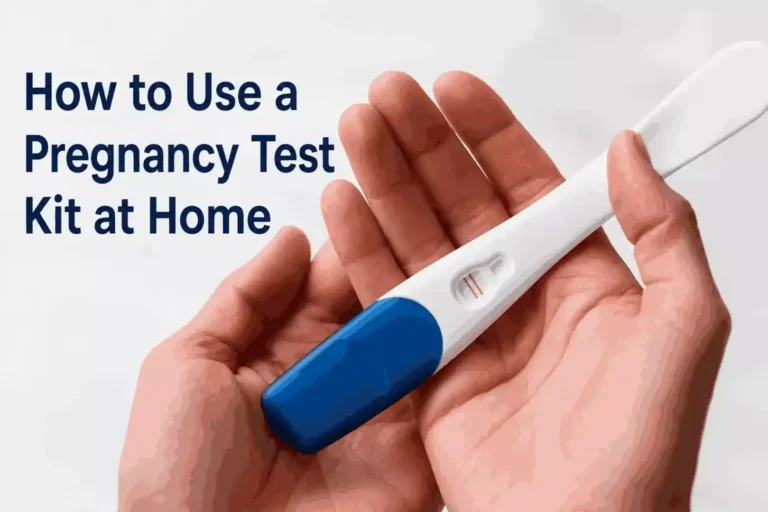
What Is a Pregnancy Test? Home / A pregnancy test detects the hormone hCG to help determine if you are pregnant. Home urine tests provide quick results, while blood tests can detect pregnancy earlier. For accurate results, follow the test instructions and test at the right time. If your result is positive or unclear, consult a healthcare professional for confirmation and further guidance. Types of Pregnancy Tests Why Do People Take a Pregnancy Test? How to Use a Pregnancy Test Kit Correctly at Home When Pregnancy Tests Give Incorrect Results What Is a Pregnancy Test Used For? Can Medications Affect Pregnancy Test Results? Positive Pregnancy Test? Here’s What to Do Next Conclusion & FAQ Types of Pregnancy Tests A pregnancy test is a quick and reliable way to check for pregnancy. It detects human chorionic gonadotropin (hCG), a hormone that the body produces after a fertilized egg attaches to the uterus. Because hCG appears early in pregnancy, testing for this hormone can help identify pregnancy at an early stage. Pregnancy tests are easy to access and can be taken at home or performed by a healthcare professional. They deliver fast results, helping individuals make informed decisions about their health and pregnancy journey. For more pregnancy, parenting, and child development resources, visit zaminotoys.in. There are several ways to test for pregnancy, depending on the situation and the level of accuracy needed. Home Pregnancy Test (Urine Test Kit) A home pregnancy test is the most common type of pregnancy test. It uses a urine sample to detect hCG and can be done privately at home. Most test kits provide results within a few minutes. Blood Test A blood pregnancy test is performed in a clinic or laboratory. It can detect lower levels of hCG than a urine test, which means it may confirm pregnancy earlier. Blood tests are often used when a healthcare provider needs more detailed information. Ultrasound An ultrasound is not usually the first step in detecting pregnancy, but it may be used later to confirm pregnancy and monitor the baby’s growth and development. Why Do People Take a Pregnancy Test? There are many reasons why someone may take a pregnancy test. Missing a menstrual period. Suspecting pregnancy after unprotected intercourse. contraception failure. Planning for pregnancy. Before starting certain medications or medical treatments. Confirming pregnancy symptoms such as nausea, fatigue, or breast tenderness. Taking a pregnancy test can provide early answers and help individuals seek appropriate medical care if needed. How to Use a Pregnancy Test Kit Correctly at Home Using a pregnancy test kit correctly is important for getting accurate results. Although most home pregnancy tests are easy to use, following the instructions carefully can improve reliability. Pregnancy Test Kit Buy product 1. Take the Test at the Right Time Testing too early may result in a false-negative result because hCG levels may not yet be high enough to detect. Many experts recommend using first-morning urine because it contains a higher concentration of hCG. 2. Read the Instructions Carefully Different pregnancy test brands may have different instructions. Before starting the test, read the information provided in the package. Understanding the correct procedure can help avoid mistakes. 3. Collect the Urine Sample Use a clean and dry container if required by the test instructions. Some pregnancy test kits allow direct testing in the urine stream. Make sure the test device remains clean and is used according to the manufacturer’s directions. 4. Wait for the Result After using the test, place it on a flat surface and wait for the recommended amount of time. Most pregnancy tests provide results within three to five minutes. Avoid checking the result too soon or long after the waiting period has ended. 5. Check the Result Most home pregnancy tests display results with lines or symbols. Two lines (+) usually mean the test is positive and pregnancy is likely. One line (–) usually means the test is negative. If the result is unclear, repeat the test after a few days or use a new test kit. 6. Confirm with a Doctor If your pregnancy test result is positive, schedule an appointment with a healthcare provider for confirmation. If the test is negative but your period remains delayed, you may need to take another test or seek medical advice. Using a pregnancy test correctly can help provide accurate results and reduce confusion. Following the instructions, testing at the right time, and consulting a healthcare professional when necessary are important steps in confirming pregnancy. https://youtu.be/zKWM5RYOg68?si=21xVjcUUv4EwgNQL What Is a Pregnancy Test Used For? Pregnancy tests are used to check whether a woman is pregnant. These tests work by detecting a hormone called hCG, which is produced in the body during pregnancy. Both urine tests and blood tests can detect hCG levels. A home pregnancy kit usually checks urine, while a blood test is done in a clinic or hospital. There are two common hCG tests used during pregnancy: Qualitative test: Confirms if you are pregnant or not Quantitative test: Measures the exact amount of hCG in the blood. Doctors may use hCG tests for several reasons, including the following. To confirm pregnancy: An hCG level above 25 mIU/mL usually indicates pregnancy. To estimate early pregnancy: hCG levels help doctors understand how early the pregnancy is progressing. To monitor high-risk pregnancies: Doctors may track hCG levels in pregnancies with a higher risk of miscarriage. To detect ectopic pregnancy: This happens when the fertilized egg grows outside the uterus. To identify molar pregnancy: A condition where abnormal tissue grows inside the uterus instead of a healthy pregnancy. To support prenatal screening: hCG tests may help detect certain conditions or birth defects in the baby. When Pregnancy Tests Give Incorrect Results False pregnancy test results are not very common, but they can happen. In most cases, incorrect use of the test is the reason. A false-negative result often occurs when the test is taken too early, before the pregnancy hormone can be detected. Using the test incorrectly, such as not

How to Use a Pregnancy Test Kit at Home: Step-by-Step Guide Read More »

Fetus Development Week by Week: Complete Pregnancy Growth Guide

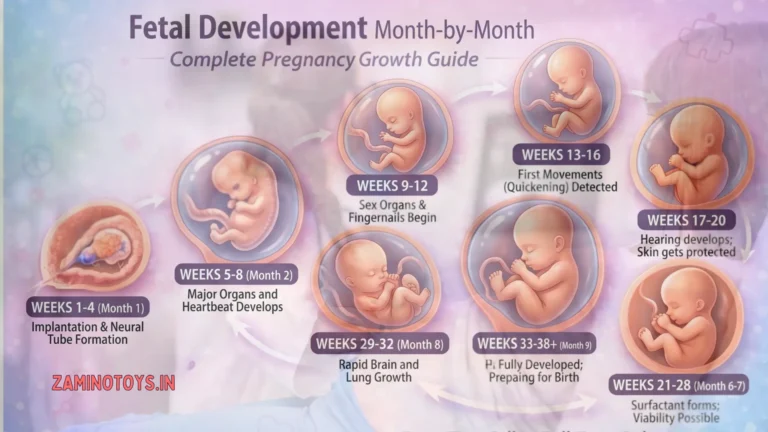
Fetal development month by month chart illustrating pregnancy growth stages and milestone timeline inside the womb

Visual & Editorial Transparency Notice: This visual infographic is custom-designed for educational illustration by the ZaminoToys Editorial Team. All developmental milestones depicted are reviewed and fact-checked against peer-reviewed healthcare standards (ACOG, NHS, Mayo Clinic). Published & Updated: July 2026 Source Authorities: Mayo Clinic, Cleveland Clinic, NHS, ACOG Pregnancy is a transformative journey where every single week brings distinct biological milestones. From a single fertilized cell during conception to a fully developed newborn, understanding how a baby grows inside the womb offers clarity and reduces unnecessary anxiety. This guide breaks down fetus development week by week across all 40 weeks of pregnancy, backed by clinical guidelines and medically reviewed data. Why Tracking Fetus Development Matters Helps you connect with your baby Gives clarity on what’s happening inside Reduces unnecessary worry Makes each stage more meaningful Quick Overview Understanding Fetal Development: Stages & Key Milestones Simply put, fetus development is the biological process where a single fertilized cell multiplies and transforms into a fully developed baby over 9 months (40 weeks). Medical consensus divides prenatal growth into three distinct stages: germinal, embryonic, and fetal. ⚡ Fertilization & Division Starts at conception with rapid cell division. 🫀 Organogenesis Major organs & structures form in months 1–2. 👶 Growth & Movement Sensory pathways, strength & weight build later. The 3 Biological Stages of Prenatal Growth Stage 1 Germinal Stage (Weeks 1 to 2) Begins at conception in the fallopian tube when sperm fertilizes the egg, forming a single-cell zygote. The cell multiplies rapidly as it travels down to implant into the uterine lining. Stage 2 Embryonic Stage (Weeks 3 to 8) The critical organogenesis phase. All foundational organ systems—including the neural tube (brain and spinal cord), primitive circulatory system, and heart—begin forming rapidly. Stage 3 Fetal Stage (Weeks 9 to 40) The official transition from embryo to fetus. Pre-existing structures mature, facial features sharpen, skeletal bones harden, sensory systems awaken, and rapid weight accumulation occurs for birth readiness. Recommended Pregnancy Care Guide Looking for the Right Foods to Support Fetal Growth? Pair your knowledge of fetus development with a trimester-by-trimester meal guide. Explore essential prenatal nutrients, key vitamins, and safe daily meal choices for expectant mothers. Read Pregnancy Diet Plan → Fetal Development Stages: Week-by-Week Visual Overview This detailed 3D animation explains fetus development week by week, illustrating how a baby grows from a single microscopic cell into a fully developed infant. Created by Scientist Cindy, the video covers essential biological milestones including implantation, organogenesis, early heart pulsing, facial formation, sensory awakening, and late-stage lung maturation. It provides a clear, high-contrast visual overview for expectant parents and educators tracking pregnancy growth. Visual overview of fetal growth stages across 40 weeks of pregnancy. Fetus Development Week by Week: Complete Timeline 🌱 First Trimester (Weeks 1 to 12) Weeks 1–4: Fertilization & Implantation Size: Poppy Seed At this stage, pregnancy quietly begins. Inside, rapid cellular multiplication is laying the foundation for all future growth. Weeks 1 & 2: Timeline counts from your last menstrual period (LMP). Ovulation occurs around week 2, leading to fertilization in the fallopian tube. Week 3: The fertilized zygote becomes a blastocyst—a microscopic cluster of multiplying cells—and travels down to the uterus. Week 4: Implantation occurs as the blastocyst burrows into the uterine lining. Placenta formation begins, releasing hCG. Weeks 5–8: Organogenesis & Heartbeat Size: Raspberry (~1.6 cm) Major body structures and internal organs begin forming at a incredibly rapid pace during these crucial weeks. Week 5: Neural tube closes (precursor to brain/spine). The primitive heart starts electrical pulsing at ~110 bpm. Week 6: Facial structures, ear depressions, and tiny arm/leg buds emerge. Week 7: Limb buds elongate into paddle shapes; cerebral brain hemispheres differentiate. Week 8: Webbed fingers and toes appear, spinal neural pathways expand, and primitive lungs begin forming. Weeks 9–12: Transition to Fetus Size: Lime (~5.4 cm) The embryo officially becomes a fetus as major body features sharpen and involuntary movements begin. Week 9: Embryonic tail disappears, elbows bend, and eyelids form over developing eyes. Week 10: Organogenesis is complete. Finger webbing dissolves, and nail beds form. Week 11: Soft passive stretching and kicking movements begin. Tooth buds appear under gums. Week 12: External genitalia differentiate, reflexes activate, and kidneys begin excreting urine. 🌼 Second Trimester (Weeks 13 to 27) Weeks 13–16: Accelerated Structural Growth Size: Avocado (~11.6 cm) Week 13: Bones harden through ossification. Unique fingerprints become permanently set. Week 14: Neck elongates, facial muscles practice expressions, and hand-to-mouth movements begin. Week 15: Scalp hair patterns form; fetus practices breathing by inhaling amniotic fluid. Week 16: Eye movements coordinate behind closed lids, and ears shift into final position. Weeks 17–20: Sensory Activation & Quickening Size: Banana (~16.4 cm) Week 17: Fat storage begins under skin, and regular hiccups start occurring. Week 18: Inner ear bones harden, enabling the fetus to hear maternal heartbeat and digestion. Week 19: Protective vernix caseosa coating covers the skin against amniotic chapping. Week 20: Midpoint of pregnancy! Mothers feel initial fetal movements (“quickening”) as fluttering. Weeks 21–24: Viability Milestone Size: Ear of Corn (~30 cm) Week 21: Fine lanugo hair covers the body. Thumb-sucking reflex strengthens. Week 22: Taste buds develop on the tongue; grip reflex allows cord touching. Week 23: REM sleep cycles emerge, and rapid muscle building occurs. Week 24: Milestone of potential extrauterine viability; lungs start producing surfactant. Weeks 25–27: Neural Expansion Size: Cauliflower (~36.6 cm) Week 25: Skin capillaries form giving a pink hue; fetus responds to external voices. Week 26: Eyelids unseal and open; amniotic fluid breathing aids lung development. Week 27: Brain waves show regular sleep/wake cycles; nervous system myelination accelerates. 🍎 Third Trimester (Weeks 28 to 40) Weeks 28–32: Subcutaneous Fat & Brain Maturation Size: Squash (~42.4 cm) Week 28: Fetus turns toward strong external light; bone marrow takes over red blood cell production. Week 29: Kick movements feel stronger as uterine space decreases. Week 30: Brain surface creates deep grooves (sulci/gyri); body temperature regulation matures. Week 31: All 5 senses are active; tracks light

Fetus Development Week by Week: Complete Pregnancy Growth Guide Read More »

Embryo Formation Process Step-by-Step (Guide)

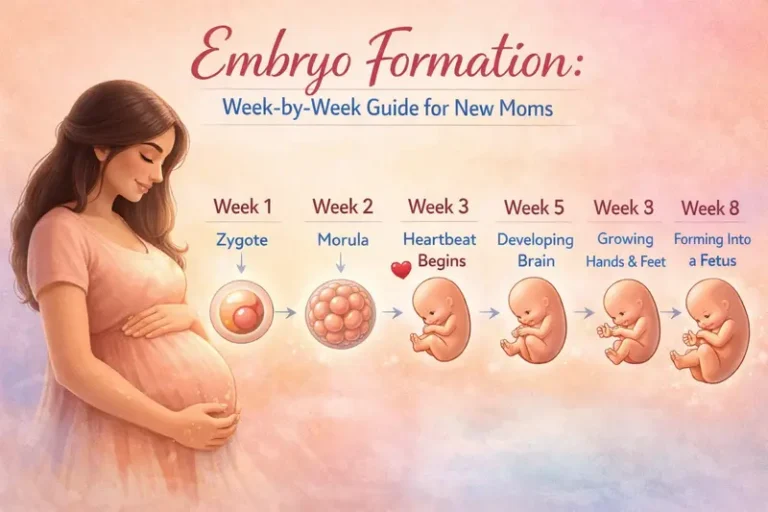
embryo formation stages week by week showing zygote morula fetal heart development and early pregnancy growth

  You just found out you are pregnant. Your heart is racing. But do you know what is actually happening inside your body right now? Inside your womb, the most incredible journey of human life has already begun. A tiny embryo — smaller than a grain of rice — is going through the embryo formation process every single day. This guide explains embryo formation in humans step-by-step in a simple way, so every parent can understand and feel connected to their baby from the very first week. Understanding these embryo formation steps helps you make better choices in these precious early weeks. In this guide, you will get a complete explanation of embryo development week by week — from the moment of fertilization all the way to Week 8. You will also learn about embryo formation stages, embryo formation time, what your body is going through, what to eat, what to avoid, and how to care for yourself and your growing baby. According to WHO and medical research, the first 8 weeks are the most critical period for embryo development in humans. Every single day counts. Quick Answer: What Is Embryo Formation? Embryo formation is the process that begins at fertilization (Day 1) and continues until the end of Week 8 of pregnancy. During this time, a single fertilized egg divides, grows, and develops into a fully formed embryo with a beating heart, brain, spine, and all major organs taking shape. After Week 8, the embryo is called a fetus. Embryo formation time: Embryo formation takes about 8 weeks in humans — starting from fertilization on Day 1 to the end of Week 8, when all major organs begin forming. Understanding the Key Terms: Zygote, Embryo, and Fetus Before we go through the embryo formation steps, let us understand three important words that every parent should know. Term What It Means When It Happens Zygote The fertilized egg formed when sperm meets egg Day 1 (Fertilization) Embryo The developing baby from Week 1 to Week 8 Week 1 to Week 8 Fetus The baby after all major organs have formed Week 9 onwards Think of it this way: a zygote is the seed, the embryo is the sprouting plant, and the fetus is when it starts to look like the full plant. Each stage of embryo development in humans builds directly on the one before it. Embryo Formation Stages: A Clear Overview Before going into the week-by-week detail, here is a clear summary of all the embryo formation stages in order. This is what your baby goes through in the first 8 weeks: Zygote — The fertilized egg on Day 1. One single cell carrying your baby’s complete genetic blueprint. Morula — A solid ball of 16 cells formed by Day 3. Still travelling toward the uterus. Blastocyst — A hollow, fluid-filled ball of cells formed by Day 5. Ready to attach to the uterus. Implantation — The blastocyst buries into the uterine wall between Day 6 and Day 10. Pregnancy officially begins. Gastrulation — Three primary germ layers form in Week 3. These become every organ and tissue in the body. Organogenesis — Organs begin forming from Week 4 onwards. Heart, brain, spine, lungs, liver — all taking shape. Why it matters: These six embryo formation stages are the foundation of your baby’s entire life. Nature ensures each step is completed perfectly before the next one begins. Embryo Formation Diagram  If you are a visual learner, here is the simplest way to understand the embryo formation process: You can also watch an embryo formation video to understand this visually — searching “embryo formation video” on YouTube will show clear animations of each stage. Image SEO note — Use image file name: embryo-formation-diagram.jpg | Alt text: “embryo formation diagram showing stages from zygote to week 8” Embryo Development Week by Week: Complete Step-by-Step Guide Here is the complete embryo formation process from Day 1 to Week 8 — each stage explained simply, the way a parent needs to understand it. Day 1 to Day 3 — Fertilization and the Zygote Stage Embryo formation begins the moment a sperm cell successfully enters an egg cell in the fallopian tube. This creates a zygote — the very first cell of your baby’s life. Within 24 to 30 hours, this zygote begins dividing.One cell turns into two, two into four, and four into eight. By Day 3, it has become a ball of 16 cells called a morula. At this stage, the embryo is still travelling slowly towards the uterus. Why this matters: The genetic blueprint of your baby — eye colour, blood type, height — is already set from this very first day. This is where your baby’s unique identity begins. Day 4 to Day 6 — Blastocyst Formation As the morula continues to divide, a fluid-filled cavity forms inside it. This new structure is called a blastocyst. It has two important parts: Inner Cell Mass — this will become your baby Trophoblast — this will become the placenta By Day 5 or Day 6, the blastocyst reaches the uterus and begins to hatch from its outer shell. This is one of the quietest yet most important embryo formation steps. Day 6 to Day 10 — Implantation Implantation is one of the most important steps in the embryo formation process. The blastocyst attaches to the lining of the uterus (endometrium) and buries itself deep inside. This is when pregnancy officially begins. Some women experience light spotting during implantation — this is called implantation bleeding and it is completely normal. It is different from a period — it is lighter, shorter, and pinkish or brownish in colour. This is the moment your body and baby truly become one. Week 2 — Two Cell Layers Form After implantation, the inner cell mass splits into two layers — the epiblast and hypoblast. These two layers are the foundation of all the organs, tissues, and structures that will form in the coming weeks of embryo

Embryo Formation Process Step-by-Step (Guide) Read More »

Implantation Bleeding And Cramping: First Signs You Might Be Pregnant

Illustration explaining implantation bleeding and cramping during early pregnancy.

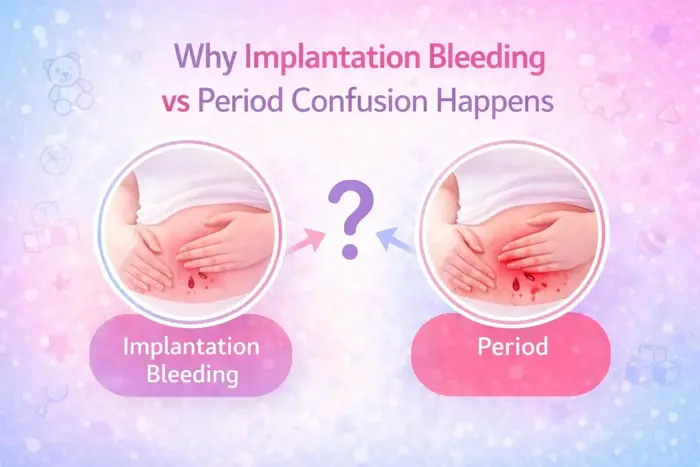
Implantation Bleeding And Cramping: First Signs You Might Be Pregnant “Something feels different… but I can’t explain it.” If you’ve ever had this thought just before your expected period, you’re not alone. Many women notice small changes, a little spotting, mild cramps, and unusual tiredness, and suddenly a question pops into their minds: “Is this just my period… or could I be pregnant?” This is exactly where confusion begins. Because one of the earliest pregnancy signs, implantation bleeding, often looks very similar to a period. And this is where the majority of individuals make mistakes. Let’s break it down step by step in a simple, real-life way so you can clearly understand what your body might be telling you about implantation and early pregnancy. Fertilization and implantation Before understanding implantation bleeding, you need to understand fertilization and implantation. Pregnancy doesn’t begin with a missed period. It starts much earlier. Step 1: Fertilization After ovulation, if sperm meets the egg, fertilization happens in the fallopian tube. Step 2: Travel to the uterus The fertilized egg slowly travels toward the uterus while dividing and growing. Step 3: Implantation Around 6 to 10 days later, the fertilized egg attaches to the uterine lining. This process is called fertilization and implantation, and this is when pregnancy actually begins. During this stage, small blood vessels may break, causing light spotting. Now let’s answer the most important question: What is implantation bleeding? Implantation  is light spotting that occurs when the fertilized egg attaches to the uterus lining. It is one of the earliest pregnancy signs. Key features of implantation bleeding: Very light flow Short duration (few hours to 2 days) Pink or brown color No clots https://youtu.be/lDrEq33YC5Q?si=J4NSPP-8UwLpNxiS Think of it like this: 👉 Your body is preparing a space for the baby 👉 While the embryo attaches, tiny blood vessels break 👉 This causes slight spotting — called implantation bleeding Many women confuse what is implantation bleeding with a period — and that’s where confusion starts. When does implantation bleeding occur Timing is one of the biggest clues. When does implantation occur? Usually 6 to 10 days after ovulation Often before your expected period This is why many women confuse implantation bleeding with an early period. Simple timeline: Day 0: Ovulation Day 1–5: Fertilization Day 6–10: Implantation Day 10–14: Possible implantation bleeding 👉 So if you notice spotting before your period, it could be implantation bleeding, not menstruation. Symptoms of implantation bleeding Recognizing the symptoms of implantation bleeding can help you understand your body better. Common symptoms of  bleeding: Light spotting (pink or brown) Very light flow (no clots) Short duration (1–2 days) Mild lower abdominal discomfort Additional early signs: Slight fatigue Breast tenderness Mood changes👉 Important: Not every woman experiences all symptoms of implantation bleeding. Some may not notice implantation bleeding at all. Implantation cramps Along with spotting, some women experience implantation cramps. What are implantation cramps? Implantation cramps are mild discomfort felt when the embryo attaches to the uterus. How implantation cramps feel: Very mild Short-lasting Light pulling sensation Not painful 👉 Unlike period cramps, implantation cramps are gentle and easy to miss. If pain is strong, it is more likely your period. Implantation bleeding vs period This is where most women get confused… and honestly, it’s completely understandable. You notice bleeding. Your first thought? “My period has started.” But what if it’s not your period? What if your body is actually giving you one of the earliest signs of pregnancy — implantation? This confusion between implantation vs period is extremely common, especially for women who are actively trying to conceive or carefully tracking their cycle. And this is exactly where most people get it wrong. Because even though both implantation bleeding and periods happen around the same time, they are not the same at all. Let’s break this down in a very simple and practical way so you can confidently understand the difference. Why implantation bleeding vs period confusion happens The biggest reason is timing. Both implantation and periods occur close to each other in your cycle: Implantation → Happens 6 to 12 days after ovulation Period → Happens around 14 days after ovulation 👉 The gap is very small. So when you see spotting before your expected date, your brain automatically assumes: “Okay… this is my period.” But here’s the truth: 👉 Not all bleeding is a period👉 Some bleeding is actually implantation And this is where awareness becomes important. Understanding the biological difference Before comparing symptoms, understand what’s happening inside your body. Period: The uterus sheds its lining This happens because pregnancy did NOT occur Implantation : A fertilized egg attaches to the uterus lining This means pregnancy HAS started 👉 So in simple words: Period = End of a cycle Implantation bleeding = Beginning of pregnancy That’s a powerful difference.   1. Flow difference (Most noticeable sign) Flow is the easiest and most practical way to differentiate implantation bleeding vs period. Implantation : Very light spotting Often visible only while wiping May not even require a pad Period: Starts light but becomes heavy Requires pads or tampons Flow increases over time 👉 Ask yourself honestly: “Do I actually need a pad?” If not, chances are high that it is implantation bleeding. 2. Color difference Color gives another strong clue in implantation bleeding vs period comparison. Implantation bleeding: Light pink Brown Slight rusty shade Period: Bright red Dark red Looks fresh and flowing 👉 Why this difference? Because implantation bleeding is older blood leaving slowly, while period blood is fresh and continuous. 3. Duration difference Duration clearly separates implantation vs period. Implantation bleeding: Few hours to 1–2 days Stops suddenly Period: 3 to 7 days Gradual start → heavy → slow end 👉 If spotting appears and disappears quickly, it is more likely implantation bleeding. 4. Clots vs no clots Implantation : No clots Smooth, light spotting Period: Clots are common Especially on heavier days 👉 Presence of clots strongly indicates a period, not implantation bleeding. 5. Implantation cramps vs period cramps​ Now

Implantation Bleeding And Cramping: First Signs You Might Be Pregnant Read More »

Human Fertilization: Understanding the Human Fertilization Proces

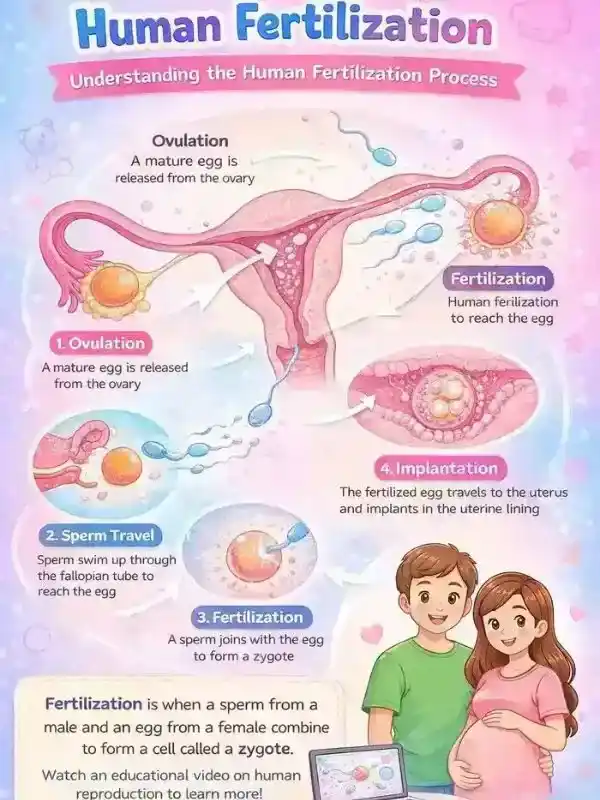
Human fertilization infographic showing ovulation, sperm travel, fertilization, and implantation in the uterus.

Human life begins with a remarkable biological event known as human fertilization. It is the process through which a male reproductive cell (sperm) and a female reproductive cell (egg) combine to form the first cell of a new human being. For parents, students, and general readers, understanding human fertilization and reproduction in humans provides valuable insight into how pregnancy begins and how the human life cycle starts. Many people search online for questions such as what is fertilization, where does fertilization occur in human females, and how the human fertilization process works. These questions are important not only for academic learning but also for basic health awareness. Parents who want to understand pregnancy and child development also benefit from learning about the human reproduction system. The process of human fertilization is carefully coordinated by the body. Several organs and biological systems work together to ensure that sperm and egg meet at the right time and place. Once fertilization occurs, the newly formed cell begins developing into an embryo and eventually a baby. In this article, we will explore the complete human fertilization process, including: What fertilization means How reproduction happens in humans The role of the human reproduction system Where fertilization occurs in human females Step-by-step explanation of the fertilization process This guide is written in simple language so that parents, students, and curious learners can clearly understand the science behind human fertilization. What is Fertilization? Human fertilization is the biological process where a male sperm cell joins with a female egg cell to form a single new cell called a zygote. This event marks the beginning of human life and is the first step in the process of reproduction in humans. Understanding Human Fertilization in Simple Words In simple terms, human fertilization happens when the sperm from the male reproductive system meets the egg from the female reproductive system. When these two cells combine, they create the very first stage of a new human life.This process is a central part of the human fertilization process and is essential for pregnancy to begin. Without fertilization, the egg cannot develop into an embryo.The sperm carries genetic information from the father, while the egg carries genetic information from the mother. When fertilization occurs, the genetic material from both parents combines to create a unique set of DNA. This DNA determines many characteristics of the future child, including physical traits such as eye colour, hair type, and certain inherited features.Shorten with AI Where Does Human Fertilization Take Place? One of the most commonly asked questions is where does fertilization occur in human females. In humans, fertilization usually takes place in the fallopian tube, which is part of the human reproduction system.During ovulation, the ovary releases an egg into the fallopian tube. At the same time, sperm entering the female body through sexual intercourse begin traveling through the reproductive tract. If a sperm reaches the egg while it is inside the fallopian tube, human fertilization occurs. This meeting of sperm and egg begins the fertilization process in humans. How Human Fertilization Happens  The process of human fertilization involves several important steps: The ovary releases an egg during ovulation. The egg enters the fallopian tube. Sperm move in the direction of the egg through the female reproductive system. One sperm penetrates the egg’s outer layer. A zygote is created when the sperm and egg unite. Once fertilization occurs, the zygote begins dividing into multiple cells. Over the next few days, it travels toward the uterus, where it attaches to the uterine lining in a process called implantation. This marks the beginning of pregnancy. Role of the Human Reproduction System The human reproduction system plays an essential role in the fertilization process. Both male and female reproductive organs are involved.The male reproductive system produces and transports sperm, while the female reproductive system produces eggs and provides the environment needed for fertilization and early development.Important human reproductive organs involved in fertilization include: Testes (produce sperm) Ovaries (produce eggs) Fallopian tubes (site of fertilization) Uterus (where the embryo develops) A human reproduction system diagram often helps students understand how these organs work together during the fertilization process.Why Human Fertilization is ImportantThe process of human fertilization is essential because it begins the development of a new human life. It combines genetic information from two parents and starts the early stages of embryo development. For parents and students learning about reproduction in humans, understanding fertilization helps explain how pregnancy begins and how the human life cycle continues from one generation to the next. Studying the human fertilization process also improves awareness about reproductive health and helps individuals understand the biological foundation of human development. Short Answer: Fertilization is the biological process where a male sperm cell combines with a female egg cell to form a new cell called a zygote. This moment marks the beginning of a new human life and is the first step in the process of pregnancy.  Understanding Fertilization In simple terms, human fertilization occurs when a sperm from the male reproductive system meets and merges with an egg from the female reproductive system. Each of these cells carries genetic information from one parent. When fertilization happens: The sperm pierces the egg’s outer covering. The genetic material from both cells combines. A new cell called a zygote forms. This zygote contains half of its DNA from the mother and half from the father. It holds the complete genetic instructions needed to develop into a human baby.  Why Fertilization Is Important The process of human fertilization is essential because it begins the formation of new life. Without fertilization, pregnancy cannot occur. The importance of fertilization includes: Starting the process of pregnancy Combining genetic traits from both parents Beginning the development of the embryo Continuing the cycle of reproduction in humans Understanding what fertilization is helps us appreciate the complexity and beauty of human biology. Human Fertilization Process This video explains the human fertilization process, showing how sperm meets the egg and forms a zygote, the first stage

Human Fertilization: Understanding the Human Fertilization Proces Read More »