
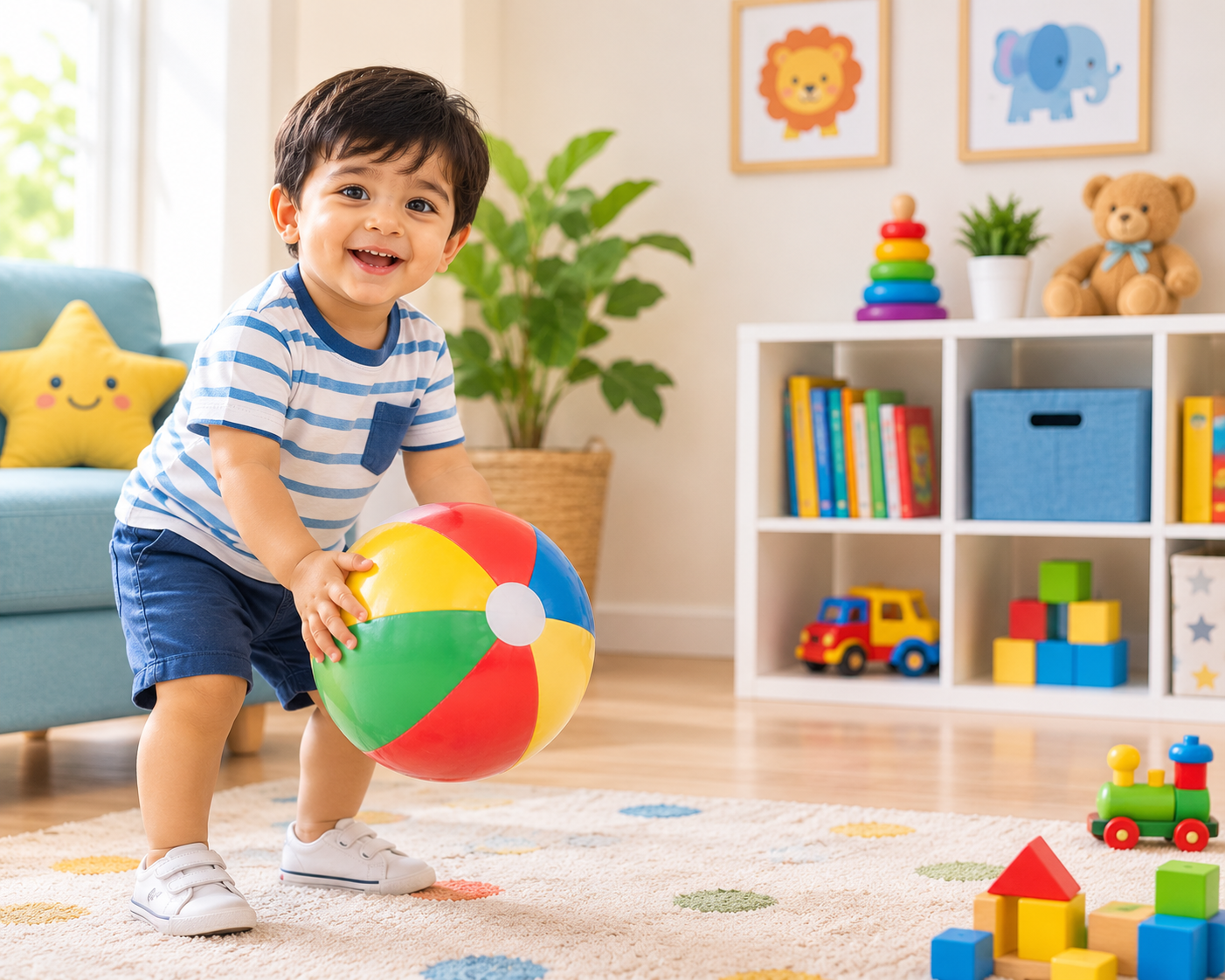
The 2-3 Year-Olds Stage: How Play,Toys and Books Fit Together
Explore toys for 2-year-olds, from building and pretend play to puzzles, books, and everyday activities that make play simple, engaging, and fun.
Toys For 2 to3 year

What's Inside This Guide
The 2-Year-Olds Stage: How Play,Toys and Books Fit Together
Somewhere between the second and third birthday, something shifts. The child who once carried a toy from room to room without much of a plan starts to use it with intention—stacking blocks instead of scattering them, feeding a doll before putting it to bed, driving a toy car along an invisible road on the living room floor. Watching this happen with my own kids has been one of the more interesting parts of parenting, and it’s a big part of why this site exists at all. This page is a look at what the 2–3 year stage tends to involve and how toys for 2-year-olds, books, and everyday play can fit into it without turning parenting into a shopping list.
None of what follows is meant to be a checklist of things your child should be doing by a certain date. Every child moves through this period differently, and some of what’s described here might show up early, late, or in a slightly different order — or not at all for a while. This is a toy and play website written from a parent’s perspective, not a medical or developmental resource, so treat everything here as general observation rather than a standard to measure your child against.
2 –3 year

What Changes Between 2 and 3 Years?
If there’s one thing that defines this stretch of time, it’s a growing sense of “I want to do this myself.” A lot of parents notice their toddler pushing away a helping hand that would have been welcomed a few months earlier — insisting on pouring their own water, choosing their own book, putting on (or attempting to put on) their own shoes. That push toward independence tends to show up across nearly everything, including play.
Alongside that, play itself often becomes more purposeful. Where a one-year-old might bang two blocks together and move on, a two-year-old is more likely to try stacking them, knock the stack down, and build it again — sometimes a dozen times in a row. This kind of repetition can look like the child is “stuck,” but it’s just as often a sign they’re genuinely enjoying mastering something.
You May Also Notice
Little signs of growth often show up in everyday moments. Here are a few common ones to look out for.
Pretend Play Becomes More Elaborate
Simple actions turn into imaginative stories, like feeding a doll, driving toy cars on adventures, or setting up a pretend tea party.
Copying Everyday Actions
Toddlers love mimicking adults, sweeping the floor, talking on the phone, or stirring a pretend pot, as they learn through imitation.
Longer Attention on Chosen Activities
You may notice your toddler sticking with a favourite puzzle or toy for longer stretches, especially when they have picked it themselves.
Interest in Repetition
Repeating favourite phrases and requesting the same predictable book again and again can become a familiar part of everyday play.
Creative Toy Combinations
Blocks become bridges and a cup becomes a hat. Toddlers start combining toys in surprising, imaginative, and unexpected ways.
Early Problem-Solving
Simple trial and error, like turning a shape to fit a hole or stacking blocks until they balance, shows early attempts at figuring things out.
Again, this is a loose sketch, not a milestone chart. Some toddlers are deep into pretend play by two and a half; others are still mostly interested in movement and physical exploration and come to imaginative play a bit later. Both are completely normal.
How Children Often Play at 2–3 Years
It helps to think about play at this age less as a single activity and more as several overlapping interests that a child dips in and out of, often within the same twenty minutes.
Pretend Play
Pretend play starts showing up more often and with more detail. A toddler might go from stirring an empty pot to actually "serving" imaginary food to a parent, expecting them to eat it and say it's delicious.
Repetitive Play
Repetitive play is common and can sometimes feel tedious for the adult in the room — the same puzzle, the same three books, or the same game of rolling a ball back and forth. Children often return to familiar activities because they are predictable and enjoyable.
Building
Building tends to move from stacking for the sake of stacking to building something with a rough idea in mind — a "tower," a "house," or a "garage" for the cars.
Sorting and Matching
Sorting and matching often appears naturally, even outside toys designed for it. Kids may line up shoes by size, group toy animals by type, or separate blocks by colour without being asked.
Simple Puzzles
Simple puzzles with a handful of large, chunky pieces can start to hold real appeal. The satisfaction of getting a piece to click into place can become part of the fun.
Drawing and Mark-Making
Drawing and mark-making — scribbling with crayons, dragging a finger through spilled flour, or drawing in the sand — becomes something many toddlers return to on their own.
Movement
Movement is still a huge part of the picture. Climbing, running, throwing, and carrying things from one room to another remain important parts of everyday play.
Books and Storytelling
Books and storytelling often become a bigger part of the daily routine, sometimes to the point where a parent could recite a favourite book from memory after many repeated reads.
Copying Everyday Activities
Copying everyday activities shows up constantly — helping "wash" dishes, "cooking" dinner, or folding a cloth after watching an adult do it. Some of the most engaged play at this age comes from watching everyday life and wanting to join in.
2–3 year
Toys That Fit the 2–3 Year Stage
With all that in mind, toys for 2 year olds tend to work best when they support the kinds of play already described above, rather than trying to introduce something entirely new. A few broad categories that often fit well:
Building toys — large, simple blocks or interlocking pieces that can be stacked, knocked down, and rebuilt without frustration. The appeal here is usually in the repetition and the small sense of achievement, not in following complicated instructions.
Simple puzzles — chunky wooden or cardboard puzzles with a small number of pieces work well before a child is ready for the fiddlier, smaller-piece kind.
Pretend-play toys — a play kitchen set, a toy phone, a doctor’s kit, a simple toy till. These give shape to the pretend scenarios many toddlers are already inventing on their own.
Vehicles — cars, trucks, trains. Often popular regardless of whether the rest of a child’s play leans imaginative or physical, since a toy car can be raced, parked, loaded up, or driven into a pretend garage.
Dolls or figures — useful for feeding, dressing, comforting and generally practising the caretaking behaviours a lot of toddlers seem drawn to at this age.
Art materials — chunky crayons, washable paint, large sheets of paper. Simple is usually better than elaborate here.
Sorting and matching toys — shape sorters, stacking cups, simple colour-matching sets.
Open-ended toys — things without a single “correct” way to play, like blocks, scarves, or a basic set of wooden shapes, which tend to hold interest longer because they can be reused in new ways as a child’s ideas change.
Push and pull toys — particularly useful for younger toddlers in this range who are still building confidence in walking and running.
Active-play toys — balls, ride-on toys, simple climbing equipment, anything that gives an outlet for the physical energy that doesn’t go away just because pretend play has arrived
3–6 Months
Pretend Play Becomes More Interesting
Pretend play deserves a section of its own, mostly because of how much it seems to expand during this period. A one-year-old holding a toy phone to their ear is doing something fairly simple. A two-and-a-half-year-old doing the same thing might be having an entire imagined conversation, complete with pauses as if listening to a reply.
Pretending to Cook
Pretending to cook, often narrating what they're making.
Feeding Dolls or Stuffed Animals
Feeding a doll or stuffed animal, sometimes quite seriously.
Playing Shop
Playing "shop," handing over pretend money or scanning items.
Pretending to Drive
Pretending to drive somewhere specific — to the shop or to grandma's house.
Copying Household Tasks
Copying household tasks like sweeping, wiping surfaces, or "fixing" something with a toy tool.
Using Objects Imaginatively
Using ordinary objects imaginatively — a box becomes a car or a spoon becomes a microphone.
Building, Puzzles and Simple Problem-Solving
There’s a particular kind of focus that shows up when a toddler is trying to fit a puzzle piece into the right spot, or figure out why a tower keeps toppling on one side. It’s worth paying attention to, not because it “proves” anything, but because it’s often genuinely absorbing for the child.
At this stage, children may enjoy:
- Stacking objects as high as they’ll go before they fall
- Building towers, “houses,” or other loosely defined structures
- Fitting shapes or pieces together through trial and error
- Working through simple puzzles, usually with a small number of large pieces
- Matching and sorting objects by colour, size or type
- Trying a few different approaches when something isn’t working — turning a piece around, trying a different spot, asking for help
What tends to matter here isn’t the toy itself so much as what the child does with it — the trying, adjusting, and trying again. A toy that allows for that kind of repeated experimentation is often more interesting to a toddler over time than one with a single fixed outcome.
Books and Everyday Play
Books fit naturally into this stage, often becoming as much a part of daily play as any toy on the shelf.A few things parents often notice around this age
Picture books with clear, simple images give toddlers something to point at and name, which many find genuinely satisfying — “dog,” “ball,” “car,” said with real enthusiasm.
Simple stories with a basic beginning, middle and end start to hold attention better than they did a year earlier, especially if the story involves something familiar, like bedtime or going to the shop.
Repetition in books — the same phrase repeated on every page, a predictable rhythm — is often a favourite, partly because it lets a toddler “read along” or fill in the words themselves.
Naming familiar objects in a book (a cup, a dog, a bus) connects reading to the child’s everyday world, which seems to make books feel less abstract.
Letting a child choose the book rather than always picking it for them tends to keep reading time more enjoyable for everyone, even if it means the same book gets picked every single night.
Reading the same book repeatedly, even to the point where you could recite it without looking, is completely normal at this age. It’s not a sign anything is wrong — if anything, it usually means the book has become a genuine favourite.
Activities for 2–3 Year Olds
Not every meaningful activity at this age needs a toy at all. Some of the simplest options include
- Building with blocks, even a modest set
- Drawing with crayons on paper, or with chalk outside
- Pretend cooking, whether with a toy kitchen or real (safe) kitchen items
- Sorting household objects — spoons by size, socks by colour
- Looking through picture books together, or letting a child “read” one alone
- Simple outdoor play — walking, running, playing with a ball, exploring a garden or park
- Carrying and organising objects, which toddlers often do simply because they enjoy the task itself
- Making simple towers out of whatever is on hand — blocks, stacking cups, even empty boxes
- Playing with everyday household items where it’s safe to do so, like plastic containers, wooden spoons, or fabric scraps
Choosing Toys for a 2–3 Year Old
Rather than trying to find the “right” toy, it can help to ask a few practical questions before buying anything new:
- Is it genuinely suitable for the child’s current age and stage?
- Is it simple enough for them to understand and use without constant help?
- Can it be played with in more than one way?
- Is it something likely to hold their interest beyond the first few days?
- Is it sturdy enough to survive being dropped, thrown, or sat on?
- Can it be combined with toys they already have?
- Is it something that could realistically become part of everyday play, rather than sitting unused on a shelf?
There’s no toy that will tick every one of these boxes perfectly, and that’s fine. The point of the list is just to slow down the decision a little, rather than buying based on packaging or trend alone.
Do 2–3 Year Olds Need "Educational" Toys?
The word “educational” gets printed on an enormous number of toy boxes, and it’s worth being honest about what that actually means in practice: not much, on its own. A toy doesn’t need a label promising to build skills in order to be genuinely useful to a child at this age.
A cardboard box, a set of plain wooden blocks, a picture book, a wooden spoon and a mixing bowl, a simple puzzle none of these come with marketing claims, and all of them can become part of meaningful, engaged play. What seems to matter more than any label is whether a toy invites a child to do something with it: build, sort, pretend, repeat, figure out. That’s really the whole idea behind this site looking at what a toy actually offers in practice, rather than what the packaging promises.
Do Babies Need Lots of Toys?
Honestly — no. It’s easy to feel, especially with a first baby, like a nursery needs to be stocked with dozens of toys before the baby even arrives. Marketing plays into this, with gift sets, toy bundles, and “must-have” lists that suggest more is better.
In practice, a newborn’s attention span is short, and their interest in any single toy tends to be brief in the earliest months. A handful of well-chosen toys — a rattle, a soft book, a play mat, maybe a mirror toy — is often more than enough to support play through the first six months. Rotating a small number of toys in and out, rather than presenting a baby with a large pile all at once, can also help keep things feeling new without needing to buy constantly.
Sometimes, the most engaging thing for a baby isn’t a toy at all — it’s a parent’s face, voice, or hands. Simple everyday moments, like talking through a diaper change or making faces during tummy time, often hold a baby’s attention just as much as anything from a toy aisle. Toys can support play, but they don’t replace time and attention, and there’s no toy that needs to be purchased to make sure a baby is developing normally.
Toy Safety for 2–3 Year Olds
Regardless of how good a toy looks on paper, safety comes first. A few practical things worth checking:
Age Labels
These exist for real reasons, often related to choking hazards, not just difficulty level.
Small Parts
Anything that could fit inside a toilet paper tube is generally considered a choking risk for this age group.
Broken Pieces
Check regularly for cracks or splits, especially on plastic toys that have been dropped repeatedly.
Loose Components
Buttons, wheels, or small decorative pieces that could come off with enough tugging.
Sharp or Damaged Edges
Particularly on older toys that have been through some wear.
Battery Compartments
Make sure they're properly secured with a screw or child-proof latch, not just a snap-shut lid.
General Wear and Tear
Fabric toys with stuffing coming out, wooden toys with splinters, anything showing its age.
Recalls
It's worth occasionally checking whether a toy has been recalled, especially secondhand ones.
Ongoing Suitability
A toy that was safe at eighteen months might need a second look as a child grows and starts using it differently, climbing on it, or putting new things in their mouth.
How Many Toys Does a 2–3 Year Old Actually Need?
Probably fewer than the average toy shelf would suggest. A smaller collection of toys that get used often, in different ways, tends to hold more value than a large collection where most items are ignored after the first week.
Books, everyday household objects and open-ended play often fill in the gaps just as well as a purpose-bought toy. A cardboard box becomes a car; a mixing bowl and spoon become a drum; a pile of cushions becomes a mountain to climb. None of that needs to be purchased, and a lot of it ends up being just as engaging as anything wrapped in plastic packaging.
A Simple Way to Think About the 2–3 Year Stage
Pulling all of this together, the goal was never to find one perfect toy there isn’t one. Instead, it can help to think about whether something:
- fits the child’s current interests, rather than interests they haven’t developed yet
- invites them to interact with it, rather than just watch or press a button
- can be used again and again without losing its appeal
- allows some freedom in how it’s played with
- is genuinely suitable for their age
- is safe and built to survive real use
A toy that meets most of those points is usually a reasonable bet, whether it’s something new or something that’s been sitting in a cupboard for months.
Bringing It Back to the Stage Itself
It’s easy to get caught up in toy choices and lose sight of what this whole stretch of time is actually about. The 2–3 year period tends to bring more independence, more imagination, more physical confidence, and a genuine curiosity about how things work and toys for 2 year olds are just one small part of how that shows up day to day, alongside books, everyday objects, and plenty of ordinary moments that don’t involve a toy at all.
None of it needs to be complicated, and it definitely doesn’t need to involve a full toy box. A well-loved picture book, a stack of blocks that gets knocked down for the hundredth time, a pretend meal served on a plastic plate these ordinary bits of play, repeated over and over, often matter just as much as anything that arrives in a box. The toy is rarely the whole story. The reading together, the pretending, the building, the running around outside that’s usually where the real value of this stage actually lives