
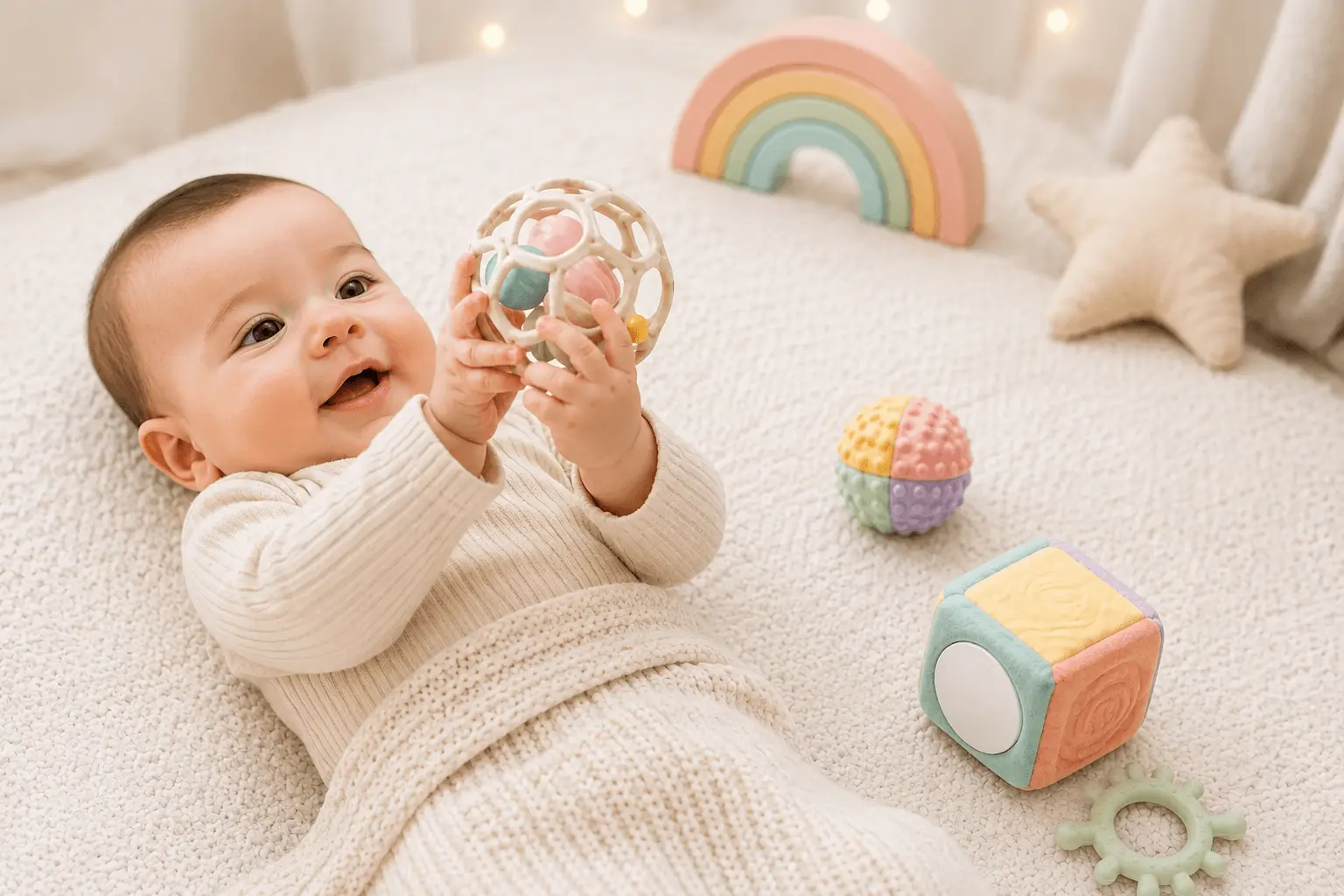
Newborn Toys for Babies 0–6 Months: What to Look For
Learn what to look for in newborn toys for babies 0–6 months, from simple play features and age labels to safe, practical choices parents can trust.
Newborn Toys · 0–6 Months

What's Inside This Guide
Walking down the baby aisle for the first time can feel overwhelming. There are rattles that light up, mats that play music, soft animals in every color, and rows of “developmental” toys that all promise to do something for your baby. If you’ve found yourself standing there wondering what your newborn actually needs, you’re not alone.
The truth is, choosing newborn toys doesn’t have to be complicated. Babies between birth and 6 months are just beginning to notice the world around them, and their play needs at this stage are simpler than most packaging suggests. This guide walks through what parents can realistically look for when picking toys for this age range what babies may notice, which toy types tend to fit different weeks and months, and how to check that a toy is safe and age-appropriate. There’s no pressure here to buy a certain number of toys or chase the “best” one. A few well-chosen items, picked thoughtfully, are usually plenty.
0–6 Months

Understanding Play From 0–6 Months
Sensory Exposure, Not "Play" Yet
A newborn's world is mostly faces, voices, light, and touch. They aren't reaching for toys or shaking a rattle on purpose — this stage is closer to gentle sensory exposure than play as we usually picture it.
Hands Start Getting Interesting
Babies begin tracking movement with their eyes and turning toward sound. Hands become fascinating too — many babies bring them together, look at them, or bat at something hanging nearby.
Reaching and Grasping On Purpose
By this stage, many babies reach more purposefully, grasp objects, and bring things to their mouth to explore them — the beginning of real hands-on discovery.
Play looks very different at six weeks than it does at six months, and that’s expected. In the earliest weeks, a newborn’s world is mostly about faces, voices, light, and touch. A baby this age isn’t reaching for toys or shaking a rattle on purpose—play at this stage is closer to simple sensory exposure than “playing” in the way we picture it with older babies.
As the weeks pass, most babies start to track movement with their eyes, turn their head toward sound, and hold their gaze on things a little longer. Somewhere around 2 to 4 months, hands start to become more interesting—babies may bring them together, look at them, or bat at something hanging nearby. By 4 to 6 months, many babies are reaching more purposefully, grasping objects, and bringing things to their mouth to explore them.
It’s worth saying clearly: these are general patterns, not a checklist your baby has to complete on schedule. Some babies reach for a toy at 10 weeks; others take a bit longer. None of this is a race, and toy interaction isn’t a measure of anything beyond what a baby happens to be curious about that day. The point of this section isn’t to hand you a timeline to worry about — it’s to help you understand why toys marketed for “0–3 months” often look and feel different from toys marketed for “3–6 months,” so the labels make more sense.
What to Look for in Newborn Toys
Once you understand the general shape of play at this age, it becomes easier to filter out what’s actually useful from what’s just marketing. A few practical things matter more than flashy features when you’re choosing newborn toys.
👁️ Simple Visual Appeal
Newborns don't see the world the way older children or adults do — their vision is still developing, and very fine detail or busy patterns often aren't the most engaging thing for them. Simpler shapes, bold outlines, and higher contrast tend to be easier for young babies to focus on than pastel or overly detailed designs.
🔔 Gentle, Non-Startling Sounds
A toy that makes a sudden loud noise can be more overwhelming than engaging for a newborn. Soft rattles, quiet chimes, or toys with a low-volume setting are usually a better fit than anything that beeps sharply or plays music at full volume right next to a baby's ear.
✋ Easy Interaction
At this age, a baby isn't going to operate buttons or press switches. Toys that are easy to grasp, easy to bat at, or that respond to simple movement (like a light shake) tend to match what a young baby can actually do.
📏 Appropriate Size
A toy needs to be large enough that it can't be a choking hazard, but still light and manageable enough for small hands or gentle swats. This becomes especially important as babies start bringing things to their mouths.
🏷️ Age Suitability
Manufacturer age labels exist for a reason — they usually reflect testing around things like weight, size, and safety features. A toy labeled for 6 months and up may include smaller detachable parts that aren't appropriate for a 2-month-old, even if the toy looks similar to something labeled 0+.
🧼 Easy Cleaning
Newborn toys get a lot of contact with hands, mouths, and drool. Toys that can be wiped down or, in some cases, machine washed tend to hold up better and stay more hygienic over weeks of use.
🧵 Secure Construction
Seams that don't fray, eyes and noses that are embroidered rather than glued on, and rattle components that are fully sealed inside the toy — these details matter more than how cute a toy looks on a shelf.
0–3 Months
Best Types of Toys for 0–3 Months
In the first three months, babies are mostly taking things in rather than actively manipulating them. Toys for this stage tend to work best when they support looking, listening, and occasional gentle touch, rather than requiring hand-eye coordination the baby hasn’t developed yet.
Some toy types that often fit well here:
High-Contrast Cards
Bold black-and-white images for calm, alert moments.
Soft Rattles
A gentle sound shaken near, not directly at, your baby.
Textured Cloth Toys
Different fabrics for tiny hands to brush against.
Simple Mobiles
Bold shapes, slow movement, made for looking.
Baby-Safe Mirrors
Unbreakable mirrors that draw a real interest in faces.
3–6 Months
Best Types of Toys for 3–6 Months
Somewhere in this window, many babies start showing more interest in using their hands. This doesn’t happen the same way or on the same day for every baby, but it’s common to notice a baby swiping at a hanging toy, holding something for a few seconds, or turning their head more deliberately toward a sound.
Toy types that tend to suit this stage include:
Grasping Toys & Teethers
Easy for small hands to hold, often ring-shaped or with textured sections.
Baby Activity Toys
Simple toys that respond to touch, like a rattle or a squeak.
Play Gyms & Activity Mats
An overhead arch with hanging toys to reach and bat at during floor time.
Textured Balls
Soft, easy-to-grip balls with bumps or ridges for exploring hands.
Cause & Effect Toys
A small action, like a squeeze or shake, produces a simple response.
High-Contrast and Visual Toys
High-contrast toys — usually black, white, and sometimes red — come up a lot in newborn toy recommendations, and there’s a simple reason for it. Very young babies’ eyesight isn’t fully developed, and bold, simple contrasts tend to be easier to notice than soft or busy colors.
This doesn’t mean high-contrast toys are the only “correct” option, or that a baby who prefers a pastel toy is missing something. Babies are individuals, and interest in visual toys can vary. What’s worth avoiding is the idea that a high-contrast toy will “boost” a baby’s visual development in some measurable way — no toy comes with that guarantee, and framing it that way overstates what these toys actually do. They’re simply a toy style that many parents find their newborn responds well to during short, calm moments of play.
If you introduce a high-contrast toy or card, it’s usually enough to hold it a comfortable distance from your baby’s face and let them look at it for as long as they seem interested — there’s no need to force engagement if a baby looks away or seems uninterested that day.
Rattles and Gentle Sound Toys
Rattles are one of the oldest and simplest baby toys for a reason: they’re easy to hold (for a grown-up shaking it, and later for the baby), and sound is genuinely interesting to babies from early on.
A few practical things to think about before choosing a rattle:
Volume
Weight
Construction
Grip Shape
- Volume — a rattle that sounds sharp or loud up close can startle rather than engage. Softer, muted sounds are usually gentler for newborns.
- Weight — for a newborn, a rattle should be light enough that a parent isn’t shaking something heavy near the baby’s face; for an older baby starting to hold objects, it should be light enough for small hands to lift.
- Construction — the sound-making parts (usually small beads or bells) should be fully sealed inside, with no way for a baby to access them even if the toy is chewed or dropped repeatedly.
- Grip shape — for babies getting closer to 4–6 months, a rattle with a shape that’s easy to grasp (rounded, no thin handles that are hard for small hands) tends to get more use.
Soft Toys, Books and Simple Play Objects
Soft toys and books can absolutely have a place in newborn play, though their role tends to be more about comfort, texture, and shared time than active engagement in the earliest weeks.
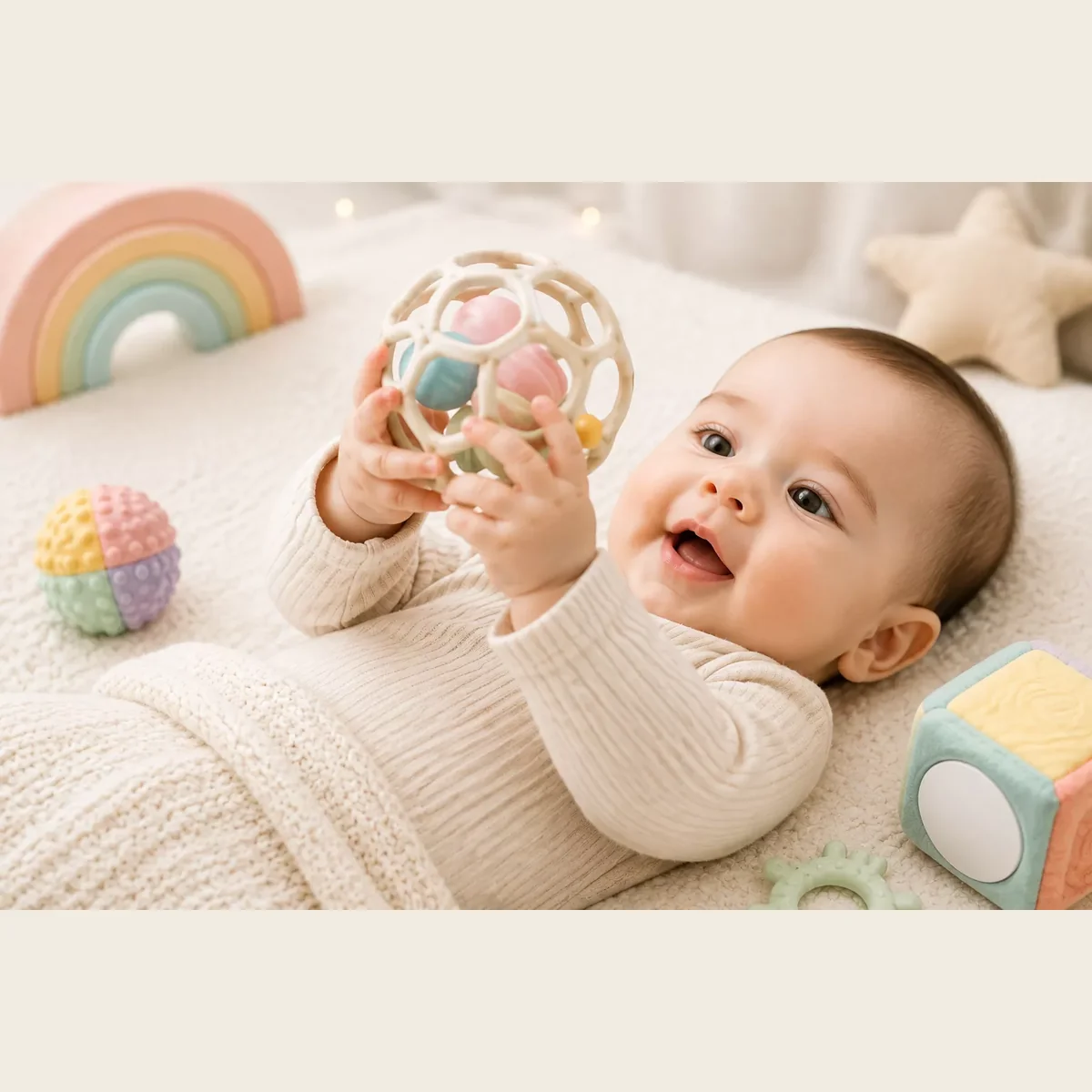
Soft toys for this age should be simple — no small attached parts like buttons, bows, or plastic eyes that could come loose. Many soft toys made specifically for young babies use embroidered or fabric-printed features instead. Soft toys can be nice for tummy time (placed just in the baby’s line of sight) or as something soft to touch during calm, supervised moments. They’re generally not meant to be left in a crib with a sleeping baby.
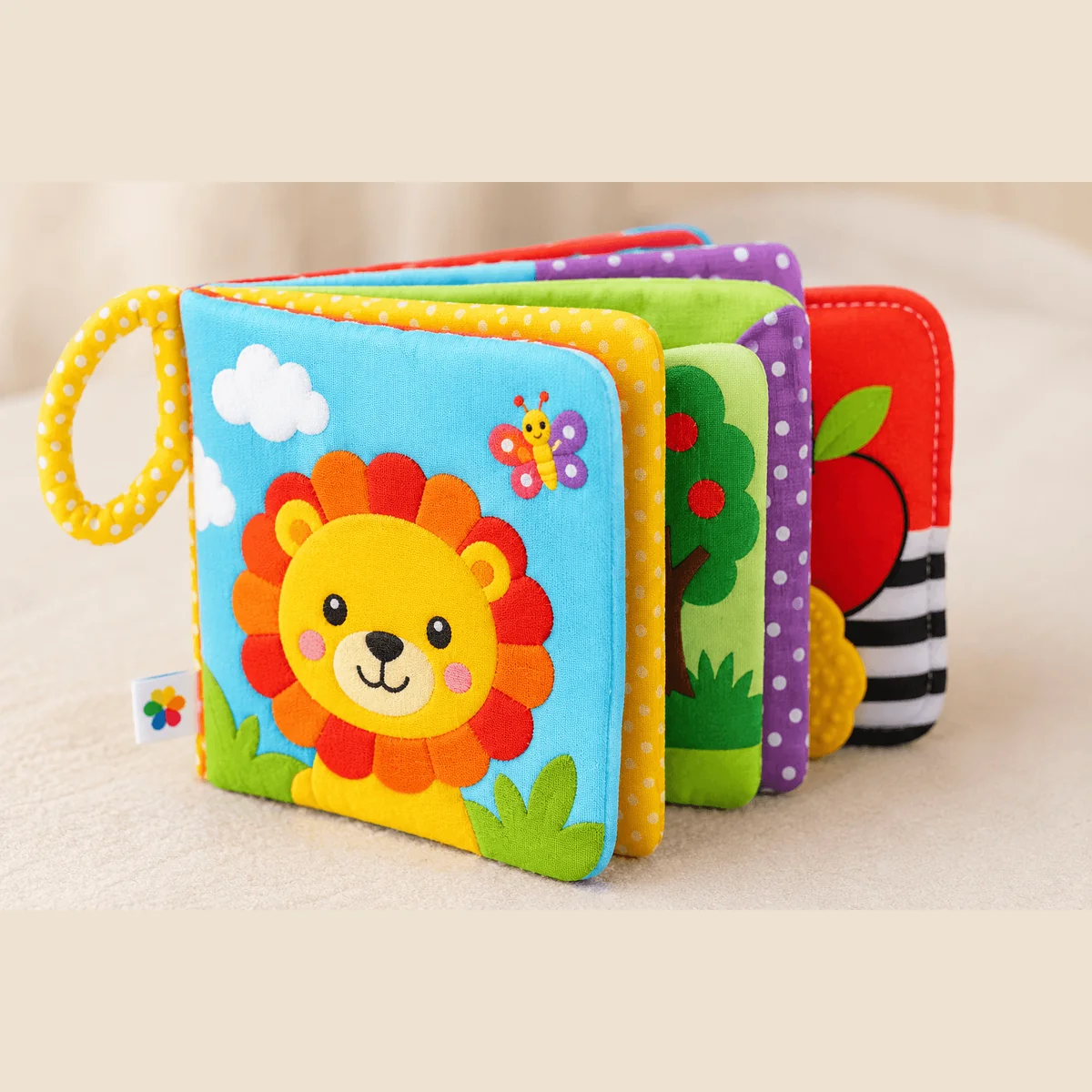
Books for very young babies usually aren’t about following a story yet. Board books or fabric books with simple high-contrast images, textures to touch, or a crinkle sound can work well as an early introduction to books — something to look at and touch together rather than read cover to cover. Sitting with your baby and pointing at a simple image, even for a minute, can become a nice small routine.
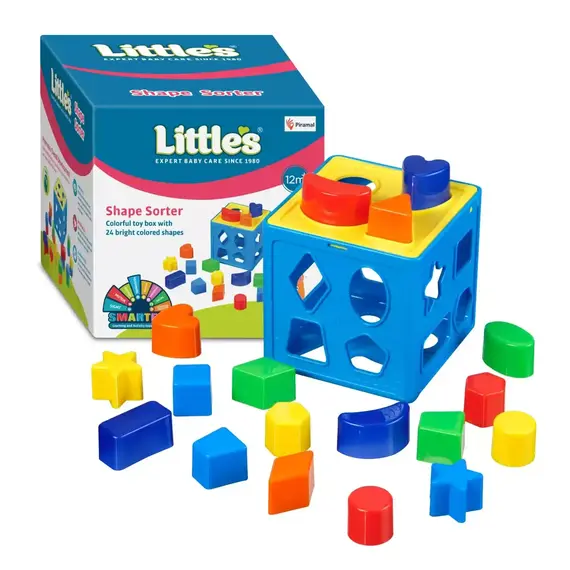
Simple play objects don’t have to come from a toy aisle at all. A clean, unbreakable household item — like a small fabric scarf, a wooden spoon, or a stacking cup — can hold just as much interest as a store-bought toy, as long as it’s safe in terms of size and material. This ties into something worth remembering throughout: at this age, novelty and safety often matter more than how “educational” a toy claims to be.
Choosing Toys by Age Label
Age labels on toy packaging aren’t arbitrary. They usually reflect testing done by the manufacturer around choking hazards, small parts, structural safety, and sometimes developmental appropriateness. A toy labelled “0+ months” has typically been tested with stricter small-parts standards than a toy labelled “6+ months” or “12+ months”.
This is one of the simplest and most useful things a parent can check before buying or using a toy for a baby under 6 months. If a toy is labelled for an older age group, it’s worth understanding why — often it’s because of small, detachable components, battery compartments that aren’t sufficiently secured, or parts that require more hand strength or coordination than a young baby has.
It’s also worth paying attention to any additional warnings on packaging, such as choking hazard notices for small parts or age restrictions tied to specific toy features like removable eyes on stuffed animals or small beads inside a rattle
Toy Safety for 0–6 Months
Safety is one of the most important parts of choosing newborn toys, and it deserves careful attention — not because toys are commonly dangerous, but because a few simple checks go a long way in preventing avoidable problems.
Choking Hazards and Small Parts
Anything that can fit inside a toilet paper tube is generally considered a choking risk for babies and young toddlers. Check rattles, teethers, and soft toys for small attachable pieces, and avoid toys with parts that could detach with normal use or chewing.
Loose or Broken Components
Over time, toys wear down. A rattle that once had a tightly sealed compartment can develop a crack; a soft toy's stitching can loosen. It's worth periodically checking toys your baby uses often for anything that's come loose, torn, or cracked, and setting aside anything that doesn't look fully intact anymore.
Cords and Strings
Long ribbons, strings, or cords attached to toys, including some mobile attachments or pacifier clips, can be a strangulation risk, particularly for a baby in a crib. Toys with cords should generally be used only during supervised, awake play and kept out of sleep spaces.
Batteries
For any battery-powered toy, check that the battery compartment is properly secured, usually with a screw rather than a simple snap-open lid. Batteries — especially small button batteries — are a serious choking hazard if a baby is able to access them, so this is worth checking every so often, not just when the toy is new.
Wear and Tear
Toys used daily go through a lot. Fabric toys get chewed, plastic toys get dropped, and rattles get shaken repeatedly. Building in a quick, occasional check — a few seconds to look over a toy's condition — can catch problems before they become a real hazard.
Recalls
It's worth knowing that toy recalls do happen, sometimes for exactly the reasons listed above, such as loose small parts, battery compartment issues, or choking risks. If you're ever unsure about a specific toy, checking the manufacturer's website or a consumer safety recall list for that product is a quick and reasonable step.
Age-Appropriateness
This comes back to the same point made earlier: using a toy that's labelled for an older age group, even if it looks harmless, can introduce risks that the toy wasn't designed to avoid for a younger baby.
Do Babies Need Lots of Toys?
Honestly — no. It’s easy to feel, especially with a first baby, like a nursery needs to be stocked with dozens of toys before the baby even arrives. Marketing plays into this, with gift sets, toy bundles, and “must-have” lists that suggest more is better.
In practice, a newborn’s attention span is short, and their interest in any single toy tends to be brief in the earliest months. A handful of well-chosen toys — a rattle, a soft book, a play mat, maybe a mirror toy — is often more than enough to support play through the first six months. Rotating a small number of toys in and out, rather than presenting a baby with a large pile all at once, can also help keep things feeling new without needing to buy constantly.
Sometimes, the most engaging thing for a baby isn’t a toy at all — it’s a parent’s face, voice, or hands. Simple everyday moments, like talking through a diaper change or making faces during tummy time, often hold a baby’s attention just as much as anything from a toy aisle. Toys can support play, but they don’t replace time and attention, and there’s no toy that needs to be purchased to make sure a baby is developing normally.
How to Choose a First Toy
Instead of looking for one “best” newborn toy, it can be more helpful to ask a few simple questions before choosing a toy for your baby:
Is it appropriate for your baby's current age?
Check the label, not just the toy’s appearance.
Is it securely made?
Lorem ipsum dolor sit amet, consectetur adipiscing elit. Ut elit tellus, luctus nec ullamcorper mattis, pulvinar dapibus leo.
Is there anything that could come loose?
Small eyes, bows, ribbons, or rattle components.
Is it simple enough for your baby to actually interact with?
A toy that’s too complex for a young baby’s current stage may just sit unused.
Does your baby show any interest in it?
Not every toy will land, and that’s fine — babies have preferences too.
Is it still in good condition?
For toys that have been used a while, a quick check for wear and tear is worth the few seconds it takes.
This approach tends to work better than following a strict shopping list, because it adapts to your actual baby rather than a generic set of recommendations. Some babies love rattles and ignore soft toys; others are the opposite. Paying attention to what your own baby responds to is often more useful than any general guide, including this one.
Final Thoughts
Choosing newborn toys doesn’t need to be complicated, and it definitely doesn’t require a shopping cart full of items. Babies from birth through 6 months are just beginning to explore sound, sight, and touch, and their needs at this stage are genuinely simple a few safe, age-appropriate toys, chosen with a bit of thought, are usually all that’s needed.
Focus on age labels, secure construction, and regular safety checks over flashy features or marketing claims. Pay attention to what your baby actually responds to, rather than what a package promises. And remember that the goal isn’t to find the single “best” or most expensive toy on the market it’s to give your baby a few simple, safe things to explore, at a pace that suits them.