Search Results for: sensory toys

Ages&Stages

Ages & Stages Watching Little Lives Bloom Home / Page Newborn 0 to 3 months Infant 3 to 12 months Toddler 1 to 2 years Preschooler 2 to 4 years Early childhood 4 to 6 years School age 6+ years Trust Bar Transparent Expert backed Parenting advice reviewed by child care experts Ages & stages Guidance for every baby growth milestone Family focused Made for modern Indian parents and families Free parenting tools Sleep charts, milestone trackers & guides Ages & Stages of : Your Complete Parenting Guide Every stage of childhood brings new experiences, exciting discoveries, and important milestones. From a baby’s first smile to their first words and early learning skills, each moment plays a key role in growth and development. At ZaminoToys, we help parents understand these changes through a simple and easy-to-follow Child Development Timeline designed for every age and stage. This page covers the complete journey from Newborn (0–3 months) to School Age (6+ years). Parents can explore developmental milestones for infants, toddlers, preschoolers, and young children, including physical growth, communication skills, social development, emotional learning, and everyday achievements. Our timeline is based on trusted child development guidelines, making it easier for families to know what to expect as their child grows.Parenting becomes easier when you understand your child’s development journey. Whether you are tracking milestones, looking for age-appropriate guidance, or simply learning more about your child’s growth, this resource is here to support you. Explore each stage, celebrate every milestone, and make every moment of childhood more meaningful with ZaminoToys. Milestone Timeline — Birth to 6 Years A child’s early years are filled with incredible growth, learning, and discovery. Our Child Development Timeline helps parents understand important milestones from birth to 6 years, making it easier to follow their child’s physical, emotional, social, and cognitive development. From a newborn’s first smile and eye contact to a preschooler’s communication and learning skills, every stage brings exciting changes that shape a child’s future.This Child Development Timeline covers key ages and stages, including newborn, infant, toddler, preschooler, and early childhood development. Based on trusted child development guidelines, it provides parents with age-appropriate insights and milestone information to support healthy growth. Explore each stage, celebrate every achievement, and enjoy the rewarding journey of watching your child grow with confidence and happiness. 0 to 3 months 3 to 6 month 6 to 12 month 1 to 2 year 2 to 4 year 4 to 6 year 0-3 Months Newborn Development First Smile Head Lifting Eye Tracking Cooing Discover newborn milestones including tummy time, bonding, feeding schedules, and sensory development. Explore → 3-6 Months Infant Growth & Learning Rolling Over Babbling Teething Grasping Learn about movement, communication, sensory play, and early food readiness milestones. Explore → 6-12 Months Sitting & Crawling Stage Sitting Crawling First Words Pincer Grasp Explore crawling, standing support, finger foods, and communication development milestones. Explore → 1-2 Years Toddler — 1 to 2 Years First Steps Running 20+ Words Tantrums Explore toddler milestones including walking, speech development, emotional growth, nutrition, and play learning. Explore → 2-4 Years Preschooler — 2 to 4 Years Sentences Drawing Imagination Friendships Explore preschool milestones including language growth, creativity, social skills, learning activities, and emotional development. Explore → 4-6 Years School Ready — 4 to 6 Years Reading Writing Name Rules Empathy Explore school readiness, confidence building, creativity, emotional growth, learning skills, and social development. Explore → 0-3 Months Newborn Development First Smile Head Lifting Eye Tracking Cooing Discover newborn milestones including tummy time, bonding, feeding schedules, and sensory development. Explore → 3-6 Months Infant Growth & Learning Rolling Over Babbling Teething Grasping Learn about movement, communication, sensory play, and early food readiness milestones. Explore → 6-12 Months Sitting & Crawling Stage Sitting Crawling First Words Pincer Grasp Explore crawling, standing support, finger foods, and communication development milestones. Explore → 1-2 Years Toddler — 1 to 2 Years First Steps Running 20+ Words Tantrums Explore toddler milestones including walking, speech development, emotional growth, nutrition, and play learning. Explore → 2-4 Years Preschooler — 2 to 4 Years Sentences Drawing Imagination Friendships Explore preschool milestones including language growth, creativity, social skills, learning activities, and emotional development. Explore → 4-6 Years School Ready — 4 to 6 Years Reading Writing Name Rules Empathy Explore school readiness, confidence building, creativity, emotional growth, learning skills, and social development. Explore → Why Child Development Milestones Matter: A Parent’s Guide to Healthy Growth Understanding your child’s growth is one of the most important parts of parenting. Every child learns new skills as they grow, from smiling and crawling to speaking, learning, and building friendships. A Child Development Timeline helps parents understand these changes and provides a clear picture of what to expect during each stage of childhood. By knowing the milestones associated with different age groups, parents can better support their child’s physical, emotional, social, and cognitive development. Tracking milestones does not mean comparing children with one another. Instead, it helps families recognize progress and celebrate achievements along the way. A well-structured Child Development Timeline allows parents to identify strengths, encourage learning opportunities, and seek guidance if they have concerns about their child’s development. Early awareness can play an important role in supporting healthy growth and building confidence in both children and parents. At ZaminoToys, we believe that every milestone is worth celebrating. From birth to 6 years and beyond, understanding child development helps create a strong foundation for lifelong learning and success. By staying informed and actively involved in your child’s journey, you can provide the encouragement, care, and support they need to reach their full potential. Every small step today contributes to a brighter future tomorrow. How Can Parents Identify Developmental Delays Early? Every child develops and learns at their own rate, which means that it is natural for developmental milestones to differ among children. However, parents should be attentive if their child repeatedly has trouble achieving age-appropriate milestones in areas such as movement, communication, learning, or socializing. Certain signs may suggest the need

Ages&Stages Read More »

The Science of Stacking: How Block Play Builds Future Engineers and Mathematicians

Block Play

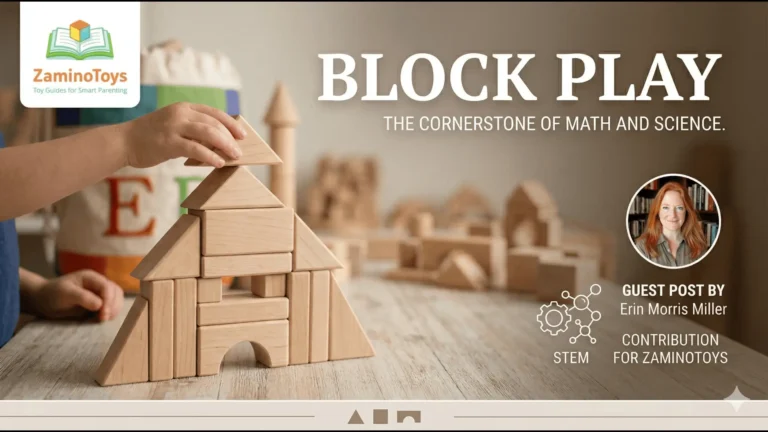
When I was five years old, my grandfather gave me one of the best Christmas gifts I ever got. They came in a big red sack my grandmother made with the letter E for Erin. The sack was full of wooden unit blocks, and I enjoyed many hours of fun through Block Play building towers and houses. They were made of smooth maple and had mathematical precision.A square was formed by two triangles, and a rectangle was formed by two squares. An arch and a half circle block could make the rectangle. They were solid and large enough to be easily stacked by small hands. I was thrilled. The blocks became a favorite toy for me and my three year old brother. It was not until I studied child development that I understood their true power. They were homemade versions of the Froebel Blocks. The Froebel Legacy: Why Kindergarten Started with Blocks Friedrich Froebel was one of the first educators to promote the idea that young children learn through play. He originated the concept of the kindergarten in 1840. He developed a range of materials for the kindergarten classroom, including a set of blocks to teach geometry and mathematics. Froebel influenced nearly every early education leader who followed, including Maria Montessori. Froebel recognized that the work of young children was play. It is through play that children learn to understand the world and lay the groundwork for future school performance.   Sharing these stories is a core part of our mission at ZaminoToys. You can find more expert-backed resources and toy reviews over on the ZaminoToys Blog. What Makes Unit Blocks Special? The Froebel blocks were special because each smaller block came together to form the larger block. This is the key feature of what are called “unit blocks.” Unit blocks develop cognitive and creative skills. Students learn: Geometry principles of shape and form. Mathematical concepts of number and pattern. Spatial manipulation. Creative skills of planning, communication, and problem-solving. Unit blocks develop cognitive and creative skills that are essential for long-term growth. For a deeper look at how specific playthings impact neural pathways, check out our 2026 Parent Guide to Brain Development Toys. Exploring Geometry and Numeracy Block play begins with the exploration of geometry. Children learn to identify the different shapes, compare the shapes to understand similarities and differences, and explore how different shapes match and combine. As children rotate the blocks, they learn about symmetry. As they stack to form towers, they learn about balance and counterbalance. Children explore the foundational concepts of mathematics. They learn to understand and apply numeracy from counting and stacking the blocks. Children learn about logical ideas such as more/less, inside/outside, above/below and repeated sequences as they build walls. As their building becomes more sophisticated, they explore pattern creation. Block play begins with the exploration of geometry, shapes, and textures. This physical interaction is a natural progression from the earlier stages of sensory play for 7-month-olds, where tactile discovery first begins.   Block Play as a Foundation for Engineering Learning through block play is even more beneficial when children play together. I was given the set of blocks with the assumption that my brothers and I would play with them together. This play is the foundation for the team-based problem solving that is often used in engineering. Engineering work begins with: A statement of the goal or problem. Making plans. Constructing prototypes. Evaluating results. Trial-and-error. Communication with others. Block play works in the same way. Children playing together with blocks need to communicate their goals. They learn to evaluate different designs and explain to each other how their ideas may work. Each child may have different ideas and must work together to evaluate and implement different creative solutions to problems. They learn to successfully integrate each child’s knowledge. The language that they use to solve problems together becomes an inner monologue when the child is working on challenges in the future. This is key to social learning theory. Inspiration for Great Minds My youngest brother and I were recruited to study engineering in college. I chose educational psychology, but my brother did become an engineer. We are not alone in being inspired by Froebel Blocks and similar building toys. Frank Lloyd Wright attributed his early play with Froebel Blocks as the inspiration for his interest in architecture. The artists Piet Mondrian and Wassily Kandinsky were inspired to play with form and shape in their work. Albert Einstein was inspired by a similar type of unit blocks made of stone. Unit blocks are likely one of the most important learning toys for STEM. Recommendations for Choosing Block- Toys Choose unit blocks: These are blocks that are precision cut so that the smaller blocks form the larger blocks. It is important that the blocks come together to form geometric shapes, such as two pyramids making the cube. Choose natural materials: Plain wood or stone can be stacked with greater precision and the right amount of friction between the surfaces. Choose the right size: The blocks should fit easily in the child’s hand. Too big or too small and there will be frustration. Choose the right amount: One set of blocks per child who is working with the blocks is sufficient. The constraint of there being a limited number of materials improves creativity. Suggested Block Sets Constructive Playthings Unit Block Set Community Playthings Introductory Set Unit Blocks GuideCraft Unit Blocks Frequently Asked Questions What are the specific mathematical benefits of block play? Block play is a direct introduction to geometry and numeracy. As children manipulate unit blocks, they learn about fractions (two squares equal one rectangle), symmetry, and spatial reasoning. These physical experiences create a “mental map” that helps children understand abstract math concepts more easily when they enter formal schooling. Why are “Unit Blocks” better than random building toys? Unlike standard blocks, Unit Blocks are precision-cut in a 1:1:2 ratio. This mathematical consistency allows children to discover that different shapes can combine to form

The Science of Stacking: How Block Play Builds Future Engineers and Mathematicians Read More »

Father of Indian Pediatrics: Dr K.C. Chaudhuri & IAP History Explained

Dr. K.C. Chaudhuri portrait, the respected 'Father of Indian Pediatrics' and founder of the Indian Journal of Pediatrics, featured on the Zamino Toys blog discussing child health history.

Free PDF: Dr. K.C. Chaudhuri Biography Download our simple guide to the life and history of the Father of Indian Pediatrics. Download Free PDF Father of Indian Pediatrics is a title closely associated with Dr. K. C. Chaudhuri. While many people are familiar with the Indian Academy of Pediatrics (IAP), very few truly know the inspiring story of the visionary who helped shape it. His relentless work laid the foundation for modern child healthcare in India. His pioneering efforts didn’t just build institutions—they transformed the future of millions of children across the country. Scroll down to learn more about his life and contributions, explore his historic journey, and download our Exclusive free PDF on his lasting legacy. Understanding the IAP: From the Father of Indian Pediatrics to Modern Guidelines Raising a healthy child today can feel overwhelming for many parents in India. Between advice from relatives, information on social media, and endless Google searches, it can be difficult to know which guidance is trustworthy. This is where the Indian Academy of Pediatrics (IAP) plays a crucial role. The IAP is a leading and highly trusted medical organization dedicated to child healthcare in India. It provides evidence-based guidelines for pediatricians, hospitals, and parents on topics like vaccination schedules, nutrition, child safety, development milestones, and parenting practices. Understanding the work of the Indian Academy of Pediatrics helps parents make informed, evidence-based decisions for their children’s health and development. In this guide, we will cover: The Indian Academy of Pediatrics’ (IAP) past  The legacy of Dr. K.C. Chaudhuri, the father of Indian pediatrics How the IAP vaccination schedule works in India Key nutrition and child development guidelines Practical parenting advice from pediatric experts By the end of this guide, you will clearly understand how IAP recommendations shape modern parenting and child healthcare in India. DR. K.C. Chaudhuri – Father of Indian Pediatrics https://youtu.be/o1oitP4jE4w?si=qfYiL5_IGGHioYj3 The father of Indian pediatrics is widely recognized as Dr. Kshitish Chandra Chaudhuri, commonly known as Dr. K.C. Chaudhuri. His pioneering work played a crucial role in establishing pediatrics as a specialized medical discipline in India and shaping the modern foundations of child healthcare in the country. In the early decades of the 20th century, healthcare systems in India were largely focused on adult medicine. Children were often treated simply as “small adults,” and very little attention was given to their unique developmental, nutritional, and medical needs. Dr. Chaudhuri strongly challenged this approach. He believed that children required dedicated healthcare systems, specialized research, and trained pediatric professionals who understood the distinct nature of childhood diseases and development. One of his most significant contributions came in 1933, when he founded the Indian Journal of Pediatrics, the first independent pediatric medical journal in India and one of the earliest in Asia. The journal helped connect Indian pediatricians with global medical research and created a scientific platform to discuss child health issues specific to India. READ  Authoritative Parenting: A Balanced Parenting Style That Builds Confident and Responsible Children Dr. Chaudhuri also played an instrumental role in building professional networks among pediatric doctors. In 1948, he helped establish the Indian Pediatric Society, which later merged with other pediatric associations and contributed to the formation of the Indian Academy of Pediatrics, now the largest professional body of pediatricians in India. Beyond academic contributions, the father of Indian pediatrics was also involved in developing institutions dedicated to child healthcare. He founded the Institute of Child Health in Kolkata, one of India’s earliest specialized pediatric hospitals, which later became an important center for pediatric treatment, education, and research. The Father of Indian Pediatrics Dr. K.C. Chaudhuri.  Fundamentally reshaped the nation’s approach to child healthcare. By championing preventive medicine, nutritional education, immunization, and specialized clinical training, he laid the groundwork for the field. His advocacy ultimately transformed pediatrics from a general practice subset into a respected, independent medical discipline in India. His philosophy about child health was simple yet powerful: “Healthy children build a healthy nation.” This idea reflected his belief that the future of any country depends on the health and well-being of its children. By promoting scientific pediatric care, he laid the foundation for modern child health policies and medical education in India. Today, decades after his pioneering work, the legacy of the father of Indian pediatrics continues through pediatric research institutions, child health programs, and medical organizations such as the Indian Academy of Pediatrics. Thousands of pediatricians across India follow the principles he championed—evidence-based medicine, child-focused healthcare, and continuous research to improve the well-being of infants and children. The influence of father of Indian pediatrics remains deeply embedded in India’s pediatric healthcare system. His contributions not only shaped medical education but also helped raise awareness among parents and doctors about the importance of specialized healthcare for children.  Download Research Guide: Father of Indian Pediatrics Readers who want a deeper understanding of the life and contributions of Kshitish Chandra Chaudhuri, widely known as the Father of Indian pediatrics,can download this detailed research guide Here. This research PDF provides a detailed biography of father of indian pediatrics, the pioneer of pediatric medicine in India and a key figure in the development of modern child healthcare. The Indian Academy of Pediatrics (IAP): What Is It? The Indian Academy of Pediatrics (IAP) is a professional association of doctors dedicated to improving the health and well-being of children across India. Founded in 1963, the organization now has over 40,000 pediatric specialists, including: Neonatologists and pediatricians Child health researchers Children’s surgeons Experts in child development The primary goal of the Indian Academy of Pediatrics is to advance pediatric healthcare through research, education, and evidence-based medical guidelines. While the organization mainly supports pediatricians, its work directly impacts millions of parents and children every year. Many of the recommendations followed by pediatricians in India — including immunization schedules, nutrition practices, and child safety guidelines — originate from IAP research and expert panels. Parents may not always realize it, but much of the advice given by doctors during routine child visits is based

Father of Indian Pediatrics: Dr K.C. Chaudhuri & IAP History Explained Read More »

Age-Wise Toy Guide: How to Choose the Right Toy for Every Stage of Childhood

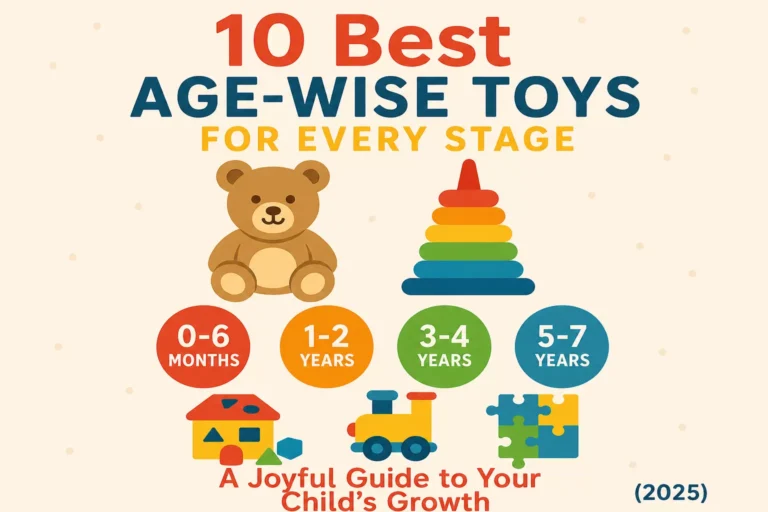
Infographic showing the 10 best age-wise toys for children from 0 to 7 years, part of an age-wise toy guide for child growth in 2025.

An Age-Wise Toy Guide helps parents choose toys based on developmental milestones instead of just age labels. The right toys improve brain development, sensory learning, emotional intelligence, motor skills, creativity, and problem-solving ability in children from newborn stage to 10 years. Why an Age-Wise Toy Guide Matters More Than Ever Toys are not just entertainment tools — they are developmental building blocks that shape your child’s physical, emotional, social, and intellectual growth. In modern parenting, toy selection has become confusing. Markets are filled with trending toys, digital gadgets, and flashy marketing, which often distract parents from choosing toys that truly support child development. This Age-Wise Toy Guide for Indian parents simplifies toy selection using child psychology research, developmental science, and real parenting experience. Instead of impulse buying, this guide helps parents invest in meaningful, growth-oriented play experiences. Whether you are raising a newborn, toddler, preschooler, or growing child, selecting the right toy at the right stage supports confidence, curiosity, and lifelong learning habits. Choosing toys using developmental guidance ensures children learn through play while building essential life skills. 👉 Related:  Still confused about why toys matter in a child’s life? Start with our Toys – What, When & Why? guide for complete clarity. Scientific Research Supporting Developmental Toy Selection According to the American Academy of Pediatrics (AAP), toys that encourage imagination, interaction, and problem-solving significantly improve early brain development, language skills, and emotional bonding between parents and children. Research from developmental psychology journals confirms that children learn fastest when toys match their developmental readiness instead of chronological age alone.   🍼 0–6 Months: The Newborn Stage – Sensory Discovery Begins Your baby is entering a brand new world, and their senses are their guide. During this fragile yet fascinating stage, babies rely on sensory input to understand their surroundings. Every sound, light, and touch shapes their early development. “In this video, we explore how introducing the right sensory toy at the right time can naturally guide your baby through their earliest developmental milestones. During the first six months, your little one is building the foundational visual and motor skills needed to eventually hold and play with objects independently.” 🧠 Developmental Focus: Visual stimulation (especially contrasting colors) Auditory development and sound localization Beginning hand movement and muscle awareness Emotional comfort and bonding ✅ Best Toys for Newborns: Soft rattles with gentle jingles to attract attention High-contrast flashcards in black, white, and red Tummy time mats to build neck and shoulder strength Soft plushies with varying fabrics for tactile experience Crib mobiles with slow movement and lullabies 🧸 Expert Insight: Toys at this stage should support sensory exploration. Introducing multiple textures and sounds gradually can help stimulate different parts of the brain without overwhelming the child. 🧠 Did you know? Research published in Infant Behavior and Development shows that visually stimulating toys significantly improve infants’ attention span and tracking ability within just a few weeks of play. 6–12 Months: Sitting, Crawling, and Cause-and-Effect Learning Around six months, your baby starts sitting independently and might begin crawling. They’re curious, eager to grab, drop, and repeat actions. Toys should now focus on building motor coordination and simple logic. 🧠 Developmental Focus: Cause-and-effect awareness (e.g., pressing a button causes a sound) Strengthening large muscles for crawling and sitting Object permanence (understanding things still exist when hidden) ✅ Recommended Toys: Pop-up activity boxes to teach surprise and interaction Teething-safe soft rings that can be twisted or chewed Mirrored toys to help babies discover their reflection Sensory balls with ridges or soft spikes for rolling and gripping 💡 Practical Parenting Tip Place toys slightly out of reach during playtime. This encourages crawling and strengthens muscle development. Using simple verbal cues like “Where is your ball?” also promotes early language development. 🚼 1–2 Years: Toddler Time – Moving, Mimicking, and Learning Words This is when your toddler is on the move—and their brain is too! More independence, testing, and emotional expression are to be assumed. The best toys are those that blend imagination with action. Work best. 🧠 Developmental Focus • Walking and climbing coordination• Vocabulary and speech growth• Emotional expression and self-awareness• Parallel play development ✅ Ideal Toys • Push walkers for stability• Stacking rings and blocks• Musical toys like drums or xylophones• Pretend play phones or tool kits 👪 Parenting Development Tip Narrating play activities helps language development naturally. Example:“You are stacking the blue block on the red block.” 2–3 Years: Imagination, Role Play & Emotional Learning   Best Toys for 2–3 Year Old Children This stage is dominated by pretend play and storytelling. Children begin understanding social roles and emotional empathy. 🧠 Developmental Focus • Symbolic and imaginative thinking• Emotional understanding through characters• Trial-and-error problem solving• Sorting and classification skills ✅ Must-Have Toys • Dolls and plush toys with character stories• Shape sorting toys• Kitchen, doctor, or mechanic role-play sets• Montessori latch and lock boards 🧩 Bonus Activity:- Creating pretend store play helps children learn communication, social interaction, and early math skills. 3–5 Years: Preschool Readiness & Structured Learning   As your child approaches the preschool years, your toy rotation should shift towards more structured and readiness-focused items. Our Age-Wise Toy Guide for 3–5 years (seen below) highlights how curated tools—from alphabet magnetic boards to memory board games—actively build memory and social cooperation. Furthermore, incorporating a specific type of age wise toy into daily quiet play routines is a critical school preparation tip, directly helping your child develop the sustained attention required in a classroom environment. Best Toys for Preschool Children Preschool children begin understanding instructions, rules, and structured activities. 🧠 Developmental Focus • Memory building• Sequential thinking• Social cooperation• Early literacy and number awareness ✅ Recommended Educational Toys • Alphabet magnetic boards• Memory board games• Creative craft kits• Beginner puzzles• Mega building blocks 🎓 School Preparation Tip:- Daily quiet play activities improve concentration and help children adjust to classroom learning. 5–7 Years: STEM Thinking & Strategy Development   Best Toys for 5–7 Year Old Children Children become curious about how things work and

Age-Wise Toy Guide: How to Choose the Right Toy for Every Stage of Childhood Read More »