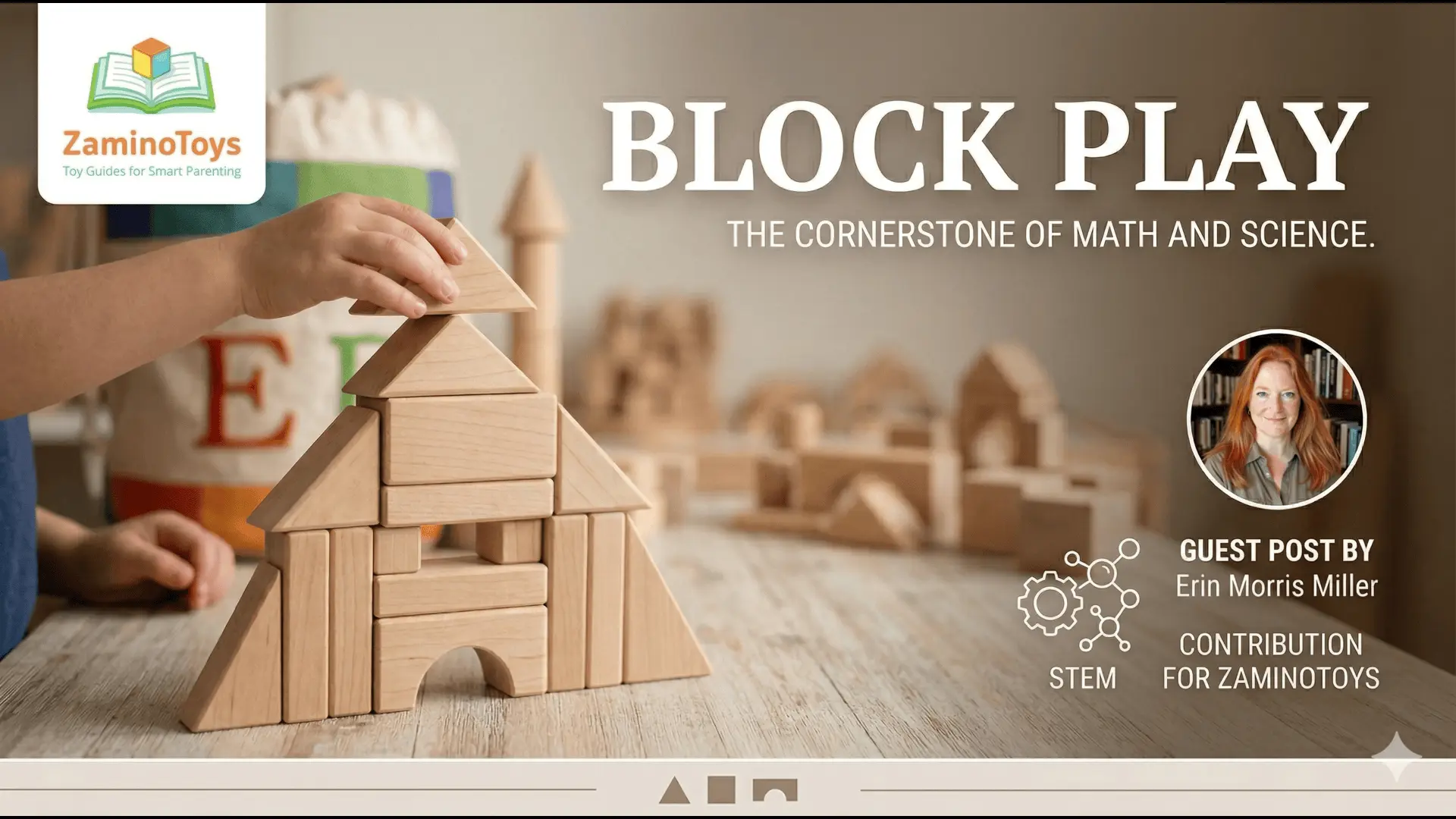
When I was five years old my grandfather gave me one of the best Christmas gifts I ever received. They came in a giant red sack my grandmother had sewn with the letter E for Erin. The sack was filled with wooden unit blocks.
They were made of smooth maple and had mathematical precision.A square was formed by two triangles, and a rectangle was formed by two squares. An arch and a half circle block could make the rectangle. They were solid and large enough to be easily stacked by small hands.
Table of Contents
ToggleI was thrilled. The blocks became a favorite toy for me and my three year old brother. It was not until I studied child development that I understood their true power. They were homemade versions of the Froebel Blocks.
The Froebel Legacy: Why Kindergarten Started with Blocks
Friedrich Froebel was one of the first educators to promote the idea that young children learn through play. He originated the concept of the kindergarten in 1840. He developed a range of materials for the kindergarten classroom, including a set of blocks to teach geometry and mathematics.
Froebel influenced nearly every early education leader who followed, including Maria Montessori. Froebel recognized that the work of young children was play. It is through play that children learn to understand the world and lay the groundwork for future school performance.
Sharing these stories is a core part of our mission at ZaminoToys. You can find more expert-backed resources and toy reviews over on the ZaminoToys Blog.
What Makes Unit Blocks Special?
The Froebel blocks were special because each smaller block came together to form the larger block. This is the key feature of what are called “unit blocks.” Unit blocks develop cognitive and creative skills. Students learn:
Geometry principles of shape and form.
Mathematical concepts of number and pattern.
Spatial manipulation.
Creative skills of planning, communication, and problem-solving.
Unit blocks develop cognitive and creative skills that are essential for long-term growth. For a deeper look at how specific playthings impact neural pathways, check out our 2026 Parent Guide to Brain Development Toys.
Exploring Geometry and Numeracy
Block play begins with the exploration of geometry. Children learn to identify the different shapes, compare the shapes to understand similarities and differences, and explore how different shapes match and combine.
As children rotate the blocks, they learn about symmetry. As they stack to form towers, they learn about balance and counterbalance. Children explore the foundational concepts of mathematics. They learn to understand and apply numeracy from counting and stacking the blocks.
Children learn about logical ideas such as more/less, inside/outside, above/below and repeated sequences as they build walls. As their building becomes more sophisticated, they explore pattern creation.
Block play begins with the exploration of geometry, shapes, and textures. This physical interaction is a natural progression from the earlier stages of sensory play for 7-month-olds, where tactile discovery first begins.
Block Play as a Foundation for Engineering
Learning through block play is even more beneficial when children play together. I was given the set of blocks with the assumption that my brothers and I would play with them together. This play is the foundation for the team-based problem solving that is often used in engineering.
Engineering work begins with:
A statement of the goal or problem.
Making plans.
Constructing prototypes.
Evaluating results.
Trial-and-error.
Communication with others.
Block play works in the same way. Children playing together with blocks need to communicate their goals. They learn to evaluate different designs and explain to each other how their ideas may work. Each child may have different ideas and must work together to evaluate and implement different creative solutions to problems. They learn to successfully integrate each child’s knowledge.
The language that they use to solve problems together becomes an inner monologue when the child is working on challenges in the future. This is key to social learning theory.
Inspiration for Great Minds
My youngest brother and I were recruited to study engineering in college. I chose educational psychology, but my brother did become an engineer. We are not alone in being inspired by Froebel Blocks and similar building toys.
Frank Lloyd Wright attributed his early play with Froebel Blocks as the inspiration for his interest in architecture.
The artists Piet Mondrian and Wassily Kandinsky were inspired to play with form and shape in their work.
Albert Einstein was inspired by a similar type of unit blocks made of stone.
Unit blocks are likely one of the most important learning toys for STEM.
Recommendations for Choosing Block- Toys
Choose unit blocks: These are blocks that are precision cut so that the smaller blocks form the larger blocks. It is important that the blocks come together to form geometric shapes, such as two pyramids making the cube.
Choose natural materials: Plain wood or stone can be stacked with greater precision and the right amount of friction between the surfaces.
Choose the right size: The blocks should fit easily in the child’s hand. Too big or too small and there will be frustration.
Choose the right amount: One set of blocks per child who is working with the blocks is sufficient. The constraint of there being a limited number of materials improves creativity.
Suggested Block Sets
Frequently Asked Questions
Block play is a direct introduction to geometry and numeracy. As children manipulate unit blocks, they learn about fractions (two squares equal one rectangle), symmetry, and spatial reasoning. These physical experiences create a “mental map” that helps children understand abstract math concepts more easily when they enter formal schooling.
Unlike standard blocks, Unit Blocks are precision-cut in a 1:1:2 ratio. This mathematical consistency allows children to discover that different shapes can combine to form a single larger shape (e.g., two triangles forming a cube). This precision reduces frustration and encourages the complex, architectural thinking required for future STEM success.
While basic exploration begins in infancy, the “Cornerstone” of math and science play typically peaks between ages 3 and 6. During this window, children move from simple stacking to complex “Engineering Peer Play,” where they begin planning structures, solving balance problems, and collaborating with others to reach a specific design goal.
Open Access Research
Book Chapter: Engineering Peer Play: A New Perspective on Science, Technology, Engineering, and Mathematics (STEM) Early Childhood Education by Zachary Gold & James Elicker in Peer Play and Relationships in Early Childhood published by Springer Nature. 2000
Article: Nurturing Wonder: Learning Engineering through Block Play. By Zachary Gold, James Elicker, and Barbara Beaulieu