You just found out you are pregnant. Your heart is racing. But do you know what is actually happening inside your body right now?
Inside your womb, the most incredible journey of human life has already begun. A tiny embryo — smaller than a grain of rice — is going through the embryo formation process every single day. This guide explains embryo formation in humans step-by-step in a simple way, so every parent can understand and feel connected to their baby from the very first week.
Understanding these embryo formation steps helps you make better choices in these precious early weeks. In this guide, you will get a complete explanation of embryo development week by week — from the moment of fertilization all the way to Week 8. You will also learn about embryo formation stages, embryo formation time, what your body is going through, what to eat, what to avoid, and how to care for yourself and your growing baby.
According to WHO and medical research, the first 8 weeks are the most critical period for embryo development in humans. Every single day counts.
Quick Answer: What Is Embryo Formation?
Embryo formation is the process that begins at fertilization (Day 1) and continues until the end of Week 8 of pregnancy. During this time, a single fertilized egg divides, grows, and develops into a fully formed embryo with a beating heart, brain, spine, and all major organs taking shape. After Week 8, the embryo is called a fetus.
Embryo formation time: Embryo formation takes about 8 weeks in humans — starting from fertilization on Day 1 to the end of Week 8, when all major organs begin forming.
Understanding the Key Terms: Zygote, Embryo, and Fetus
Before we go through the embryo formation steps, let us understand three important words that every parent should know.
| Term | What It Means | When It Happens |
| Zygote | The fertilized egg formed when sperm meets egg | Day 1 (Fertilization) |
| Embryo | The developing baby from Week 1 to Week 8 | Week 1 to Week 8 |
| Fetus | The baby after all major organs have formed | Week 9 onwards |
Think of it this way: a zygote is the seed, the embryo is the sprouting plant, and the fetus is when it starts to look like the full plant. Each stage of embryo development in humans builds directly on the one before it.
Embryo Formation Stages: A Clear Overview
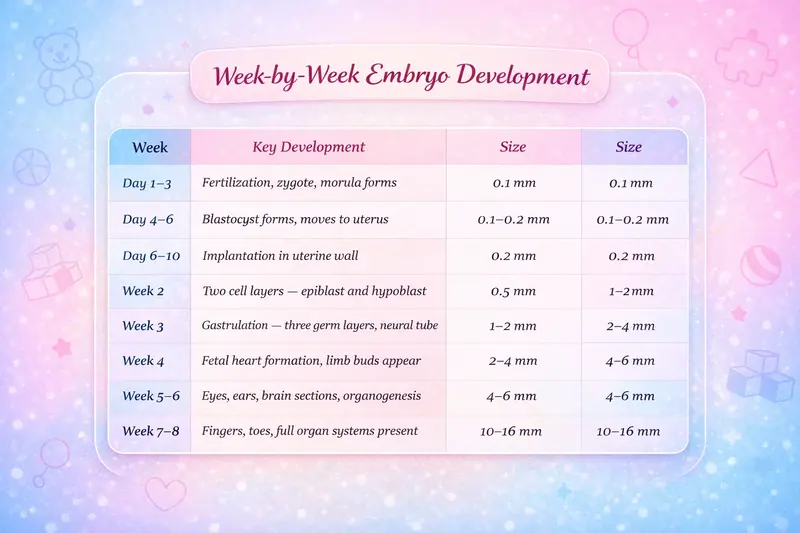
Before going into the week-by-week detail, here is a clear summary of all the embryo formation stages in order. This is what your baby goes through in the first 8 weeks:
- Zygote — The fertilized egg on Day 1. One single cell carrying your baby’s complete genetic blueprint.
- Morula — A solid ball of 16 cells formed by Day 3. Still travelling toward the uterus.
- Blastocyst — A hollow, fluid-filled ball of cells formed by Day 5. Ready to attach to the uterus.
- Implantation — The blastocyst buries into the uterine wall between Day 6 and Day 10. Pregnancy officially begins.
- Gastrulation — Three primary germ layers form in Week 3. These become every organ and tissue in the body.
- Organogenesis — Organs begin forming from Week 4 onwards. Heart, brain, spine, lungs, liver — all taking shape.
Why it matters: These six embryo formation stages are the foundation of your baby’s entire life. Nature ensures each step is completed perfectly before the next one begins.
Embryo Formation Diagram
If you are a visual learner, here is the simplest way to understand the embryo formation process:
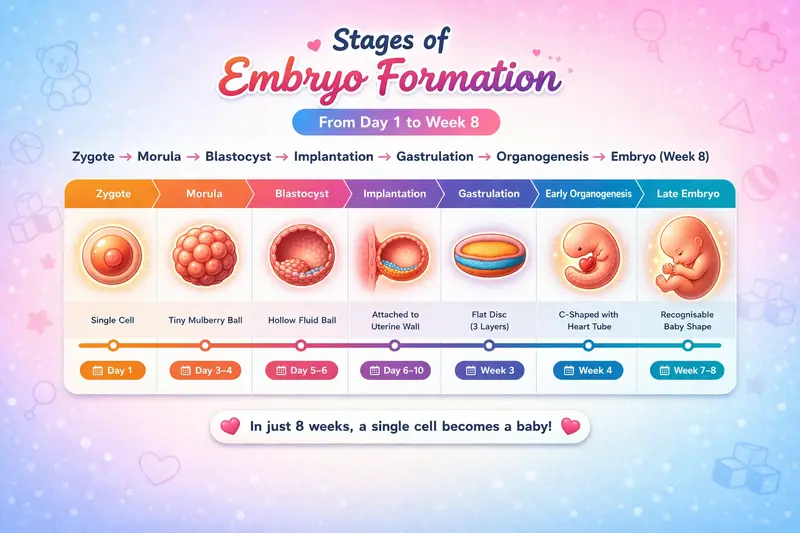
You can also watch an embryo formation video to understand this visually — searching “embryo formation video” on YouTube will show clear animations of each stage.
Image SEO note — Use image file name: embryo-formation-diagram.jpg | Alt text: “embryo formation diagram showing stages from zygote to week 8”
Embryo Development Week by Week: Complete Step-by-Step Guide
Here is the complete embryo formation process from Day 1 to Week 8 — each stage explained simply, the way a parent needs to understand it.
Day 1 to Day 3 — Fertilization and the Zygote Stage
Embryo formation begins the moment a sperm cell successfully enters an egg cell in the fallopian tube. This creates a zygote — the very first cell of your baby’s life.
Within 24 to 30 hours, this zygote begins dividing.One cell turns into two, two into four, and four into eight. By Day 3, it has become a ball of 16 cells called a morula. At this stage, the embryo is still travelling slowly towards the uterus.
Why this matters: The genetic blueprint of your baby — eye colour, blood type, height — is already set from this very first day. This is where your baby’s unique identity begins.
Day 4 to Day 6 — Blastocyst Formation
As the morula continues to divide, a fluid-filled cavity forms inside it. This new structure is called a blastocyst. It has two important parts:
- Inner Cell Mass — this will become your baby
- Trophoblast — this will become the placenta
By Day 5 or Day 6, the blastocyst reaches the uterus and begins to hatch from its outer shell. This is one of the quietest yet most important embryo formation steps.
Day 6 to Day 10 — Implantation
Implantation is one of the most important steps in the embryo formation process. The blastocyst attaches to the lining of the uterus (endometrium) and buries itself deep inside. This is when pregnancy officially begins.
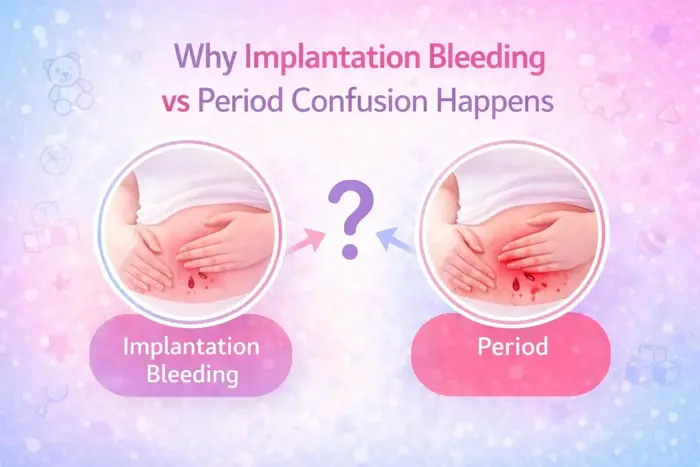
Some women experience light spotting during implantation — this is called implantation bleeding and it is completely normal. It is different from a period — it is lighter, shorter, and pinkish or brownish in colour.
This is the moment your body and baby truly become one.
Week 2 — Two Cell Layers Form
After implantation, the inner cell mass splits into two layers — the epiblast and hypoblast. These two layers are the foundation of all the organs, tissues, and structures that will form in the coming weeks of embryo development in humans.
Why this matters: Without this split, organogenesis — the formation of all organs — cannot begin.
Week 3 — Three Germ Layers and the Neural Tube (Gastrulation)
A simple visual of embryo formation from zygote to early development stages in pregnancy.
This is one of the most critical weeks in the embryo formation stages. Three primary layers now form through a process called gastrulation:
- Ectoderm — will become the brain, spine, skin, and nerves
- Mesoderm — will become the heart, muscles, bones, and kidneys
- Endoderm — will become the lungs, liver, stomach, and intestines
The neural tube — which will become your baby’s brain and spinal cord — also begins forming this week. This is exactly why folic acid is so critical in early pregnancy. According to WHO guidelines, folic acid supplementation before and during early pregnancy significantly reduces the risk of neural tube defects.
Week 4 — Fetal Heart Formation Begins
By Week 4, fetal heart formation begins. A tiny tube-shaped structure starts to develop and, by Day 22 to Day 24, this primitive heart begins to flutter and beat.
This is the stage where your baby’s heart begins its very first beat — one of the most emotional moments in the entire embryo development journey.
At this stage, the embryo is about 2 to 4 mm long — roughly the size of a poppy seed. Yet it already has a beating heart, a forming brain, and early limb buds.
Why this matters: Fetal heart formation at Week 4 is a key milestone in embryo formation time. It signals that organogenesis is fully underway.
Week 5 and Week 6 — Organs and Features Form (Organogenesis)
Embryo formation accelerates rapidly during these weeks:
- The brain divides into three main sections
- Eyes and ears begin forming as small pits
- Arm and leg buds appear and start to grow
- The liver, pancreas, and lungs begin developing
- The digestive system starts to take shape
By Week 6, the embryo is about 4 to 6 mm long. An ultrasound can usually detect the heartbeat for the first time around this point. Every embryo formation step from here builds toward a complete baby.
Week 7 and Week 8 — The Embryo Looks Like a Baby
These final weeks of the embryo stage bring rapid changes in embryo development in humans:
- Fingers and toes begin to form
- The face develops — nose, mouth, and eyelids taking shape
- The brain grows rapidly
- Movement begins, though the mother cannot feel it yet
- All major organ systems are now present
By the end of Week 8, the embryo is about 16 mm long — the size of a raspberry. All embryo formation stages are now complete. After this point, it is officially called a fetus.
What Is Happening in Your Body During the Embryo Stage?
While your baby is going through embryo formation stages, your body is also changing in big ways. Here is what to expect:
| Week | Early Pregnancy Symptom |
| Week 3–4 | Missed period, mild cramping, breast tenderness |
| Week 4–5 | Nausea (morning sickness), fatigue, frequent urination |
| Week 5–6 | Food aversions, mood changes, heightened smell |
| Week 7–8 | Increased nausea, bloating, possible light spotting |
Every mother experiences pregnancy differently. Some feel strong symptoms early, while others feel very little. Both are completely normal.
How to Care for Yourself During the Embryo Stage (Week 1 to Week 8)
What to Eat
Nutrition during embryo formation is critical because your baby’s brain, heart, and spine are forming right now. What you eat directly supports every embryo formation step.
- Folic acid (400–800 mcg daily) — protects the neural tube, reduces birth defect risk
- Iron-rich foods — dal, spinach, beetroot, ragi — support blood production
- Calcium — milk, curd, sesame seeds — for bone and teeth formation
- Protein — eggs, lentils, paneer — for cell growth and embryo development
- Vitamin B12 — essential for brain development, especially for vegetarians
- Water — drink at least 8 to 10 glasses daily to support embryo development in humans
What to Avoid
- Raw or undercooked meat and eggs — risk of infection harmful to embryo formation
- Alcohol and smoking — proven to damage embryo development, human research confirms
- Excess caffeine — limit to under 200 mg per day (about 1 cup of coffee)
- Dairy products that have not been pasteurized may contain dangerous microorganisms.
- High-mercury fish — avoid shark, swordfish, king mackerel
- Self-medication — always consult your doctor before taking any medicine