
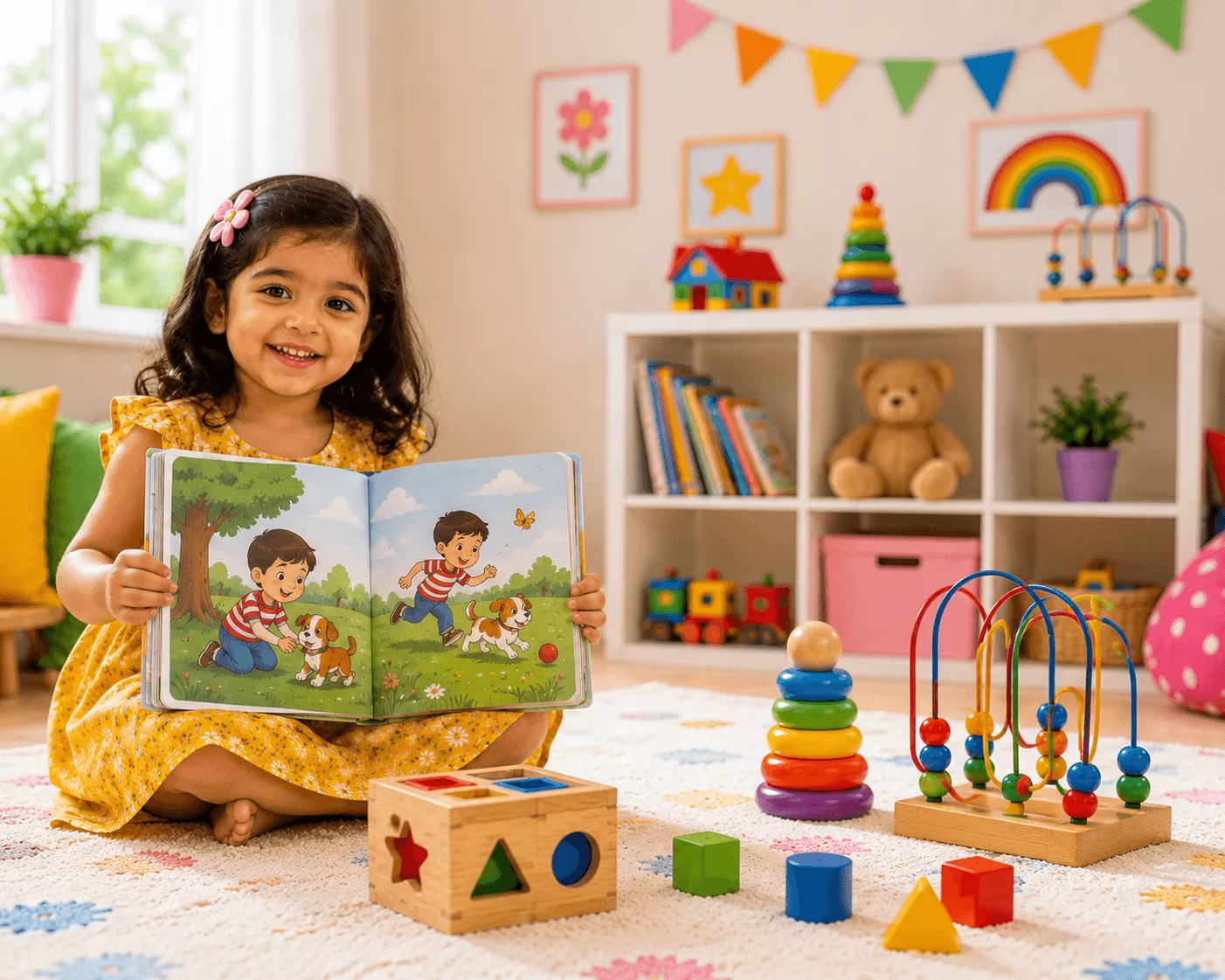
Life Around 3 and 4 Years Can Be More Unpredictable Than You Expect
The best newborn toys aren't the loudest or the brightest — they're the ones built for exactly where your baby is right now. Explore our full 0–6 month toy guide, stage by stage.
3 to 4 Years

What's Inside This Guide
Somewhere around the third birthday, play starts to look different. It’s not always sudden—some weeks nothing seems to change at all, and then one afternoon you notice your child talking to a stuffed rabbit like it’s a real guest at dinner or lining up cars in a very specific order that apparently matters a great deal.
This is a good time to think about toys for 3-year-olds, but not because the house needs more of them. It’s more that the toys already around and a few thoughtfully chosen ones start being used in new ways.
This stage isn’t about upgrading everything your child owns. Some children go all-in on pretend play. Others would rather stack, sort, or take things apart. A few seem to want nothing but the same three toys for months. None of that means anything is wrong — it just means children this age are figuring out what they like, and that process looks different in every house.
This guide walks through what tends to shift during the 3–4 year stage, how play tends to change, and where toys, books, and simple everyday activities genuinely fit in—without turning any of it into a shopping list or a checklist of milestones your child needs to hit.
3 to 4 Year

Life Around 3 and 4 Years Can Be More Unpredictable Than You Expect
If there’s one honest thing to say about this age, it’s that it resists tidy descriptions. At this age, you may notice longer stretches of focus on one activity, followed by days where nothing holds attention for more than a minute.
Many children become more interested in stories, in pretending to be someone else, or in doing things “by “myself”—sometimes loudly insisting on it even when help would clearly be faster. Some children start asking a lot of questions. Not just “what’s that,” but “why,” repeated in a loop that can genuinely test a parent’s patience by the fifth round. Others go the opposite direction and prefer to work things out quietly, watching before joining in. Your child might want company for every activity or might suddenly prefer to play alone in a corner for twenty minutes without a word.
It’s worth resisting the urge to compare too closely with other children the same age.Including siblings. Development at this stage isn’t a straight line, and a child who seems behind in one area is often well ahead in another. This isn’t a medical claim or a developmental assessment—just something that becomes obvious after enough ordinary afternoons of watching a child play.
What does tend to be common is a growing interest in stories and pretend scenarios, more physical confidence (climbing, running, occasionally attempting something that makes a parent’s stomach drop), and a stronger sense of preference. Three-year-olds tend to know what they like, and they’re not shy about saying so.
How Play Itself Starts to Shift
Play at two and play at four can look almost unrecognisable from each other. Somewhere in between, several things tend to happen at once.
Pretend Play Becomes More Elaborate
Pretend play becomes more elaborate. A cardboard box stops being just a box — it's a car, then a boat, then a spaceship for imaginary crew members that only your child can see. Dolls and figures start having conversations. Stuffed animals get fed, scolded, and put to bed with surprising seriousness.
Building and Stacking Get More Deliberate
Building and stacking get more deliberate. Where a two-year-old might knock a tower down as fast as it goes up, a three- or four-year-old is often more interested in building something specific — a garage for the cars, a tower "as tall as me," a bridge that things can drive under.
Drawing Starts to Represent Something
Drawing starts to represent something. Scribbles slowly turn into shapes that are meant to be a person, a dog, or a house, even if nobody else could guess that from looking at it. Ask what it is rather than guessing — you'll usually get an answer, and often a story to go with it.
Simple Problem-Solving Shows Up
Simple problem-solving shows up in ordinary moments. Working out how to fit puzzle pieces, figuring out which block goes where so the tower doesn't fall, or negotiating how two children can both play with the same toy — all of this counts, even though it rarely looks like "learning" in the moment.
Role Play and Storytelling Blend Together
Role play and storytelling often blend together. Playing pretend shop, pretend doctor, or pretend family dinner lets children try out situations and language they've picked up from daily life. It's less about accuracy and more about rehearsing how the world seems to work.
Repetition Is Common, Not a Bad Sign
Repetition is common and not a bad sign. The same story, the same game, the same song on loop — children this age often want to repeat things long after an adult would have moved on. This repetition tends to matter to them in a way that isn't always obvious from the outside.
Independent Play Starts Stretching Longer
Independent play starts stretching a little longer. Not for hours, but noticeably longer than before, especially with toys that don't have one "correct" way to be used.
What to Look For When Choosing Toys for This Stage
There’s no need to overhaul a toy shelf every few months. A few practical things are worth keeping in mind when something new does get added.
Open-ended toys blocks, simple figures, art supplies, pretend-play sets tend to get used longer than toys with only one function. A toy that lights up, plays a tune, and does exactly one thing often gets a week of attention and then sits untouched, while a bucket of blocks might still be in use a year later.
A few categories worth thinking about at this stage:
-
Pretend-Play Toys
Play kitchens, tool sets, dress-up items, or simple figures.
-
Building Toys
Chunky blocks, magnetic tiles, or basic construction sets.
-
Puzzles
Simple ones with larger pieces tend to work well early in this range.
-
Art Materials
Crayons, chunky pencils, washable paint, playdough.
-
Simple Games
Early matching or turn-taking games, kept short.
-
Books
Picture books with repetition or simple stories.
-
Outdoor Play Items
Balls, ride-on toys, sand and water play where appropriate.
Toys for 3 Year Olds: What Actually Tends to Get Used
When people search for toys for 3 year olds, they’re usually hoping for something more useful than a list of trending products. In practice, the toys that hold up over time tend to share a few traits, regardless of what they’re called on the box.
Invites Interaction
They invite interaction rather than just producing a reaction. A toy that only needs a button pressed doesn't leave much room for a child to actually do anything with it. A toy that responds to how it's used — stacked, sorted, arranged, pretended with — tends to stay interesting longer.
Works More Than One Way
They can be used in more than one way. A set of blocks can be a tower, a road, a wall, or a pile to knock over. A basket of play food can be dinner, a shop, or ingredients for an imaginary cake. That flexibility is often what keeps a toy relevant for months instead of days.
Matches Their Interests
They match what the child already seems drawn to. A child who loves being outside may get far more use from a ball or a simple ride-on toy than from an indoor puzzle. A child who's constantly narrating stories to their toys may get the most from figures or a small pretend-play set rather than anything mechanical.
Genuinely Age-Appropriate
They're genuinely age-appropriate — not just labelled that way, but suited to what the child can currently do with their hands, their patience, and their interests, which don't always match what's printed on the box.
Books and the Habit of Reading Together
Books tend to matter more at this age than people expect, partly because 3- and 4-year-olds are often ready for slightly longer stories than they were a year earlier, and partly because reading together becomes less about routine and more about conversation.
Picture books with some repetition a phrase that comes back, a pattern the child can predict often get requested again and again. That repetition isn’t boring for a child the way it might be for an adult reading it for the fifteenth time; it’s often exactly what makes the story feel familiar and satisfying.
Letting a child choose the book, even if it’s the same one every night for a week, tends to go a long way. So does pausing partway through to ask a simple question “What do you think happens next?” or “Why is he doing that?” rather than reading straight through without a break. Talking about the pictures, not just the words, often draws out more from a child than the text alone.
Things to Do That Don't Involve Buying Anything New
It’s easy to assume a new stage of development calls for new toys, but a lot of the best play at this age comes from things already lying around the house.
A cardboard box can turn into almost anything with a bit of imagination
Sorting household objects by colour, size, or type can hold attention longer than expected
Drawing with whatever's on hand — paper, chalk, an old whiteboard
Setting up a pretend shop using empty containers and play money
Pretend cooking with real (safe) kitchen tools under supervision
Building with blocks or containers already in the toy box, just rearranged
A simple scavenger hunt around the house or garden
Making up a story together, taking turns adding a sentence each
Water play in a basin or shallow tub, closely supervised
Everyday objects — wooden spoons, containers, fabric scraps — repurposed into props
A Few Toy Safety Checks Worth Making
Toy safety is worth a regular, unglamorous check, especially as toys get handed down, mixed between siblings, or kept around longer than the box recommends.
A few practical habits help:
- Check the age recommendation on the packaging, and treat it as a guide rather than a rule that overrides how your own child actually plays
- Look for small parts, especially with toys originally meant for an older sibling
- Check for broken or loose pieces, particularly on wheels, joints, or anything with small magnets or batteries
- Watch for general wear and tear — cracked plastic, fraying fabric, exposed stuffing
- Check occasionally whether a toy has been part of a safety recall, particularly for secondhand or older items
- Keep an eye on supervision needs, especially for water play, small parts, or anything with cords or strings
- Consider whether a toy is genuinely suited to what your child can currently do, not just their age in years
Choosing Based on Your Child, Not What's on the Box
Every parent eventually runs into toy packaging that promises a lot—smarter, faster learning; more advanced skills; guaranteed results. It’s worth reading those claims with a healthy amount of skepticism. No single toy will make a child more advanced, and a toy that doesn’t live up to a bold label on the box isn’t a failure—it’s just a toy.
A more reliable approach is watching your own child. Do they gravitate toward building things, or would they rather act out a story? Do they like puzzles they can solve alone, or do they want a play partner for everything? Do they return to the same toy over and over, long after it stopped being new?
There isn’t one best toy for a 3- or 4-year-old, and any list claiming otherwise is skipping over the fact that children this age are genuinely different from one another. A toy that gets ignored in one house might be the favorite in another, and that’s not a reflection of the toy’s quality—just a reflection of the child using it.
Where This Leaves Things
The 3–4 year stage tends to bring more pretend play, longer stretches of independent focus, and a clearer sense of what a child actually enjoys. Toys, books, and simple everyday activities all have a place in that not as things to constantly add to, but as tools that support whatever kind of play your child seems drawn to.
At ZaminoToys, we believe the 3–4 year stage doesn’t need to be complicated. When it comes to toys for 3 year olds, the goal isn’t finding a perfect one or building a perfect play setup. Most of what matters happens in ordinary moments a cardboard box, a repeated bedtime story, a pile of blocks rearranged for the tenth time that week.
None of it has to be impressive. It just needs to be something your child wants to come back to.