
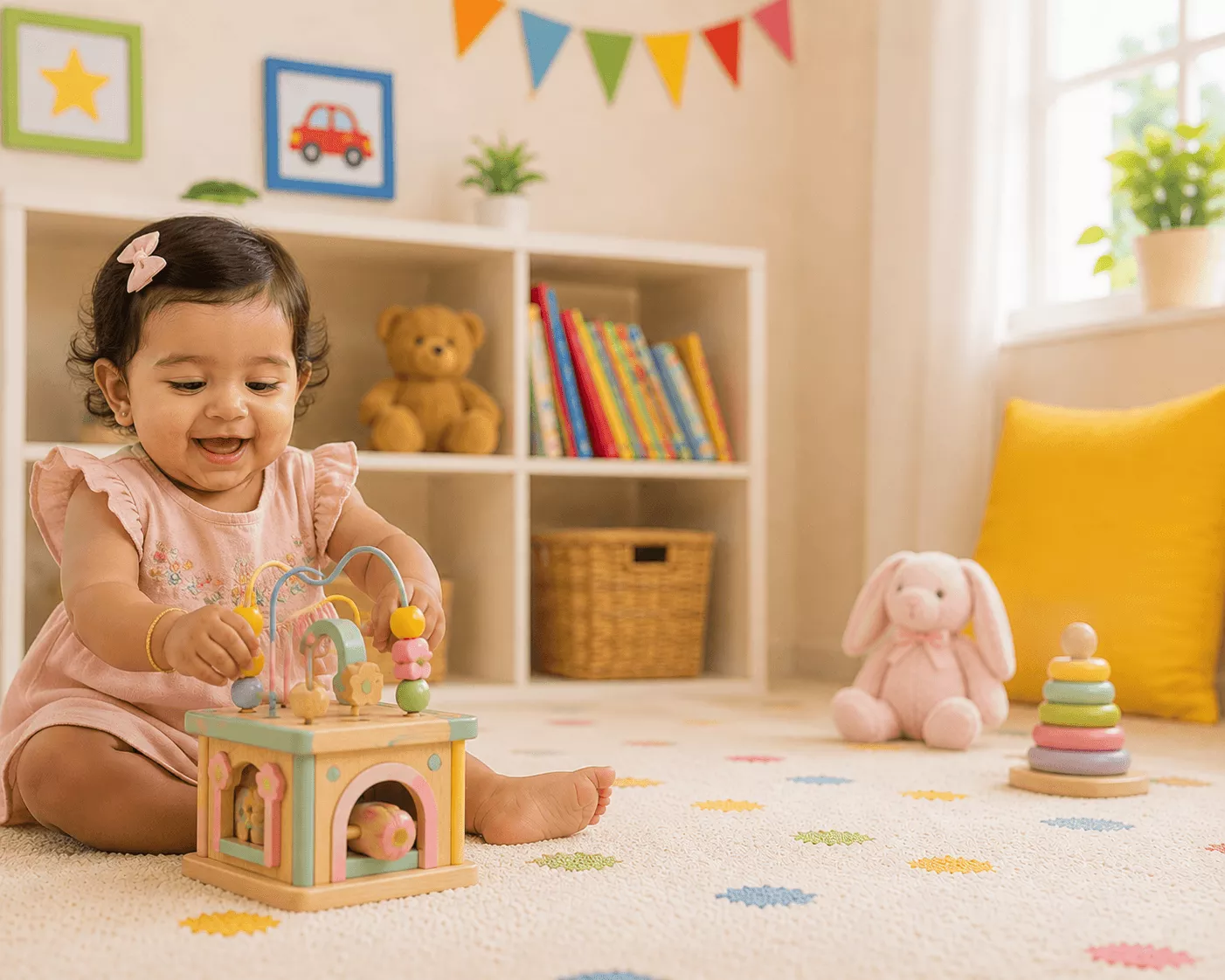
Toys for 6 Months to 1 Year: Finding What Works for Your Baby
Toys for 6 months to 1 year, with simple ideas for choosing age-appropriate, engaging, and safe toys that fit your baby's changing play needs.
Toys for 6–12 Months

What's Inside This Guide
My daughter was sitting on the living room floor one afternoon, surrounded by a small pile of toys we’d collected over a few months, and she reached past the flashy electronic one that lit up and played music and grabbed a plain wooden ring instead. She turned it over a few times, put one edge in her mouth, dropped it, and looked mildly satisfied with the whole exchange. That toy had cost less than the batteries in the one she ignored.
That moment stuck with me, mostly because it wasn’t dramatic at all. It was just an ordinary few minutes on a Tuesday. But it’s the kind of small thing that starts to teach you something about this stage babies are not always drawn to what looks impressive on a shelf. They’re drawn to what they can actually do something with.
Somewhere around six months, a lot of babies start reaching for things more deliberately. They grab, they mouth, they bang objects together, they notice sounds and textures in a way they didn’t a couple of months earlier. And a lot of parents, myself included at the time, end up standing in a store aisle or scrolling through a shopping app wondering what’s actually worth bringing home.
This guide is meant to help with that question. It covers toys for 6 months through the first birthday what kinds of toys tend to fit this window, what to look for when you’re choosing them, a few simple ways to use them during play, some notes on books that work well at this age, and the safety checks that matter most. It’s not about finding one “perfect” toy, because that doesn’t really exist. Every baby is different, and what holds one baby’s attention for twenty minutes might get a passing glance from another. The goal here is to help you narrow things down with a bit more confidence, not to hand you a shopping list to follow exactly.
It’s also worth saying upfront: babies develop at their own pace, and nothing in this guide should be read as a timeline your baby needs to hit. Think of it more as a general map of what tends to happen during this stretch, and how toys can fit naturally into it.
You’ll also find some notes here about what commonly goes wrong when choosing toys for this age the kinds of purchases that end up sitting unused in a bin somewhere, and the reasons behind that. Knowing what to avoid can sometimes be just as useful as knowing what to look for, especially when you’re standing in an aisle trying to decide between a dozen similar looking options.
6–12 Months

What Babies Often Explore Between 6 Months and 1 Year
Many babies start reaching for objects with more accuracy around this age, and grasping becomes more intentional than it was earlier on. You might notice your baby transferring a toy from one hand to the other, or holding one object while looking at another. Mouthing continues to be a major way babies explore things it’s often less about teething and more just how they gather information about an object’s shape, texture, and weight.
Sounds tend to become more interesting too. A soft rattle or a toy with a gentle noise can catch attention in a way that felt less consistent a few months back. Some babies start tracking moving objects with their eyes more smoothly, and many become more curious about different textures smooth versus bumpy, soft versus firm.
Sitting ability varies a lot during this period. Some babies sit steadily without support fairly early in this window, others need more time, and both are within the range of typical development. The same goes for movement generally some babies are already scooting or attempting to crawl by nine or ten months, while others are still working on it closer to their first birthday.
The goal isn't to make every toy "educational." At this age, ordinary play is already giving your baby opportunities to reach, grasp, move, explore, repeat, and discover.
According to general guidance from organizations like the CDC and WHO, this period is often associated with growing interest in cause-and-effect play, more back-and-forth interaction with caregivers, and increasing curiosity about how objects work. Some babies also start showing early signs of object permanence during this window — watching where a toy went after it rolled out of view, or looking for something that was just hidden under a blanket. This is why simple hiding games and toys that disappear and reappear sometimes start to hold more interest as the months go on.
But these are broad patterns, not requirements, and there’s a wide range of what counts as typical. If you ever have specific concerns about your baby’s development, a pediatrician is the right person to talk to — this guide is only meant to give some context for why certain toys tend to be appealing during this stretch, not to offer any kind of developmental assessment.
Toys for 6 Months to 1 Year: Categories That Fit This Stage
There’s no need to buy one of everything. But knowing the general categories that tend to work well during this window can make it easier to choose with some intention, rather than just picking whatever looks most colorful on a shelf.
🪀 Rattles & Grip Toys
Rattles remain a staple for a reason. At this age, a lot of babies are working on grasping objects and bringing them toward their mouth or their other hand, and a toy that's easy to hold makes that whole process less frustrating. Look for shapes that fit reasonably well into a small hand — not too wide, not too smooth to grip — and a weight that isn't tiring to hold up.
Sound matters here too, but more is not automatically better. A soft, distinct rattle sound seems to hold attention better than something loud or overstimulating. I noticed that the toys my daughter kept coming back to during this stage were usually the simpler ones — a rattle with one kind of sound, rather than a toy with five different noise settings and a light-up panel. That's just one household's experience, but it lines up with something I've read from several parenting sources: simpler toys often invite more actual interaction, because the baby has to do something to get a result, rather than just watching the toy perform on its own.
Read our guide to rattles and grip toys →🧸 Textured & Sensory Toys
Somewhere in this stage, texture starts to matter more. Babies begin noticing the difference between a smooth plastic surface and a ridged silicone one, or between soft fabric and a firmer material. Toys that combine a few different textures — bumps, ridges, soft patches, fabric elements — can give a baby something new to investigate each time they pick it up.
Material safety matters more here than almost anywhere else, since these toys tend to spend a lot of time in a baby's mouth. Look for materials labeled BPA-free, and check that any fabric elements are washable, since sensory toys get dropped, drooled on, and generally put through a lot in a short amount of time. It's worth resisting the urge to buy into marketing language that claims a textured toy will "boost brain development" — there's no need for that kind of claim. A toy that gives a baby something interesting to explore with their hands and mouth is doing its job without needing to promise anything more.
🤸 Simple Tummy-Time Toys
Tummy time can be a hard sell for some babies, and a toy placed just within reach can sometimes make the difference between a baby tolerating it and a baby actually engaging with it. This doesn't need to be anything elaborate — a toy that makes a small sound when nudged, or one with an interesting texture or color, can be enough to encourage a baby to lift their head, reach forward, or push up on their arms.
This isn't a guarantee, and plenty of babies still find tummy time frustrating no matter what's placed in front of them, which is completely normal. The idea is just that a well-placed toy can sometimes turn a few minutes of tummy time into something a bit more engaging rather than something to get through.
⚫ High-Contrast Toys & Books
Even as vision continues developing throughout this stage, many babies still show real interest in high-contrast patterns — bold blacks, whites, and reds, or simple geometric shapes. Toys and books built around this kind of contrast tend to catch attention quickly, sometimes more so than softer pastel colors.
Simple is generally better here. A toy or page with one clear image tends to hold interest longer than something busy with a lot going on at once. This is one area where it's easy to overthink things — a basic high-contrast card or a sturdy black-and-white board book can do the job just as well as something more elaborate.
6–12 Months
Books to Look at Together
Books at this age aren’t really about a baby “reading” in any independent sense they’re about the shared moment of sitting together, looking at pages, and hearing a familiar voice. That’s worth keeping in mind, because it takes some of the pressure off choosing the “right” book.
Sturdy board books tend to work best during this stage, since they can survive being mouthed, dropped, and occasionally thrown across the room. High-contrast books with simple images are often a good fit early in this window, while books with slightly more detail animals, everyday objects, simple faces tend to hold interest as the months go on. Textured books, with a patch of fabric or a raised element on each page, can add a sensory layer that keeps a baby engaged a bit longer.
Repetition is genuinely useful here. Reading the same book multiple times in a row, or the same handful of books across weeks, isn’t a sign you need more variety it’s often exactly what a baby wants at this stage. The predictability seems to be part of the appeal.
What matters most isn’t really the book itself, but the back-and-forth of the moment pointing at a picture, naming something out loud, letting your baby turn a page even if it’s the wrong direction. That interaction is doing more than the book alone ever could.
Some toy types that often fit well here:
Books to Look at Together
Books at this age aren't really about a baby "reading" in any independent sense — they're about the shared moment of sitting together, looking at pages, and hearing a familiar voice. That's worth keeping in mind, because it takes some of the pressure off choosing the "right" book.
Sturdy Board Books
High-Contrast Books
Faces & Everyday Objects
Textured Books
Repetition is genuinely useful here. Reading the same book multiple times in a row, or the same handful of books across weeks, isn't a sign you need more variety — it's often exactly what a baby wants at this stage. What matters most isn't really the book itself, but the back-and-forth of the moment — pointing at a picture, naming something out loud, letting your baby turn a page even if it's the wrong direction. That interaction is doing more than the book alone ever could.
6–12 month
Simple Activities for 6 Months to 1 Year
Not everything at this stage needs to involve a purchase. Some of the most engaging moments come from ordinary objects and a little bit of intention.
One simple activity is placing a toy just slightly out of reach during floor play, close enough that your baby can work toward it but far enough that it takes some effort. This can encourage reaching, scooting, or general movement, depending on where your baby is with mobility. Another option is offering a couple of different safe textures side by side a soft fabric toy next to something with a firmer, bumpier surface and just watching which one gets more attention.
Reading together and turning pages, even loosely, is another low-effort but genuinely valuable activity. So is simple object-transfer play handing your baby a toy and letting them pass it between hands, or gently rolling a lightweight toy within their reach and letting them try to retrieve it.
None of this needs to be structured or scheduled. These are small moments that fit naturally into a day, not a program to follow. The point isn’t to turn playtime into something formal it’s just to notice what your baby is already curious about and give them a bit more opportunity to explore it.
Things to Check Before Giving a Toy
This is one of the more important sections in this guide, and it’s worth reading carefully even if it feels like common sense.
Age labels on toy packaging are a reasonable starting point, but they shouldn’t be the only thing you rely on. It’s worth actually inspecting a toy yourself before handing it to your baby, especially anything that’s secondhand, inherited from an older sibling, or purchased somewhere without strict quality control.
A few things worth checking regularly:
Small Parts
Anything that could fit through a toilet paper tube is generally considered a choking hazard for this age group.
Loose or Detachable Pieces
Buttons, eyes, small decorative elements, or parts that can be pulled or chewed off over time.
Battery Compartments
These should be secured with a screw, not just a snap-shut lid, since babies are strong enough at this age to pry open weaker compartments.
Damaged Toys
Cracks, splitting seams, or foam that's starting to break down should be retired, even if the toy was fine a few months earlier.
Washable Surfaces
Given how much mouthing happens at this stage, toys that can actually be cleaned regularly are worth prioritizing over ones that can't.
What Commonly Goes Wrong When Choosing Toys?
After going through this stage and talking with other parents, a few patterns come up again and again the kinds of mistakes that are easy to make and pretty easy to avoid once you know to look out for them.
Buying toys that are too advanced. It’s tempting to buy ahead, especially when a toy looks educational or is marketed toward slightly older babies. But a toy that’s too complex for where your baby currently is often just gets ignored. Complicated isn’t the same as better.
Choosing toys because the packaging looks impressive. This one’s easy to fall into. A toy with bold claims on the box “boosts development,” “builds genius brains” can feel like the responsible choice, but packaging is marketing, not evidence. It’s worth looking past the claims and asking whether the toy itself is something your baby can actually pick up, explore, and do something with.
Buying toys with too many sounds and buttons. Toys that do a lot on their own flashing lights, pre recorded songs, multiple sound effects triggered by a single press can be entertaining in short bursts, but they don’t always invite much actual interaction. A toy that requires the baby to do something to get a result tends to hold attention differently than one that performs regardless of what the baby does.
Buying too many toys at once. It’s easy to end up with a large collection quickly, especially with gifts from family added into the mix. But babies at this age don’t necessarily benefit from having a huge selection available at once. A smaller rotation a handful of toys out at a time, with others put away and swapped in later often keeps things more interesting than a big pile all at once.
Ignoring wear and tear. As mentioned above, this is worth repeating. A quick periodic check of the toys already in rotation matters just as much as choosing new ones carefully.
So what actually tends to work better? Toys that are simple, appropriately sized for where your baby is right now, easy to grasp, interesting enough to invite some interaction, safe under close inspection, and suited to what your baby is currently doing reaching, sitting, mouthing, transferring objects rather than what they might be doing several months from now
Choosing Toys for Your Baby's Current Stage
None of this is about finding a magic toy. Nothing on this list is going to accelerate anything or guarantee any particular outcome, and it’s worth being skeptical of anything that claims otherwise. At ZaminoToys, we believe what tends to matter more is fit—whether a toy or a book or a few minutes of floor play actually lines up with what your baby is interested in and capable of right now.
When it comes to toys for 6 months through the first year, the honest answer is that you don’t need every option on the market. You need a handful of things that fit your baby’s current stage, that are safe when you actually inspect them, and that hold attention because they’re simple enough to interact with rather than just watch. That was true with the wooden ring on our living room floor, and it’s likely to keep being true as your baby moves through this whole stretch of the first year.