
Toys for 1- to 2-Year-Olds: What They Actually Play With
Explore toys for 1 to 2 year olds, with practical ideas for choosing engaging, age-appropriate toys that support everyday play, curiosity, and fun.
Toys for 1- to 2-Year-Olds

What's Inside This Guide
Somewhere between the first wobbly steps and the first real sentences, toy shopping starts to feel a little different. The rattles and soft blocks that worked so well at six months don’t hold much interest anymore, and the toy box at home probably has a few things gathering dust in the corner. If you’re looking for toys for 1 to 2 year olds, you’ve likely noticed how quickly this age group changes sometimes week to week.
This guide is meant to help you think through toddler toys in a practical way: what tends to work at different points during this stage, what to look out for in terms of safety, and how to avoid ending up with a pile of toys that never actually get used. There’s no single “correct” toy list here. Every toddler plays a little differently, and what works for one child might sit untouched for another.
1- to 2-Year

What Changes Between 1 and 2 Years?
The year between a first and second birthday covers a lot of ground. Around 12 months, many toddlers are just starting to stand, cruise along furniture, or take their first independent steps. Grasping is still fairly basic — a lot of picking things up with a full hand, banging them together, or simply moving objects from one place to another.
By 18 months or so, things usually shift. Walking becomes steadier, climbing shows up more often, and toddlers start figuring out that objects can be stacked, nested, or fit into specific spaces. Pointing and naming things becomes a regular part of the day. Pretend play often starts to appear too, even if it’s just pretending to feed a stuffed animal or “talking” on a toy phone.
By the time a child approaches age 2, play tends to get more purposeful. Simple puzzles, matching games, and early building projects become more interesting. Language is usually expanding fast, and toddlers often want toys that let them copy what they see adults doing — sweeping, cooking, talking on the phone, pushing a cart.
It’s worth saying clearly: these are general patterns, not deadlines.Every child grows and learns at their own pace, so there can be plenty of variation in what is typical at this age. If you ever have specific concerns about your child’s development, that’s a conversation for your pediatrician, not something to sort out through toy choices.
Choosing Toys for a 1-Year-Old
At this age, a lot of play is physical and exploratory. Toddlers this age are often more interested in the process—pushing, pulling, dropping, and retrieving—than any particular end result.
A few things that tend to hold a 1-year-old’s attention:
- Simple stacking toys, like large rings or soft blocks, that don't require much precision
- Push toys or ride-along toys that support new walking skills
- Toys that respond to an action — pressing a button, pulling a string, turning a dial—since cause-and-effect play is often a big part of this stage
- Containers to fill and empty, which can be as simple as a basket and a few soft balls
- Simple shape sorters, though full mastery usually comes a bit later
Choosing Toys for a 2-Year-Old
By the time a child is closer to 2, play usually looks a bit more involved. Fine motor skills are more developed, so toys that require some hand control—like simple puzzles with a few large pieces or basic building blocks—often become more appealing.
Pretend play tends to take on a bigger role here too. A toy kitchen, a set of play food, a doctor kit, or even just a few dolls and stuffed animals can open up a lot of imaginative play. Around this age, many toddlers start narrating what they’re doing, even if it’s mostly to themselves.
Sorting activities—by color, size, or shape—are also common at this stage. So are toys that involve some light problem-solving, like simple shape puzzles or stacking cups that need to go in a particular order to balance properly.
Movement is still a big part of play too. Toddlers approaching 2 are often more coordinated, so ride-on toys, balls, and simple climbing opportunities (with appropriate supervision) tend to get a lot of use.
It’s worth keeping in mind that a 2-year-old’s attention span is still short. A toy doesn’t need to occupy a child for an hour to be worthwhile—a few focused minutes of genuine engagement is often more valuable than a toy that’s technically impressive but doesn’t get picked up.
Toddler Toys That Fit Everyday Play
Rather than thinking in terms of specific products, it can help to think in categories. Most toddlers benefit from having a mix of the following types of toys available, rather than a large number of similar ones.
Stacking and nesting toys.
These support early hand-eye coordination and are usually simple enough for younger toddlers while still holding interest as skills improve.
Blocks.
Large, chunky blocks work well for stacking, knocking down, and — later on — very basic building.
Simple puzzles.
Chunky knob puzzles with a handful of pieces are usually a good starting point. More complex puzzles can come later.
Pretend-play toys.
Play food, simple dolls, a toy phone, or a small kitchen set can support imaginative play, especially as a child approaches 2.
Push-and-pull toys.
These often support walking confidence and give toddlers something purposeful to do while moving around.
Sensory or open-ended toys.
Things like textured balls, fabric toys, or simple sensory bins can offer a different kind of play that doesn't have a "correct" way to use them.
Books.
More on this below, but books deserve a place alongside toys, not as an afterthought.
Simple musical toys.
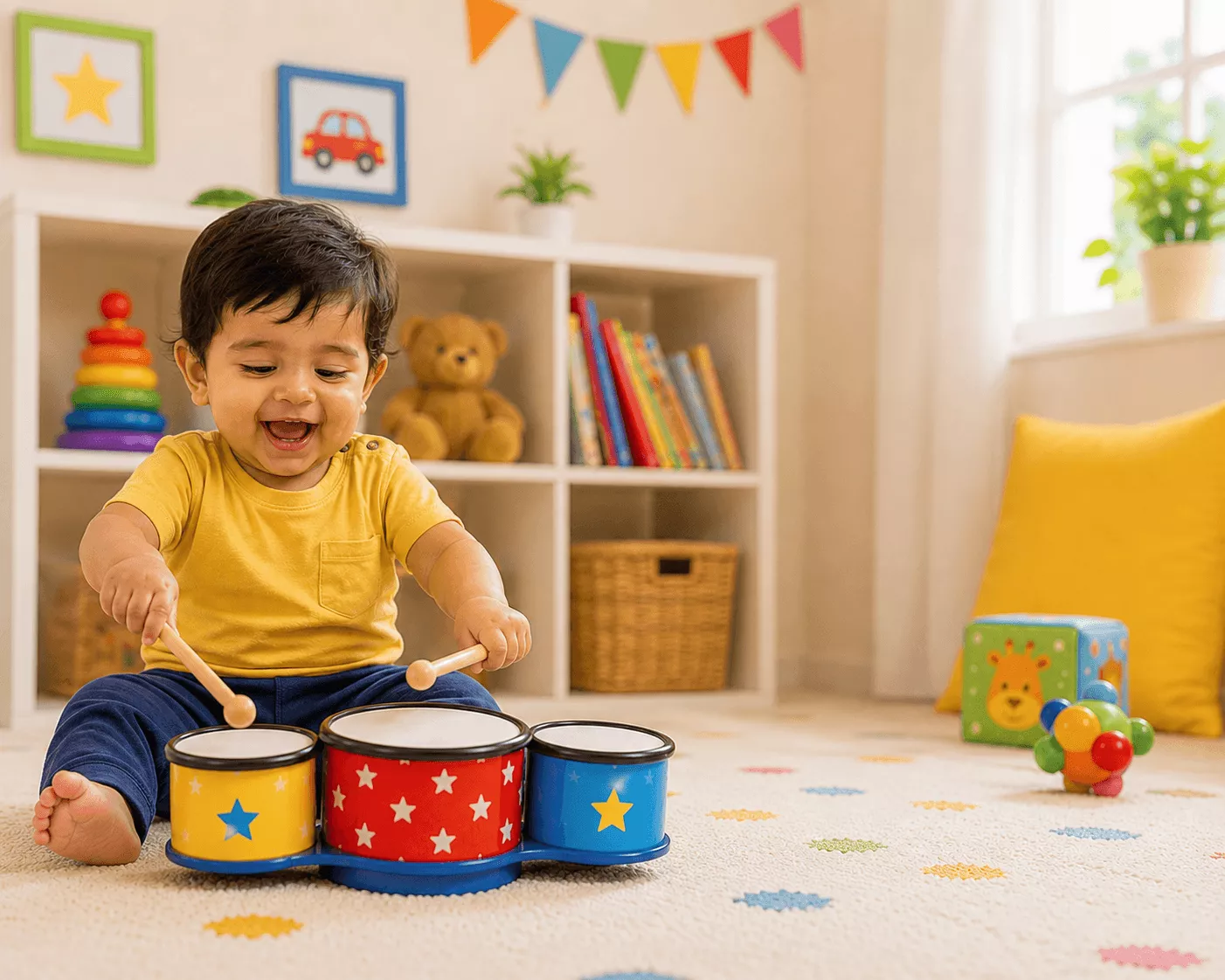
Basic instruments like a drum, shaker, or xylophone can be engaging, particularly for toddlers who enjoy sound and rhythm.
Books for 1- to 2-Year-Olds
Books are easy to overlook when thinking about toys, but they play a real role in everyday play at this age. Board books are the practical choice here—they hold up to a lot of handling, page-turning, and the occasional chew.
At this stage, toddlers usually respond well to books with simple, repetitive text. A story that repeats the same phrase or pattern gives a toddler something predictable to latch onto, and many toddlers enjoy “finishing” a familiar line once they’ve heard it enough times.
Picture books with clear, uncluttered illustrations tend to work better than busier ones. Pointing at pictures and naming what’s there — “dog,” “ball,” “red” — is often just as valuable as reading the actual text, especially with younger toddlers in this age range.
Reading together doesn’t need to follow a strict routine. A few minutes before nap time, before bed, or just when a toddler brings a book over and wants to sit down, is enough. What tends to matter more than frequency is that reading stays a relaxed, low-pressure part of the day rather than something forced.
Simple Play Ideas for 1 to 2 Year Olds
Not every activity needs a purchased toy behind it. Some of the most reliable play ideas at this age use things you probably already have at home.
-
Stacking safe household items, like soft-sided containers or large plastic cups
-
Sorting objects by color or size into different bowls or boxes
-
Building something simple and then knocking it down — a favorite at almost every stage of toddlerhood
-
Pretend play with everyday objects, like a wooden spoon and a bowl
-
Looking through picture books together and naming what's on the page
-
Simple movement games, like following a leader around the room or dancing to music
-
Filling and emptying a basket or bag with soft toys
Toy Safety for 1 to 2 Year Olds
Safety is one area where it’s worth being genuinely careful, especially since toddlers at this age still explore a lot with their mouths.
Check age labels.
Age recommendations on toy packaging usually reflect small-part testing, not just general suitability. A toy labeled for older children may contain pieces that are a choking risk for a toddler under 2 or 3.
Watch for small parts.
Anything that can fit inside a toilet paper tube is generally considered a choking hazard for this age group. This includes small accessories, detachable pieces, and anything with buttons, beads, or eyes that could come loose.
Inspect toys regularly.
Toys get chewed on, dropped, and generally worn down at this stage. It's worth periodically checking for cracked plastic, loose stitching on stuffed toys, or any parts that have come partly detached.
Be cautious with cords and strings.
Pull toys with long strings, or toys with ribbons and cords, should be used with supervision and stored appropriately when not in play.
Secure battery compartments.
Battery-operated toys should have compartments that require a screwdriver or similar tool to open. If a compartment feels loose, that toy is worth setting aside.
Keep an eye on recalls.
Toy recalls happen more often than most parents expect. It's worth doing an occasional check, particularly for toys that were secondhand or received as gifts without original packaging.
How to Know if a Toy Is Actually Useful
It’s easy to end up with toys that looked great in a photo but barely get touched at home. A few practical questions can help sort out what’s actually worth keeping around.
-
Does my child show real interest in it, or does it get picked up once and ignored?
-
Is it suitable for where they are right now, not just their age in months?
-
Can they interact with it on their own sometimes, and with me at other times?
-
Does it offer more than one way to play, or does it only do one thing?
-
Is it still in good, safe condition?
-
Will it realistically get used, given our space and daily routine?
Building a Simple Toy Collection
It’s a common assumption that more toys means more play value, but in practice, toddlers often do better with a smaller, rotating selection than an overflowing toy box.
A few practical approaches:
Rotate toys instead of keeping everything out.
Putting a portion of toys away and swapping them in every few weeks can make familiar toys feel new again, without needing to buy anything new.
Keep the everyday selection small.
A manageable number of toys, spread across a few different categories, tends to get more genuine use than a large collection that's hard to sort through.
Mix types of play.
A good spread might include something physical, something for pretend play, a puzzle or sorting toy, and a couple of books, rather than several similar toys in one category.
Prioritize durability and versatility.
Toys that can be used in more than one way, or that grow with a child's skills over a few months, tend to be worth the space they take up.
Pay attention to what actually gets used.
Over time, it becomes fairly obvious which toys are reached for regularly and which ones sit untouched. That observation is usually more useful than any recommendation list, including this one.
Conclusion
Choosing toys for 1 to 2 year olds doesn’t need to be complicated, even though it can feel that way with so many options available. At ZaminoToys, we focus on helping parents choose toys based on where their child actually is their current interests, their coordination, and what they seem drawn to rather than chasing whatever’s newest or most heavily marketed. A small, thoughtfully chosen set of toddler toys, mixed with regular reading and everyday play, usually covers far more ground than a full toy box ever could. If you keep paying attention to what your child reaches for and what gets set aside, you’ll likely find you already have a good sense of what works, long before any guide tells you.