What Is Newborn Vision? How Your Baby's Eyesight Develops Month by Month
At birth, newborn vision is blurry and limited to objects about 8–12 inches away-roughly the distance from a parent’s face during feeding. Babies see mostly in black, white, and grey, with high-contrast patterns catching their attention first. Over the following months, eyesight sharpens rapidly: colour perception builds around 2–3 months, depth perception emerges near 5 months, and by 12 months most babies see the world with near-adult clarity. Understanding this timeline helps you support your baby’s growing eyesight at every stage.
Every new parent asks the same question in the first sleepless week: can my baby actually see me? At zaminotoys.in, we spend a lot of time talking with Indian parents about early development, and newborn vision is one of the topics that comes up again and again — usually somewhere between the 2 a.m. feed and the first pediatrician visit. This guide breaks down exactly how a baby’s eyesight develops month by month, what’s normal, what’s worth a doctor’s attention, and simple ways to support healthy visual growth at home.

Newborn Babies Vision: Adjusting to Light and Beginning to Focus
A baby's eyes are physically complete at birth, but the neural pathways connecting the eyes to the brain are still immature. This is why newborn vision looks so different from adult sight.
In the first days, a baby's pupils are small and highly sensitive to bright light, which is why many newborns squint or turn away from windows and overhead lamps. This isn't discomfort alone-it's a protective reflex while the retina continues developing.
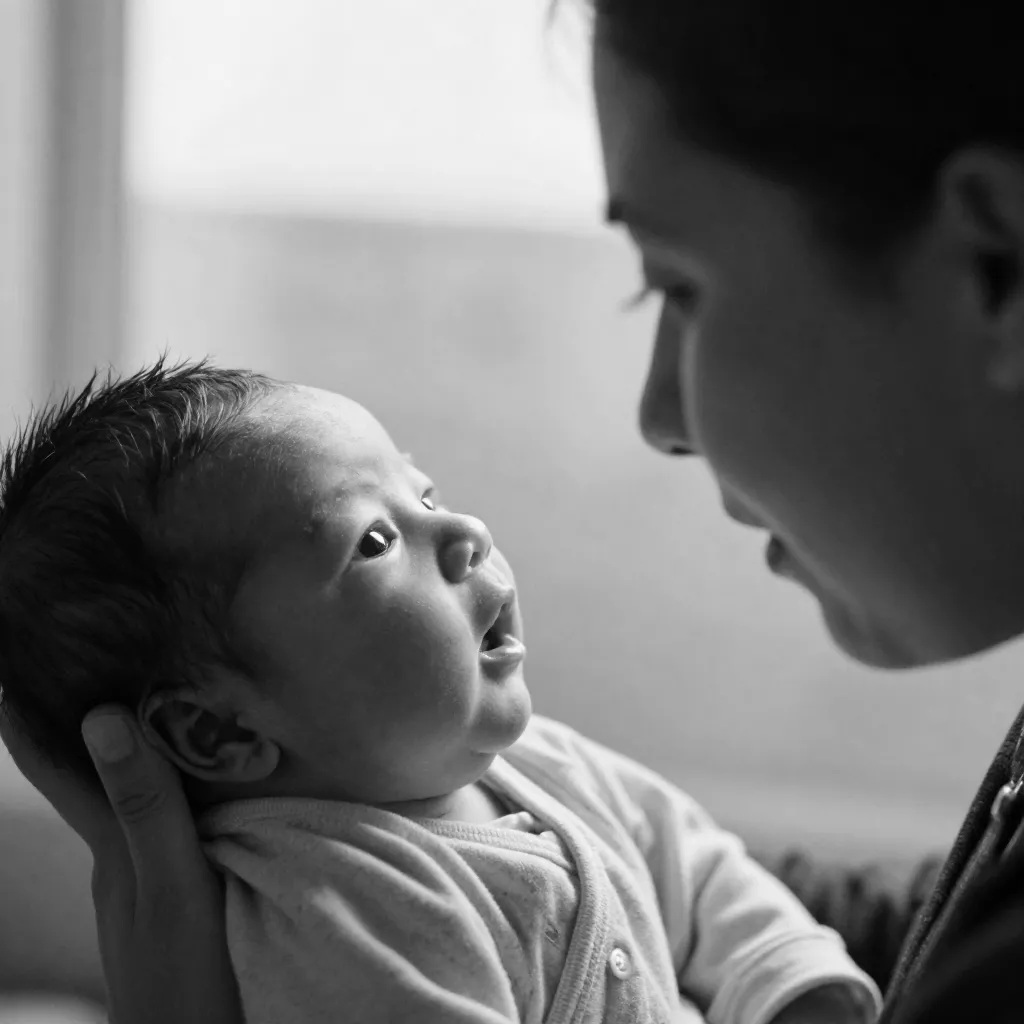
Eyesight at this stage is also short-range. Babies focus best on objects roughly 8 to 12 inches from their face - almost exactly the distance between a baby's eyes and a parent's face while nursing or bottle-feeding. Anything farther away appears hazy, and colour vision hasn't fully switched on yet, so newborn vision mostly picks up strong contrasts: black-and-white stripes, bold checks, and sharply outlined faces stand out far more than pastel toys or soft patterns.
Peripheral vision is more developed than central vision in the earliest weeks, which is why a newborn may seem to notice movement at the edge of a room before locking eyes on something directly in front of them.
As the retina matures over the first few weeks, the pupils widen, light sensitivity eases slightly, and the baby's eyesight begins picking up light-dark patterns and basic shapes more reliably.
👶 Vision Development Timeline
Newborn vision doesn't follow a single fixed schedule-every baby is a little different-but there is a broadly predictable path most infants follow:
👁️ Birth to 4 Weeks
Eyesight is blurry beyond arm's length, with a strong preference for faces and high-contrast patterns. Eye movements can look uncoordinated, and occasional crossing is normal.
😊 6 to 8 Weeks
Babies begin to track slow-moving objects with their eyes and hold eye contact for longer stretches. Social smiling often appears around this point, closely tied to improving eyesight.
🌈 2 to 3 Months
Colour vision starts developing, beginning with reds and other bold, saturated tones before expanding to a fuller palette.
🧸 4 to 5 Months
Depth perception starts to emerge, helping babies judge distance and reach for objects with more accuracy. Many babies can now recognise a parent's face from across a room.
👀 6 Months
Eye coordination improves significantly, and both eyes typically work together consistently. This is also the age pediatric eye specialists often recommend a first formal eye check for newborn vision progress.
🚼 7 to 9 Months
Crawling begins for many babies, and the coordination between what they see and how they move strengthens hand-eye-body awareness.
🎯 9 to 12 Months
By this stage, eyesight has matured well beyond its starting point-babies can judge distances fairly well, follow fast-moving objects, and recognise familiar pictures or toys.
Every stage of this timeline builds on the one before it, which is why consistent visual stimulation in the early months matters so much for long-term development.
For more information about infant vision and eye health, visit the American Optometric Association (AOA) .
👶 How to Support Visual Development
Parents can't speed up biology, but the right environment gives newborn vision plenty to practise on:
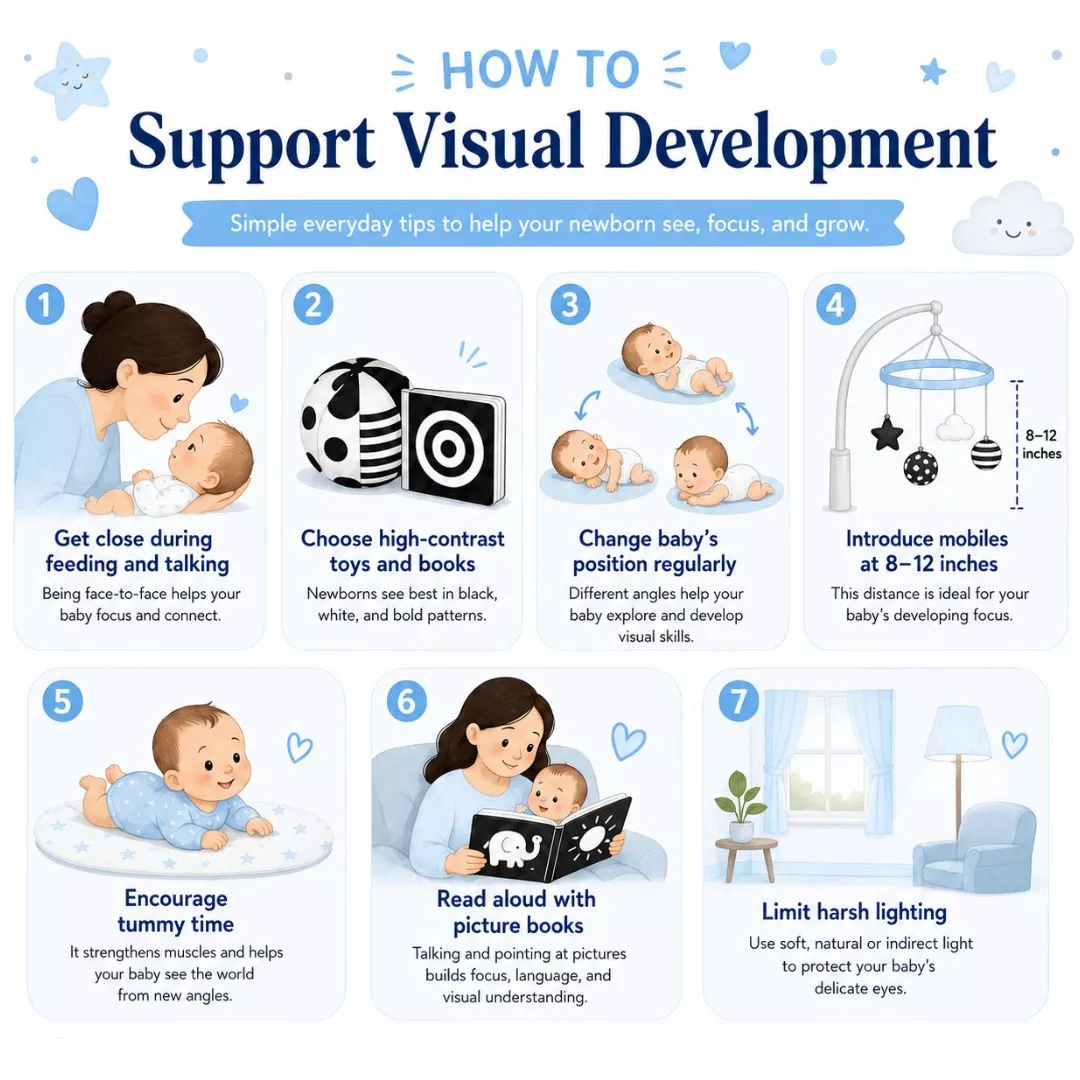
Small daily interactions like talking, smiling, reading and playing help your baby's eyes and brain develop together.
Get close during feeding and talking. Since a baby's eyesight is sharpest at close range in the early weeks, feeding time and face-to-face chatting are ideal moments for eye contact and bonding.
Choose high-contrast toys and books early on. Black-and-white or bold primary-colour patterns are easier for a young baby to focus on than soft pastels.
Change your baby's position and room regularly. Alternating which side your baby faces during naps and feeds encourages balanced eye muscle use and prevents a fixed gaze preference.
Introduce mobiles and toys at the right distance. Placing objects around 8–12 inches away in the early weeks, and gradually farther as reaching skills develop, matches how newborn vision naturally focuses.
Encourage tummy time. This strengthens neck and shoulder muscles, giving babies more control over where they direct their gaze.
Read aloud with picture books. By 3–4 months, simple illustrated books support both visual tracking and early language exposure.
Limit harsh, direct lighting. Soft, indirect light is more comfortable for developing eyes than bright bulbs or direct sunlight.
Many parents we've spoken with say a simple black-and-white toy or a soft-contrast play gym made a visible difference in how quickly their baby started tracking objects - a small, low-cost change with a real everyday impact on healthy eyesight.
🌸 Every cuddle, smile, story, and playtime is more than just bonding—it gives your newborn valuable opportunities to strengthen visual skills while exploring the world with confidence.

Real Parent Experience
One mother from Kerala shared with us that her son barely reacted to colourful toys in his first month, which worried her at first. After switching to a high-contrast black-and-white book during daily tummy time, she noticed him holding his gaze and following the pictures within about two weeks-right around the point pediatricians say tracking skills typically improve. Her pediatrician reassured her this was completely normal newborn vision progress, not a delay, and that consistency mattered more than the type of toy. Stories like this are common: small, steady visual stimulation, paired with patience, tends to matter far more than expensive gadgets.
👶 When to Talk to a Pediatrician
Most newborn vision changes are part of healthy development. However, a few warning signs should never be ignored. Early consultation with a pediatrician helps identify vision problems before they affect your baby's growth and learning.
Eyes remain constantly turned inward or outward after 4–6 months. Occasional crossing before this age is usually normal.
Your baby does not make eye contact or follow faces by 2–3 months.
Persistent excessive tearing that may indicate blocked tear ducts.
One or both pupils appear white or cloudy in photographs.
Extreme sensitivity to bright light beyond the newborn stage.
The eyes do not move together normally by around 6 months.
A family history of childhood eye diseases or inherited vision disorders.
🌸 Early Eye Care Makes a Big Difference
Pediatric eye specialists recommend a comprehensive eye examination around 6 months of age, even if your baby appears to see normally. Routine eye checks can identify hidden vision problems before symptoms become noticeable.
If your baby's eyesight seems unusual, your pediatrician can recommend a pediatric ophthalmologist. Conditions such as strabismus (eye misalignment) and congenital cataracts respond much better when diagnosed early.
The Bigger Picture on Infants and Vision
Understanding infants and vision as a connected system – eyes, brain, and body developing together – helps explain why milestones like reaching, crawling, and even babbling often show up around the same time as visual leaps. Research in this area consistently shows that visual development isn’t isolated; it’s tightly linked to motor skills, social bonding, and cognitive growth. This is part of why pediatricians treat vision checks as a routine part of general infant wellness visits, not a separate specialty concern. When parents pay attention to infants and vision alongside other milestones, they’re better equipped to spot both healthy progress and early red flags.
📘 External Reference : https://www.aao.org/eye-health/tips-prevention/baby-vision-development-first-year
Conclusion
Your babys eyesight gets little by little during the first year. Every new thing they can see is a part of how they grow. You can help your baby see well by looking at them a lot playing with them safely putting them on their tummy and giving them things to look at that are right for their age. This is a way to help your babys vision. At Zamino Toys we want to give parents information so they can make good choices. If you think something is wrong, with your babys vision or the way they move their eyes you should talk to your doctor. They can give you the advice and help you early on. Your babys vision is important and Zamino Toys wants to help you take care of it.
FAQ
When does newborn vision start to clear up?
Newborn vision begins improving within the first few weeks as the retina matures. Most parents notice sharper focus and better tracking as part of normal newborn vision progress by 6 to 8 weeks of age.
Can a newborn see colour?
Newborn vision is mostly limited to black, white, and grey at birth. Colour perception is one of the later stages of newborn vision to develop, usually starting around 2 to 3 months with bold shades like red.
What distance can a newborn baby focus on?
Newborn vision is sharpest at close range-typically 8 to 12 inches away, which is roughly the distance between a baby’s face and a parent’s face during feeding.
When should a baby have their first eye exam?
Even without visible symptoms, pediatric eye specialists recommend a first comprehensive check-up around 6 months of age to make sure newborn vision is developing on track.
What toys help support healthy newborn vision development?
High-contrast black-and-white toys and books work especially well in the early months, since newborn vision responds far more strongly to bold contrast than to soft pastel colours.
Is blurry eyesight normal for a newborn?
Yes. Blurry, short-range sight is a normal part of newborn vision in the first few weeks and gradually sharpens as the eyes and brain finish developing over the following months.
🔗 Related Reads:
- How to Caring for a Newborn ? Baby Care Tips for Every Parent
- baby care Guide for New Parents | Newborn Care & Baby Development
- Baby Bath Essentials: Safe Bath Time Made Easy
📌 Bookmark this blog and share it with new parents who are walking the same beautiful journey of play and parenting.
📘 External Reference: Vision Development in Childhood
Written by Rashida Karuvattil
Rashida Karuvattil is a Digital Marketer at ZaminoToys with 2 years and 9 months of clinical experience as a Nursing Assistant in the Gynecology and Pediatrics department. She also earned a Diploma in Digital Marketing from Skillz Hub, Kottakkal.
Drawing on her healthcare experience and digital marketing expertise, Rashida researches and creates evidence-based content on pregnancy, baby care, parenting, and child development, helping parents access accurate, reliable, and practical information.