
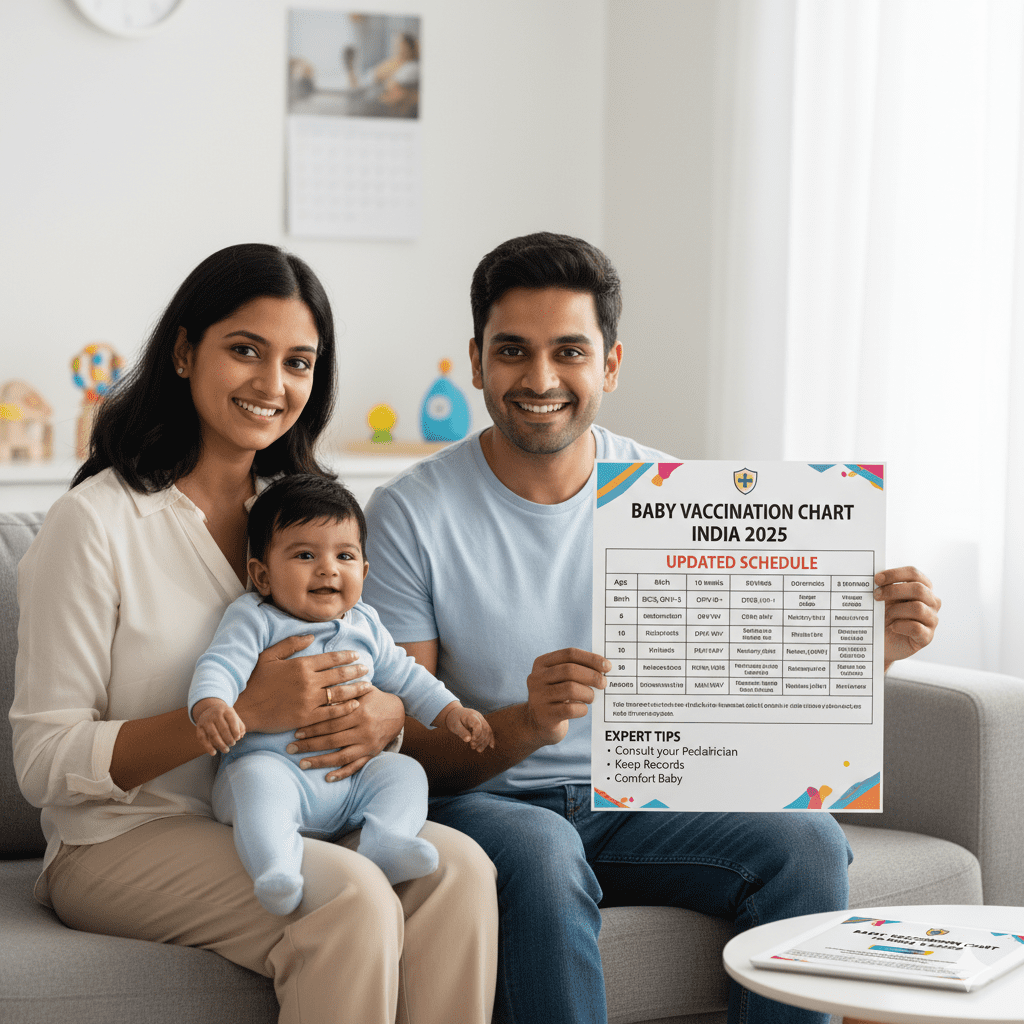
🌟 Introduction: A Parent’s Biggest Shield
Every parent wants one thing above all — to see their child grow healthy, strong, and happy. From the very first cry in the hospital to those tiny steps at home, we worry about everything: a little fever, a sneeze, or even a skipped nap. And in today’s world, with so many illnesses around us, one of the strongest protections we can give our babies is vaccination.
Vaccines are like invisible shields. They don’t just protect your baby from dangerous diseases but also keep the entire community safe. In India, where millions of children are born every year, vaccines play a huge role in preventing outbreaks of illnesses like polio, measles, diphtheria, and whooping cough.
But as a parent, you may ask:
- “When should my baby get each vaccine?”
- “Which ones are free under the government schedule?”
- “Are optional vaccines really necessary?”
- “What if my baby misses a dose?”
That’s where the baby vaccination chart comes in. It is a simple, step-by-step guide to help parents track all essential and optional vaccines from birth up to adolescence.
👉 In this blog, we’ll cover the latest baby vaccination chart in India (2025 update) as recommended by the Government of India (UIP – Universal Immunization Programme) and also the additional optional vaccines advised by the Indian Academy of Pediatrics (IAP).
We’ll also answer common parent doubts, explain catch-up plans, talk about mild side effects, and give expert tips to make vaccination stress-free for both you and your baby.
“The baby vaccination chart in India 2025, as per the National Immunization Schedule, includes BCG, OPV, Hepatitis B at birth, followed by DPT, Hib, Polio, Rotavirus, and Pneumococcal vaccines at 6, 10, and 14 weeks, with MR vaccine at 9 months and boosters at 16–24 months. Optional vaccines include Influenza, Varicella, Hepatitis A, HPV, and Meningococcal.”
Now let’s start from the basics.
WHO — Recommendations for Routine Immunization (Summary Tables)
Global standard guidance for vaccination schedules and booster doses, useful to compare and validate your chart.
🧾What is a Baby Vaccination Chart?
A baby vaccination chart is the official schedule recommended by health authorities in India. It lists which vaccines your child should receive at specific ages, starting from birth until adolescence, to protect against serious childhood diseases.
Parent-Friendly Explanation
Think of the vaccination chart like a school timetable, but instead of maths or science, each “subject” is a vaccine dose your baby must get on time. The chart ensures:
- No vaccine is skipped.
- Every disease is covered at the right age.
- Boosters are given on schedule for long-term protection.
In India, we follow mainly two vaccination charts:
- Government schedule (UIP/NIS – National Immunization Schedule) → free vaccines provided at government health centres.
- IAP schedule (Indian Academy of Pediatrics) → includes some extra vaccines available in private hospitals/clinics for added protection.
Both are reliable, but parents often choose a combination depending on their baby’s needs, health conditions, and financial situation.
Why Do We Need a Chart at All?
- Babies can’t tell us what they need, so the chart acts as a reminder.
- Vaccines work best at certain ages when the baby’s immune system is ready.
- Missing or delaying a vaccine can increase risk of infections.
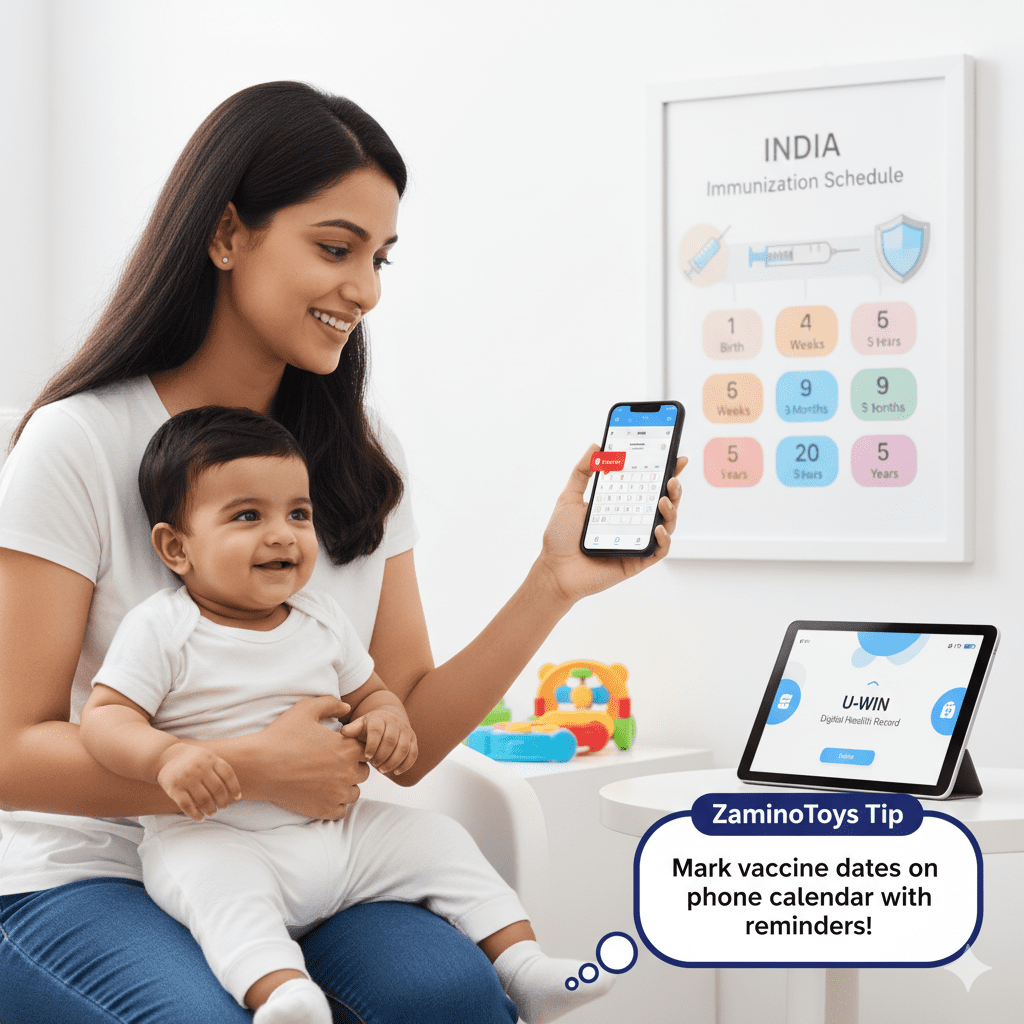
👉 That’s why paediatricians always recommend keeping a vaccination card or U-WIN digital record handy. It’s your baby’s health passport!
ZaminoToys Tip for Parents ❤️
Always mark vaccine dates on your phone calendar with reminders. Many parents forget booster shots after the first year, but those are equally important for long-term protection.
🛡️ Why Vaccinations Are Important for Babies
Vaccines are important because they protect babies from life-threatening diseases, build long-lasting immunity, prevent epidemics, and save families from high medical costs.
1. Protecting Against Deadly Diseases
Diseases like polio, tuberculosis, diphtheria, whooping cough, measles, and meningitis used to cause thousands of child deaths every year. Thanks to vaccines, India is now polio-free and cases of measles and diphtheria are very rare.
When your baby gets vaccinated, their tiny body learns to fight these germs safely, without falling sick first.
2. Building Herd Immunity
Herd immunity means when most children in a community are vaccinated, diseases have no chance to spread. Even babies who are too young or kids with weak immunity are protected.
As a parent, by vaccinating your baby, you’re also protecting your neighbour’s baby, your niece, and the whole community.
3. Saving Lives and Reducing Hospital Costs
A simple vaccine costing ₹0 (free in govt centres) can save you lakhs of rupees in hospital bills. For example:
- Treating pneumonia can cost ₹25,000–₹50,000 in a private hospital.
- But the PCV vaccine (pneumococcal) prevents most cases of childhood pneumonia.
So vaccines are not just health savers, they’re money savers too.
4. Long-Term Benefits for Your Baby
Vaccines don’t just prevent immediate illness; they also stop complications later in life. For example:
- Hepatitis B vaccine → protects against chronic liver disease.
- HPV vaccine (for teens) → protects against cervical cancer later.
So you’re not just protecting your baby for today, but for the future as well.
5. Busting the “Fever Fear” Myth
“There are many parents who are concerned that their child would develop a fever following vaccination”.
Yes, mild fever or swelling is common. It’s a sign that the body is building immunity. This is temporary and safe compared to the disease itself.
👉 Imagine this: a little fever for a day is nothing compared to a lifetime of suffering from polio.
When you hold your baby after a vaccination, it’s natural to feel guilty seeing them cry. But remember — in that small moment of tears, you’re gifting them a lifetime of protection.
Expert Note
According to UNICEF and WHO, vaccines prevent 4–5 million deaths every year worldwide. In India, government vaccination drives have reduced child mortality rates significantly in the last two decades.
ZaminoToys Parent Tip ✨
- Always breastfeed before and after vaccination — it comforts the baby and reduces crying.
- Carry a favourite toy or blanket to the hospital — it distracts them during the shot.
📅Latest Baby Vaccination Chart in India (2025 Update)
Vaccination schedules can sometimes feel confusing for new parents. Don’t worry — here’s the complete, updated baby vaccination chart for India (2025) that you can follow with confidence.
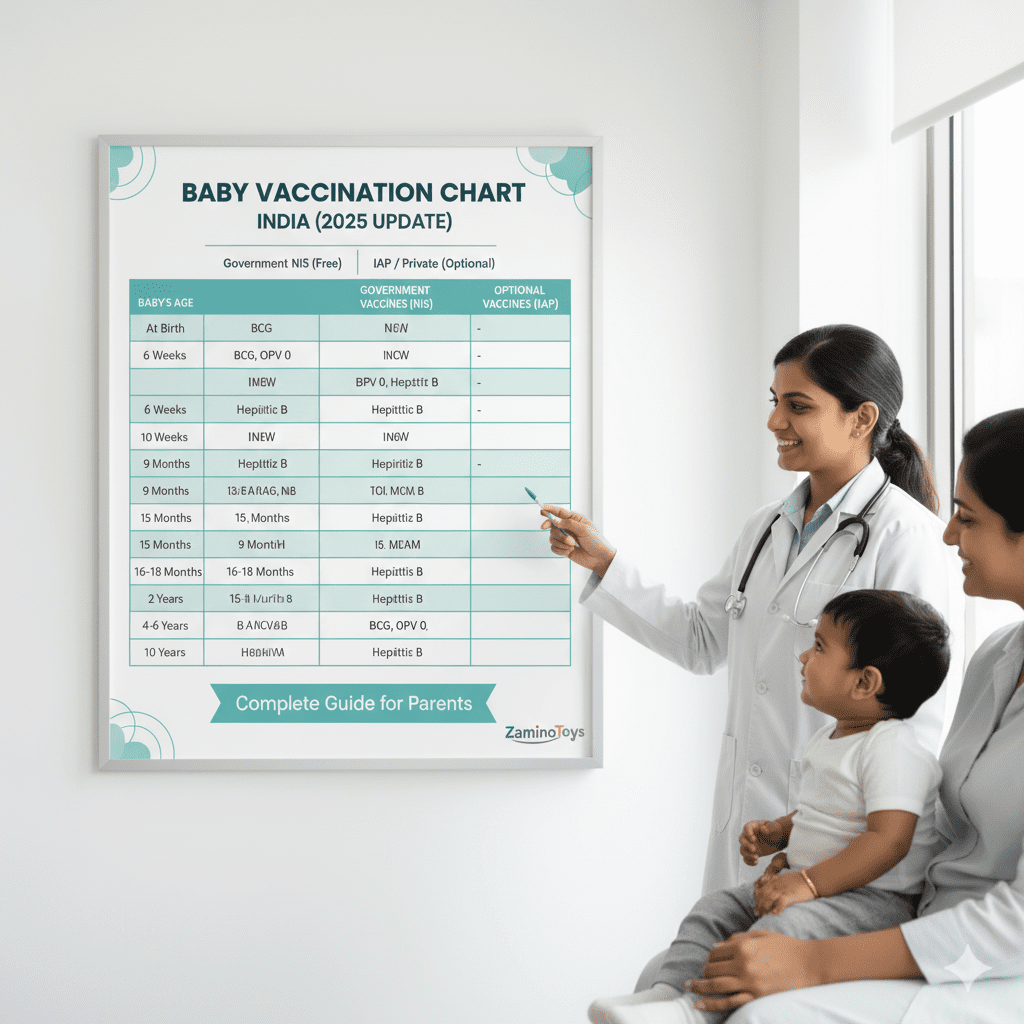
👉 This chart is based on:
- National Immunization Schedule (NIS/UIP) → free vaccines from the Government of India.
- Indian Academy of Pediatrics (IAP) 2025 updates → optional but strongly recommended vaccines from private hospitals.
🍼 Baby Vaccination Chart at a Glance
Baby Vaccination Schedule (India 2025)
| Baby’s Age | Vaccines (Government NIS) | Optional (IAP / Private) |
| At Birth (within 24 hrs) | BCG (Tuberculosis), OPV 0 (Oral Polio – zero dose), Hepatitis B (birth dose) | – |
| 6 Weeks | Pentavalent-1 (DPT + HepB + Hib), OPV-1, IPV-1 (Injectable Polio), Rotavirus-1, PCV-1 (Pneumococcal) | – |
| 10 Weeks | Pentavalent-2, OPV-2, IPV-2, Rotavirus-2, PCV-2 | – |
| 14 Weeks | Pentavalent-3, OPV-3, IPV-3, Rotavirus-3, PCV-3 | |
| 6 Months | Hepatitis B (dose 3 if required) | Influenza (first dose, then yearly) |
| 9 Months | MR-1 (Measles + Rubella), JE (where applicable) | Varicella (Chickenpox-1), Hepatitis A (HepA-1) |
| 12 Months | – | MMR-2, Varicella-2 |
| 15 Months | DPT/DTaP Booster-1, Hib booster, PCV booster | – |
| 16–18 Months | MR-2 (booster), OPV booster | Hepatitis A-2 |
| 2 Years | – | Typhoid Conjugate Vaccine |
| 4–6 Years | DPT/DTaP Booster-2, OPV booster | Varicella booster if missed |
| 10 Years | Td/Tdap booster | HPV vaccine (for girls 9–14 yrs) |
💡
“ The baby vaccination chart in India 2025 includes BCG, OPV, Hepatitis B at birth; Pentavalent, Polio, Rotavirus, PCV at 6, 10, 14 weeks; MR at 9 months; DPT, Hib, PCV boosters at 15–18 months; and boosters at 4–6 years.”
👶 Explanation by Age Group
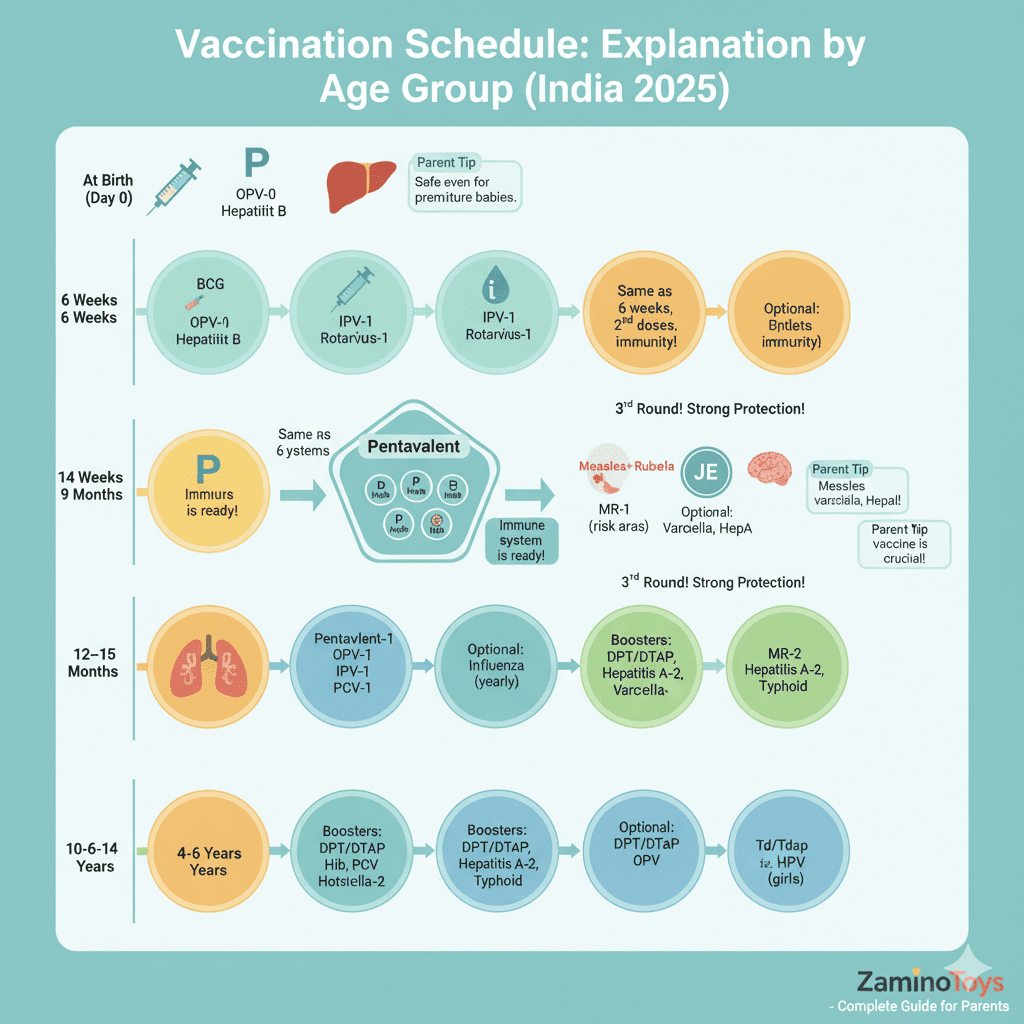
✅ At Birth (Day 0 – within 24 hours)
- BCG → protects against severe forms of tuberculosis.
- OPV-0 (Oral Polio, zero dose) → first shield against polio.
- Hepatitis B birth dose → prevents hepatitis B infection, which can cause lifelong liver disease.
🍼 Parent Tip: Even if your baby is premature, these vaccines are safe and recommended at birth.
✅ 6 Weeks (1½ months)
- Pentavalent-1 → one shot that covers 5 diseases (Diphtheria, Pertussis, Tetanus, Hepatitis B, Hib).
- OPV-1 → polio protection.
- IPV-1 → stronger injectable polio dose.
- Rotavirus-1 → protects against diarrhoea that can cause dehydration.
- PCV-1 → prevents pneumonia, meningitis, and ear infections.
💡 Why this timing? At 6 weeks, your baby’s immune system is ready to handle these vaccines safely.
✅ 10 Weeks (2½ months)
- Same set as 6 weeks, second doses.
- This strengthens the immune system response.
👉 Think of it like teaching your child a lesson twice so they remember better.
✅ 14 Weeks (3½ months)
- Third round of Pentavalent, Polio, Rotavirus, and PCV.
- By now, your baby has strong protection against 10+ diseases!
✅ 6 Months
- Some babies may receive an additional Hep B dose here.
- Optional: Influenza vaccine → prevents seasonal flu. Needs yearly repetition.
✅ 9 Months
- MR-1 (Measles + Rubella) → protects against measles outbreaks.
- JE (Japanese Encephalitis) → given in high-risk districts in India.
- Optional: Varicella (Chickenpox-1), Hepatitis A (HepA-1)
🍼 Parent Tip: The measles vaccine is crucial — measles can cause pneumonia, brain damage, and even death in children.
✅ 12–15 Months
- DPT/DTaP booster, Hib booster, PCV booster
- Optional: MMR-2, Varicella-2
- These boosters refresh immunity for long-term protection.
✅ 16–24 Months
- MR-2 booster
- OPV booster
- Optional: Hepatitis A second dose
- Optional: Typhoid Conjugate Vaccine at 2 years
✅ 4–6 Years
- DPT/DTaP booster
- OPV booster
- Optional Varicella booster if missed earlier.
✅ 10–14 Years
- Td/Tdap booster
- Optional: HPV vaccine (for girls) – prevents cervical cancer.
Ministry of Health & Family Welfare — National Immunization Schedule (NIS), India
The official government schedule PDF and detailed guidelines for infant, child, and maternal immunization in India.
🧾 Government UIP vs Optional (IAP) Vaccines
Government UIP (Free at Govt Centers)
- Covers BCG, OPV, Hep B, Pentavalent, Rotavirus, MR, DPT, JE (in endemic states).
- Available free at PHCs, Anganwadis, and through immunization drives.
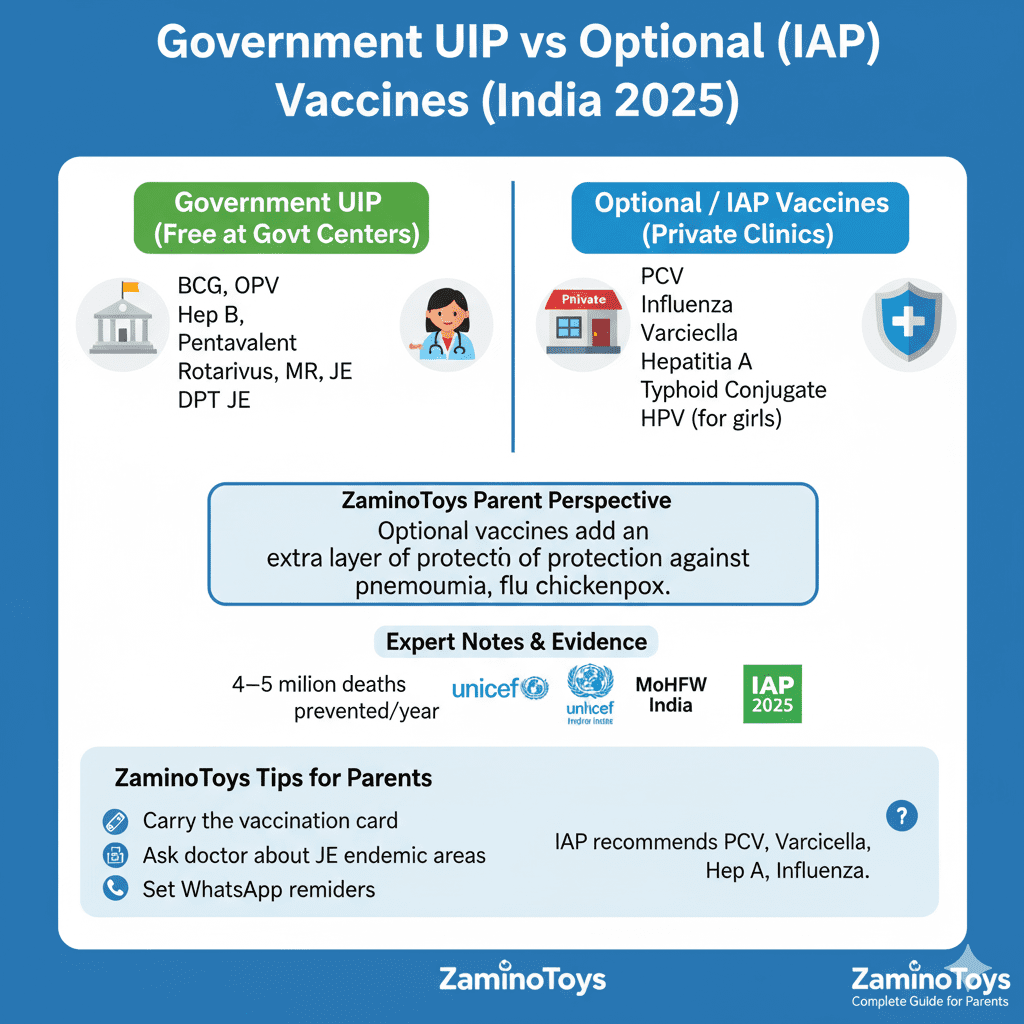
Optional / IAP Vaccines (Private Clinics)
- PCV (Pneumococcal)
- Influenza (Flu shot)
- Varicella (Chickenpox)
- Hepatitis A
- Typhoid Conjugate
- HPV (for girls)
👉 ZaminoToys Parent Perspective: While government vaccines are life-saving, optional vaccines add an extra layer of protection, especially against pneumonia, flu, and chickenpox — common in Indian children.
👩⚕️ Expert Notes & Evidence
- WHO + UNICEF → Vaccines prevent 4–5 million child deaths every year.
- MoHFW India (UIP) → Provides free vaccines covering 12+ deadly diseases.
- IAP (2025) → Strongly recommends PCV, Varicella, Hep A, Influenza in addition to UIP.
💡 ZaminoToys Tips for Parents
- Always carry the vaccination card. Without it, tracking is difficult.
- Ask your doctor whether your area is JE (Japanese Encephalitis) endemic.
- For working parents, set WhatsApp reminders before due dates.
🧾 Catch-Up Vaccination Schedule (If Doses Are Missed)
👉 If your baby misses a vaccine dose, you don’t need to restart the series. Instead, the missed dose should be given as soon as possible and the schedule continued from there.
✅ Parent-Friendly Explanation:
Life happens. Sometimes, babies fall sick, parents get busy, or clinics are closed. Missing a vaccine appointment is common and normal—but the good news is, you don’t need to panic.
- Doctors follow a catch-up schedule where your child continues from the last missed vaccine.
- No need to repeat earlier doses.
- Some vaccines have upper age limits (like Rotavirus – must be started before 15 weeks, completed by 8 months).
📊 Catch-Up Vaccination Quick Guide
| Scenario | What Parents Should Do |
| Missed 6-week vaccines | Get them as soon as possible, then continue with 10-week schedule. |
| Missed booster doses | Give the booster when you visit next, don’t restart. |
| Started late (e.g., 5-month-old, not vaccinated) | Doctor will design a catch-up plan with necessary vaccines only. |
| Rotavirus missed after 8 months | Cannot be given. Doctor will continue with other vaccines. |
💡 Tip: Always bring your child’s vaccine card when visiting the doctor—it helps them adjust the schedule quickly.
💉 Common Concerns & Side Effects
👉 Most baby vaccines only cause mild side effects like fever, swelling, or fussiness. Severe reactions are extremely rare.
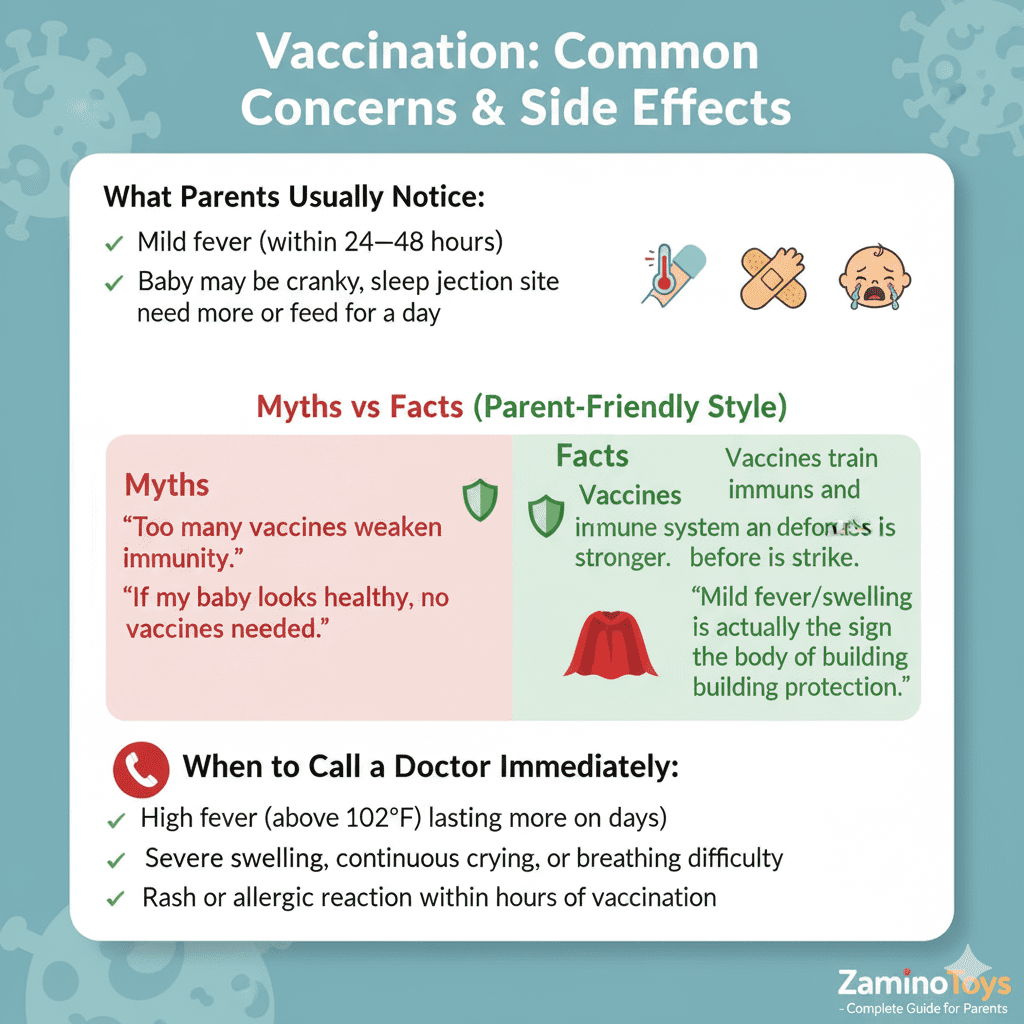
✅ What Parents Usually Notice:
- Mild fever (within 24–48 hours)
- Swelling or redness at injection site
- Baby may be cranky, sleep more, or feed less for a day
🔍 Myths vs Facts (Parent-Friendly Style)
- ❌ “Too many vaccines weaken immunity.”
✅ Fact: Vaccines train the immune system and make it stronger. - ❌ “If my baby looks healthy, no vaccines needed.”
✅ Fact: Vaccines prevent diseases before they strike. - ❌ “Side effects mean the vaccine is harmful.”
✅ Fact: Mild fever/swelling is actually a sign that the body is building protection.
💡 When to Call a Doctor Immediately:
- High fever (above 102°F) lasting more than 2 days
- Severe swelling, continuous crying, or breathing difficulty
- Rash or allergic reaction within hours of vaccination
🏥 Where to Get Baby Vaccinations in India
👉 Baby vaccinations in India are available free under the Government’s Universal Immunization Programme (UIP) at health centres, and also at private hospitals/clinics with optional vaccines.
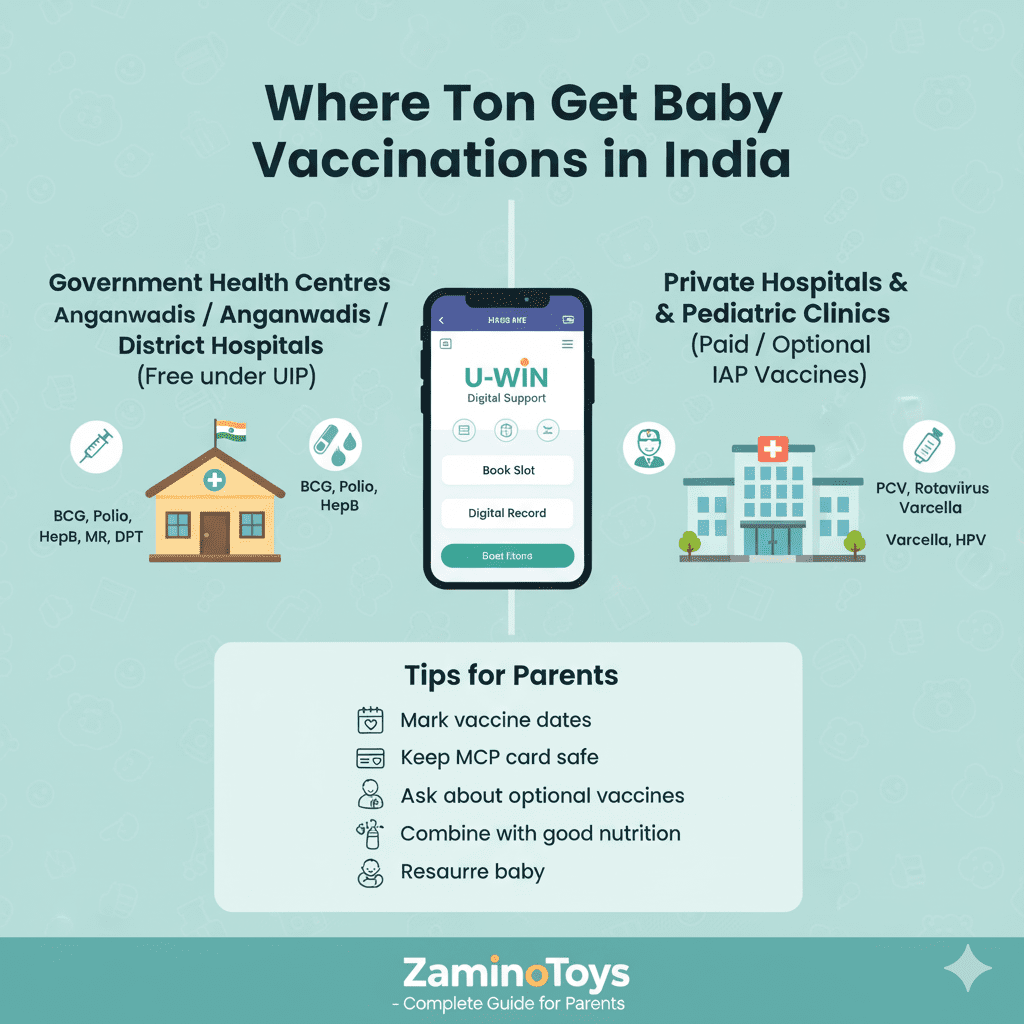
✅ Options for Parents:
- Government Health Centres / Anganwadis / District Hospitals
- Free vaccines under UIP
- Covers major vaccines: BCG, Polio, HepB, MR, DPT, JE (in some states)
- Private Hospitals & Pediatric Clinics
- Paid vaccinations, including optional IAP vaccines (like PCV, Rotavirus, Varicella, HPV)
- Convenient timings, SMS reminders, cold-chain assurance
- Digital Support: U-WIN
- The government’s digital vaccine tracking system
- Helps book slots, store vaccine records digitally
💡 Tip for Parents: Even if you choose private vaccination, keep your Mother-Child Protection (MCP) card updated.
👨👩👧 Expert Tips for Parents
Here’s a mix of practical + emotional advice:
- 📅 Mark vaccine dates on your calendar – treat them like birthdays!
- 📖 Keep your baby’s vaccination card safe – it’s proof for schools, travel, and emergencies.
- ❓ Always ask your doctor about optional vaccines – like PCV, Rotavirus, HPV.
- 🌸 Don’t skip because of minor fever/cold – doctors usually advise continuing.
- 🍼 Combine vaccines with good nutrition – breastmilk, vitamin D, and safe feeding make vaccines more effective.
- 💖 Reassure your baby – cuddle, breastfeed, or distract them with toys after the shot.
❓FAQs
Q1. What is the first vaccine given to newborns in India?
👉 At birth, babies receive BCG (TB), OPV-0 (polio), and Hepatitis B.
Q2. Is PCV vaccine mandatory in India?
👉 PCV (Pneumococcal) is part of the government schedule in some states. In others, it is optional and given in private hospitals.
Q3. Can vaccines be delayed if my baby is sick?
👉 Mild fever, cold, or cough = vaccination can continue. Only high fever or serious illness may require postponement.
Q4. Are vaccines safe for premature babies?
👉 Yes, vaccines are safe and especially important for preemies as they are more vulnerable.
Q5. Where can I download the official vaccination chart?
👉 You can download it from the Ministry of Health & Family Welfare (MoHFW India) website or ask your pediatrician for the IAP chart.
Read our:-
10 Best Age-Wise Toys for Every Stage: A Joyful Guide to Your Child’s Growth (2025)
🌟 Conclusion
Vaccines are one of the greatest gifts you can give your child—a gift of health, safety, and a brighter future.
As parents, it’s natural to feel nervous about injections, side effects, or costs. But remember:
- Government provides most vaccines free under UIP
- Optional vaccines add extra protection
- Missing a dose isn’t the end—you can always catch up
💖 So, keep your baby’s vaccine card handy, trust your pediatrician, and stay consistent.
👉 Bookmark this vaccination chart, share it with fellow parents, and double-check your baby’s vaccine card today. Because healthy kids = happy families.
Pingback: Indian Academy of Pediatrics: A Guide for Parents in India