Play based learning activities are one of the most effective and natural ways for young children to learn, grow, and understand the world around them. In Indian homes and classrooms, children learn best when learning feels joyful, meaningful, and connected to everyday life. Instead of pressure-filled methods, play based learning activities allow children to explore concepts through hands-on experiences, imagination, and interaction. Parents today are increasingly looking for balanced learning approaches that support academic readiness while protecting childhood curiosity. When used thoughtfully, play based learning activities help children build strong foundations for lifelong learning without stress or fear.
What Are Play Based Learning Activities?
Play based learning activities are structured or semi-structured experiences where children learn through play rather than direct instruction. In these activities, play is not a break from learning; it is the learning itself. Through play based learning activities, children experiment, ask questions, solve problems, and express creativity. Whether a child is stacking blocks, role-playing a shopkeeper, or solving a puzzle, the process encourages thinking and understanding. In Indian early education settings, play based learning activities are often blended with cultural practices, stories, and daily routines, making learning relatable and meaningful.
Why Play Based Learning Activities Matter in Early Childhood
Early childhood is a critical period for brain development, and play based learning activities support this growth naturally. Children between birth and eight years develop cognitive, emotional, social, and physical skills rapidly. Play based learning activities give children opportunities to practice these skills in a safe environment. In India, where academic pressure can start early, play based learning activities help maintain a healthy balance between learning and emotional well-being. They encourage curiosity, independence, and resilience, which are essential qualities for success in school and life.
Benefits of Play Based Learning Activities for Children
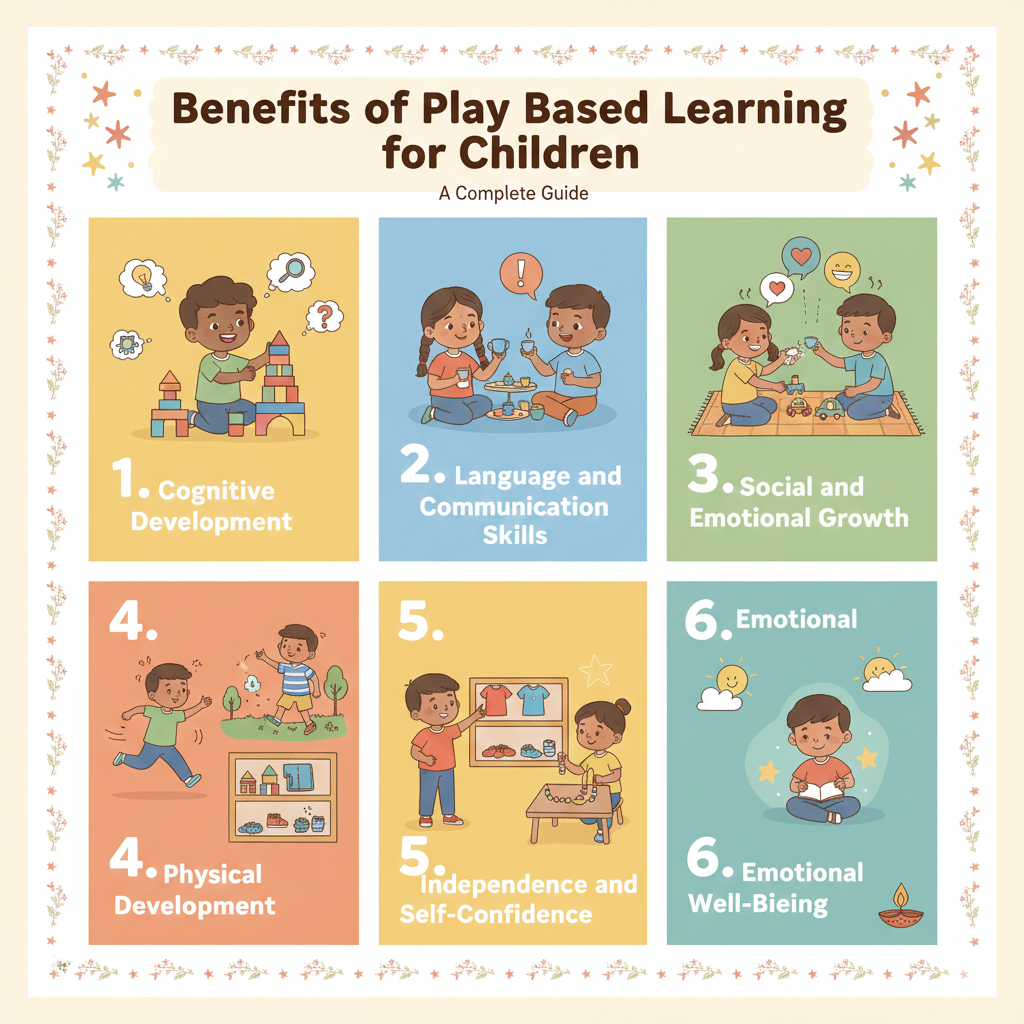
Benefits of Play-Based Learning for Children
Play-centered learning offers deep and long-lasting benefits for a child’s overall development. Unlike rigid teaching methods, this approach allows children to learn at their own pace while enjoying the process. When learning feels enjoyable, children remain curious and motivated, which is essential during early childhood.
1. Cognitive Development
One of the strongest advantages of learning through play is cognitive growth. During meaningful play experiences, children naturally use thinking skills such as:
-
Observing and exploring
-
Comparing and sorting
-
Remembering information
-
Solving simple problems
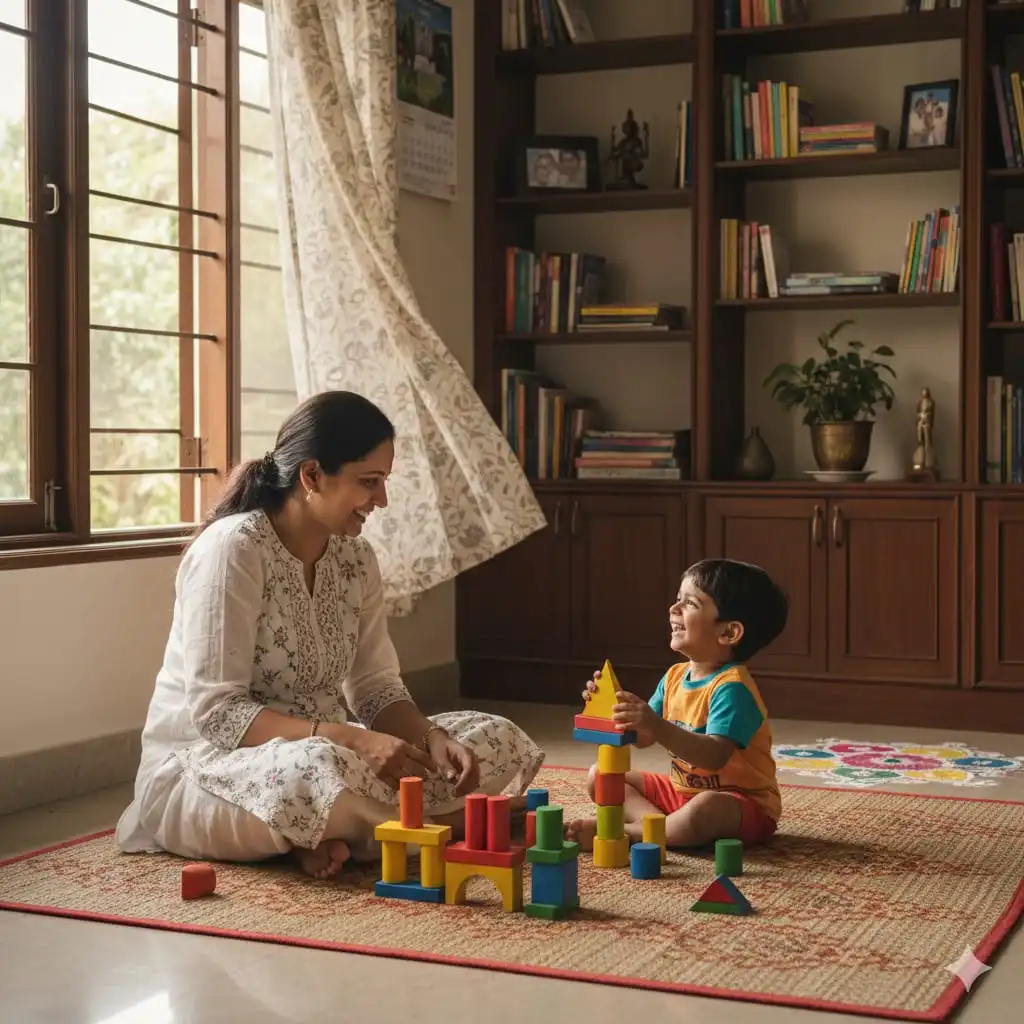
For example, when a child builds a tower using blocks, they understand balance, size, and cause-and-effect. These concepts stay longer in memory because they are learned through hands-on experience rather than memorization.
2. Language and Communication Skills
Language development improves naturally when children engage in playful interactions. While playing, children:
-
Talk to parents, siblings, or friends
-
Describe actions and ideas
-
Ask questions and express emotions
Pretend play such as playing house, shop, or school helps children learn new words and sentence structures in a natural way. In many Indian homes, exposure to more than one language during play further strengthens communication skills.
3. Social and Emotional Growth
Learning through play strongly supports social and emotional development. When children play together, they learn important life skills such as:
-
Sharing and taking turns
-
Cooperation and teamwork
-
Understanding others’ feelings
Small disagreements during play teach children how to manage emotions and resolve problems calmly. These experiences help children grow into emotionally confident and socially responsible individuals.
4. Physical Development
Active play supports both gross and fine motor development. Activities involving movement, such as running, jumping, climbing, and ball games, help improve strength and coordination. Fine motor skills develop through puzzles, drawing, threading beads, and building with small objects. These abilities later support writing and daily self-care tasks.
5. Independence and Self-Confidence
Play allows children to make choices, test ideas, and explore independently. When children succeed through their own efforts, they develop confidence. Even when things do not work out, they learn patience and resilience without fear of failure or punishment.
6. Emotional Well-Being in the Indian Context
In India, where academic expectations can begin early, learning through play helps protect a child’s mental well-being. It reduces stress, improves attention span, and builds a positive attitude toward learning. Children who experience joyful learning are more likely to enjoy school and adjust better to structured education later.
7. Preparation for Real Life
Overall, play-centered learning supports balanced growth by nurturing the mind, body, and emotions together. It prepares children not only for academics but also for real-life situations, relationships, and problem-solving.
Types of Play Based Learning Activities
Indoor Activities
Indoor play based learning activities are ideal for Indian homes where space may be limited. Activities like sorting household items, building with blocks, matching games, and storytelling support learning indoors. These play based learning activities help children develop focus, problem-solving skills, and imagination. Simple materials such as bowls, spoons, paper, and crayons can become powerful learning tools when used creatively. Indoor play based learning activities are especially helpful during hot summers or monsoon seasons when outdoor play is restricted.
Outdoor Activities
Outdoor play based learning activities provide children with fresh air, physical movement, and sensory experiences. Activities like sand play, water play, gardening, and nature walks encourage exploration. In Indian neighborhoods, children often learn through traditional outdoor games that naturally support play based learning activities. These experiences build physical strength, teamwork, and environmental awareness. Outdoor play based learning activities also help children release energy and reduce screen dependency.
Toy-Based Activities
Toy-based play based learning activities use purposefully designed toys to support development. Puzzles, building blocks, pretend play sets, and sorting toys help children understand shapes, numbers, patterns, and roles. Educational toys support structured play based learning activities while still allowing freedom and creativity. Choosing age-appropriate toys ensures that play remains challenging but not frustrating. Trusted platforms like zaminotoys.in offer thoughtfully designed toys that align with play based learning activities and child development needs.
Montessori-Inspired Activities
Montessori-inspired play based learning activities focus on independence, order, and hands-on learning. Activities such as pouring, transferring objects, buttoning frames, and sensory trays help children develop fine motor skills and concentration. These play based learning activities encourage children to learn at their own pace and build confidence. In Indian homes, Montessori-inspired play based learning activities can be easily adapted using common household materials.
Age-Wise Play Based Learning Activities
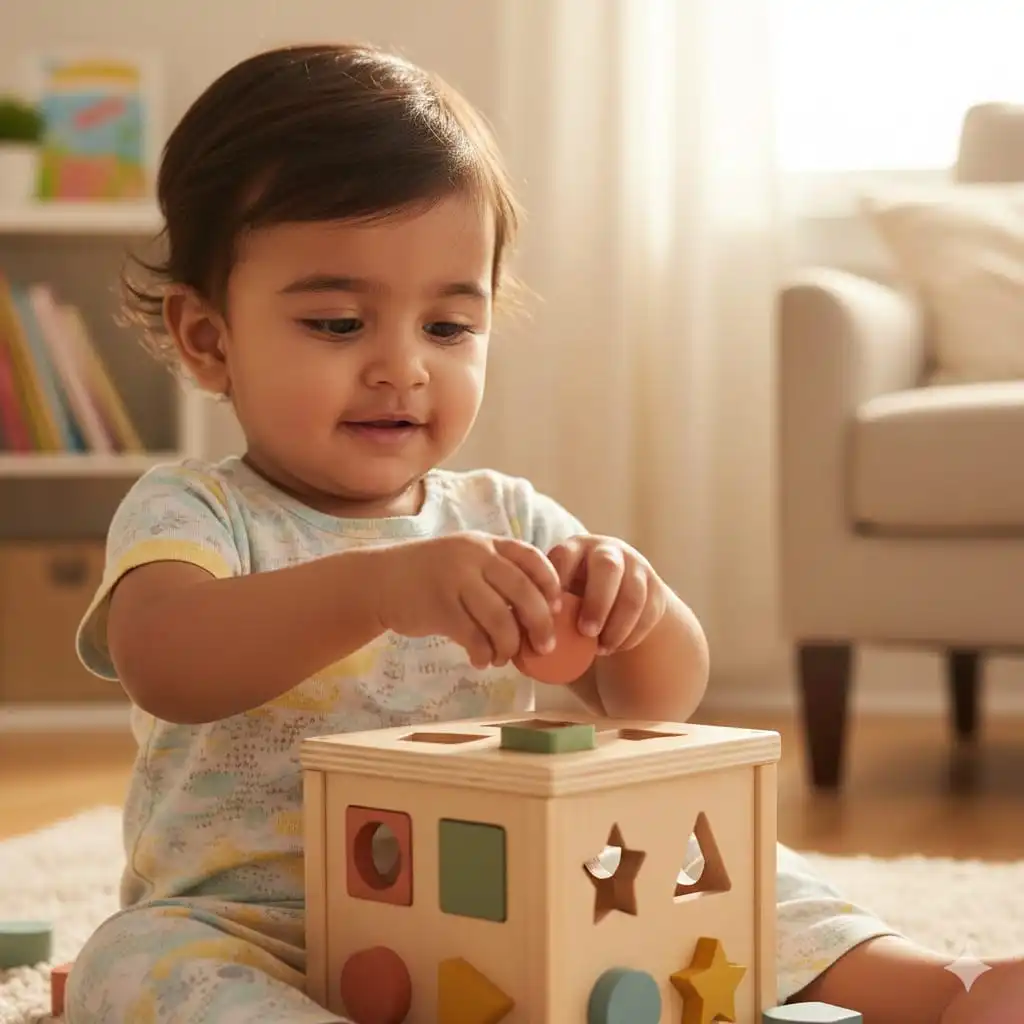
Toddlers (1–3 Years)
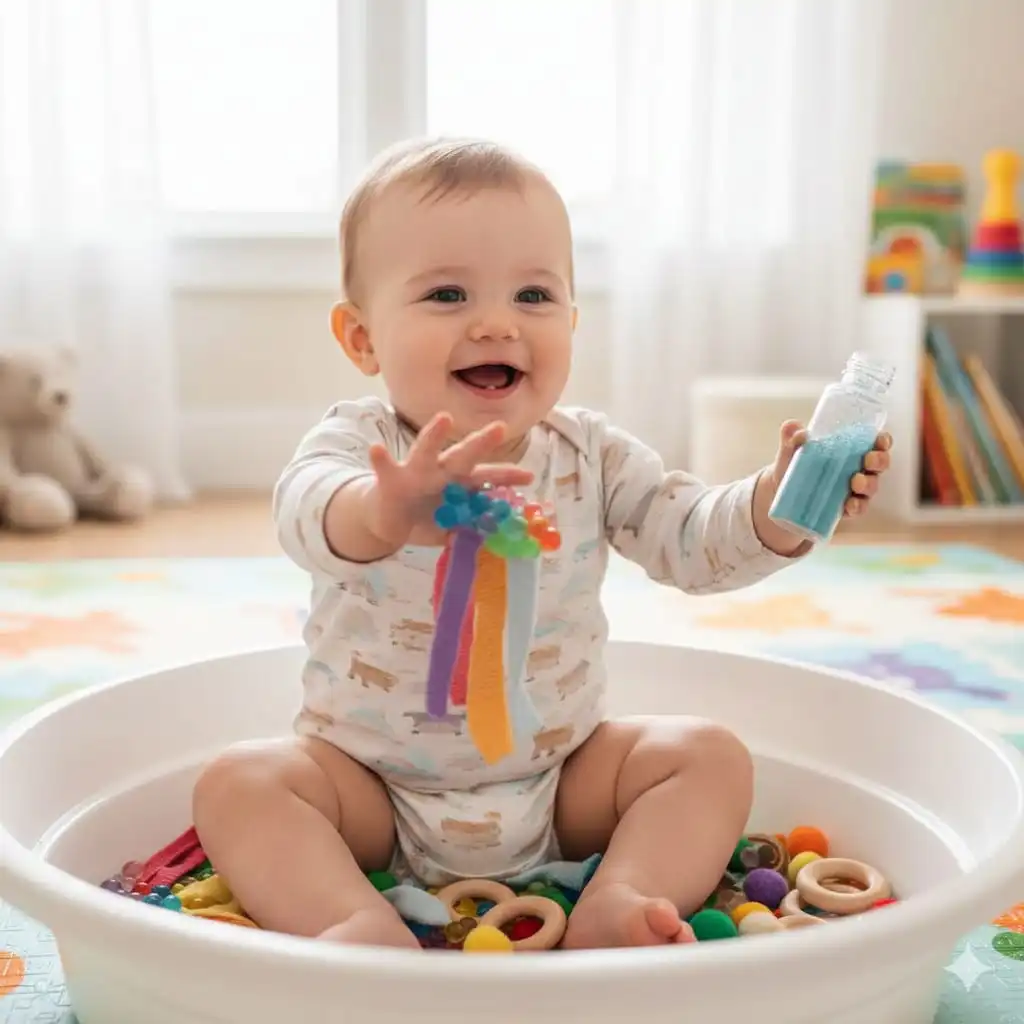
For toddlers, play based learning activities should focus on sensory exploration and movement. Activities like stacking cups, soft block play, musical toys, and water play help toddlers understand cause and effect. Simple play based learning activities also support language development as parents talk, sing, and read during play. At this age, repetition is important, and play based learning activities should be safe, simple, and engaging.
Preschoolers (3–5 Years)
Preschoolers benefit from more imaginative and structured play based learning activities. Role play, puzzles, matching games, and art activities support creativity and early academic skills. Play based learning activities at this stage help children recognize letters, numbers, shapes, and colors naturally. Indian parents can include cultural stories, festivals, and daily routines into play based learning activities to deepen understanding and relevance.
Early School-Age Children (5–8 Years)
For early school-age children, play based learning activities can include problem-solving tasks, board games, construction challenges, and simple STEM activities. These play based learning activities strengthen logical thinking, teamwork, and persistence. Children at this stage enjoy goal-oriented play based learning activities that allow them to experiment and reflect. Educational toys and games support learning while keeping motivation high.
Role of Educational Toys in Play Based Learning Activities
Educational toys play an important role in supporting children’s overall development by turning everyday play into meaningful learning experiences. Unlike regular toys that mainly focus on fun, educational toys are created with a purpose. They help children think, imagine, explore, and build essential skills while still enjoying the joy of play.
One of the biggest benefits of educational toys is skill development. Simple puzzles help children improve problem-solving ability, patience, and logical thinking. Building blocks support an understanding of shapes, balance, and space while also strengthening hand–eye coordination. Sorting, matching, and stacking toys introduce early number awareness, comparison, and sequencing in a very natural way. When children touch and manipulate objects, learning becomes easier and more memorable.
Imaginative toys play a strong role in emotional and social growth. Items such as kitchen sets, doctor kits, tool sets, and vehicle toys allow children to copy real-life situations. Through pretend scenarios, children learn to express feelings, communicate ideas, and understand relationships. In Indian homes, children often recreate daily routines they see around them, which makes learning feel familiar and meaningful.
Educational toys also help introduce science and technology concepts at an early age. Construction sets, simple experiment kits, and problem-solving games encourage children to explore ideas like movement, balance, patterns, and cause and effect. These toys motivate children to ask questions and try different solutions on their own. Learning through curiosity builds confidence and reduces fear of making mistakes.
Another advantage of educational toys is their ability to support independent and focused play. Thoughtfully designed toys keep children engaged for longer periods, improving concentration and attention span. Montessori-style toys, for example, allow children to learn through repetition and self-correction, helping them gain confidence and independence without constant adult guidance.
For parents, educational toys act as silent teachers. They reduce the need for continuous instruction and give parents a chance to observe how their child thinks and solves problems. When parents occasionally join in by asking simple, open-ended questions, children feel encouraged without feeling pressured. This creates a positive learning environment at home.
It is important to remember that quality matters more than quantity. Too many toys can confuse children and limit creativity. A small collection of age-appropriate, open-ended toys allows deeper engagement and better learning outcomes. Trusted Indian platforms like zaminotoys.in focus on development-friendly toys that support learning without unnecessary lights, noise, or distractions.
In conclusion, educational toys support children’s growth by combining learning with enjoyment. When chosen carefully and used in balance, they help develop thinking skills, creativity, independence, and emotional understanding. These toys become valuable companions in a child’s early learning journey.
How Parents Can Support Play Based Learning Activities at Home
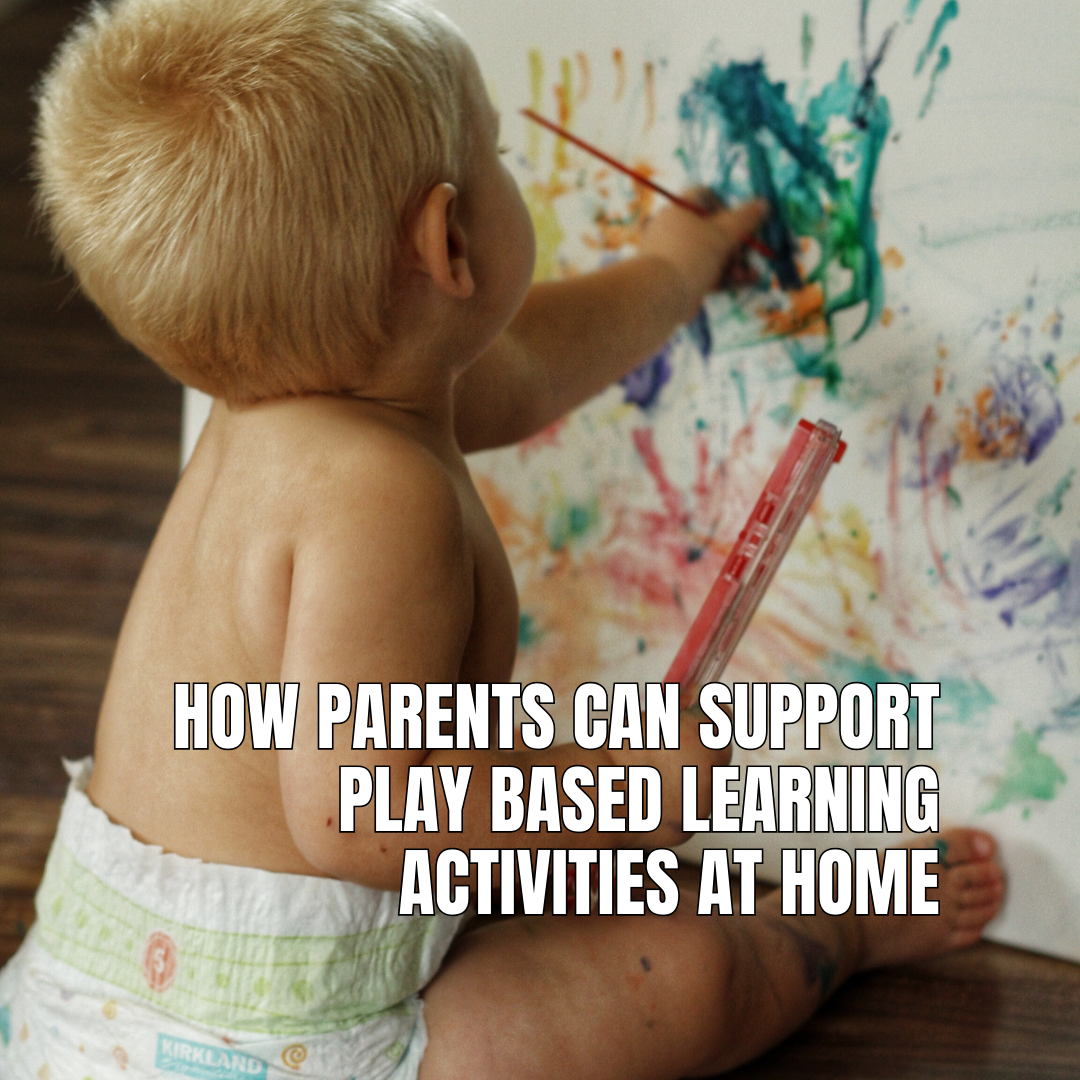
Parents play a crucial role in shaping how children learn and grow at home. When learning is naturally blended into play, children feel more motivated, relaxed, and curious. A home environment that respects play as a meaningful activity helps children develop skills without pressure. In Indian families, everyday routines and close family interactions already create strong foundations for this kind of learning.
One of the most important steps parents can take is creating a simple and comfortable space for play. This does not require a separate room or costly arrangements. A small area with enough floor space, a mat, and a few accessible toys is more than sufficient. When children can choose their materials independently, they gain confidence and feel a sense of control over their activities.
Parents are most effective when they act as quiet supporters rather than constant teachers. Children learn deeply when they are allowed to explore freely. Instead of correcting or directing every action, parents can observe patiently. Watching how a child approaches a task reveals a lot about their thinking style and interests. Gentle questions such as “What made you try that?” or “What could you do next?” help children reflect and think independently.
Daily household activities offer powerful learning moments. Cooking, cleaning, shopping, and gardening can all support skill development when children are involved. Counting items in the kitchen, matching socks while folding clothes, or helping water plants teaches practical concepts in a natural way. In Indian homes, children often imitate adults, making these experiences both familiar and meaningful.
Consistency matters more than long hours. Parents do not need to plan extended sessions or structured schedules. Even a short period of focused engagement each day creates a strong impact. Regular shared time builds emotional security and strengthens the bond between parent and child, which is essential for healthy development.
Maintaining a healthy balance with screens is also important. While digital devices may offer educational content, too much screen exposure limits movement, imagination, and hands-on discovery. Activities involving physical objects, art materials, or simple household items encourage creativity, coordination, and active thinking in ways screens cannot replace.
Selecting the right toys also supports learning at home. Open-ended toys that can be used in different ways encourage imagination and problem-solving. Instead of giving many toys at once, parents can rotate them occasionally to maintain interest. Indian platforms like zaminotoys.in offer thoughtfully designed toys that support developmental growth without unnecessary distractions.
Most importantly, parents should value effort over results. Children gain confidence when curiosity, persistence, and creativity are appreciated. There is no need to focus on perfection or correct outcomes. When children feel accepted and encouraged, they develop a positive relationship with learning that lasts beyond early childhood.
In conclusion, parents nurture learning at home by providing a supportive environment, respecting a child’s pace, and involving them in everyday experiences. With mindful participation and simple choices, the home can become a space where children grow emotionally, socially, and intellectually through joyful experiences.
Common Mistakes Parents Should Avoid
One common mistake is turning play based learning activities into formal lessons. Over-instructing or correcting too often can reduce a child’s interest. Another mistake is expecting immediate academic results from play based learning activities. Learning through play is gradual and developmental. Comparing children or forcing outcomes can create stress. Parents should also avoid overcrowding children with too many toys, as fewer well-chosen toys support deeper play based learning activities.
Play Based Learning Activities vs Rote Learning
Play based learning activities differ significantly from rote learning methods. Rote learning focuses on memorization and repetition, often without understanding. In contrast, play based learning activities encourage exploration, questioning, and application. While rote learning may produce short-term recall, play based learning activities support long-term understanding and skill development. In the Indian education context, combining foundational academics with play based learning activities creates balanced and confident learners.
Frequently Asked Questions About Play Based Learning Activities
What are play based learning activities?
Play based learning activities are learning experiences where children gain knowledge, skills, and understanding through play, exploration, and interaction rather than through direct instruction or memorization. In this approach, play is not separate from learning—it is the primary way learning happens.
Through play based learning activities, children explore ideas, test solutions, ask questions, and express creativity in a natural and stress-free manner. Activities such as building with blocks, role play, puzzles, storytelling, and sensory play help children develop thinking skills while enjoying the process. This method supports holistic development by nurturing cognitive, emotional, social, and physical growth together.
Are play based learning activities suitable for Indian schools?
Yes, play based learning activities are highly suitable for Indian schools when thoughtfully adapted to cultural values, classroom size, and available resources. India’s education environment already includes storytelling, music, group activities, and hands-on experiences, which align naturally with play-based learning principles.
When integrated properly, play based learning activities help Indian classrooms move beyond rote memorization and encourage understanding, creativity, and participation. These activities can be implemented using low-cost materials, traditional games, and real-life examples, making them practical and effective for both urban and rural schools.
How much time should children spend on play based learning activities daily?
Children benefit most when play based learning activities are spread throughout the day rather than limited to one long session. On average, children can engage in one to two hours of play based learning activities daily, depending on their age, routine, and energy level.
Younger children require shorter, more frequent play sessions, while older children can engage in longer, goal-oriented activities. The key is balance. Learning through play should feel enjoyable and flexible, not forced. Consistent daily exposure helps children build skills gradually and develop a positive relationship with learning.
Can play based learning activities help with academics?
Yes, play based learning activities strongly support academic readiness by building deep conceptual understanding rather than surface-level memorization. Through play, children naturally develop early literacy, numeracy, and problem-solving skills.
For example, sorting games introduce math concepts, storytelling builds language skills, and construction play improves logical thinking. These foundational skills prepare children for formal academics by strengthening attention, comprehension, and reasoning. Children who learn through play often transition more smoothly into structured learning environments.
Do play based learning activities require expensive toys?
No, effective play based learning activities do not require expensive toys or special equipment. Many meaningful learning experiences can be created using simple household materials and everyday activities.
Items such as bowls, spoons, cloth pieces, cardboard boxes, and natural objects can support exploration, creativity, and problem-solving. The value of play based learning activities lies in how children interact with materials, not in the cost of the toys. Open-ended, age-appropriate materials encourage imagination and deeper engagement.
How do play based learning activities support emotional development?
Play based learning activities play an important role in emotional and social development. Through play, children learn to express feelings, manage emotions, and understand the perspectives of others.
Group play encourages sharing, cooperation, and empathy, while individual play supports self-regulation and confidence. Role play and pretend play allow children to explore real-life situations in a safe environment. These experiences help children develop emotional resilience, self-control, and healthy social relationships over time.
Are play based learning activities better than worksheets?
For young children, play based learning activities are generally more developmentally appropriate and engaging than worksheet-based learning. Worksheets often focus on repetition and correct answers, while play based learning activities emphasize understanding, exploration, and creativity.
Learning through play keeps children motivated and curious, allowing skills to develop naturally. While worksheets may have limited use for older children, play based learning activities are more effective in early childhood because they support whole-child development and long-term learning outcomes.
Note
This information is based on established early childhood education practices, developmental psychology principles, and play-based learning research widely supported by educators and pediatric experts. The guidance is adapted for the Indian education and parenting context and is intended to support informed decision-making. Parents and educators are encouraged to consider individual child needs and consult qualified professionals when necessary.
Final Thoughts
Play based learning activities provide children with joyful, meaningful, and effective learning experiences that support overall development. In Indian homes and schools, integrating play based learning activities into daily routines helps children grow confidently and creatively. With supportive parents, thoughtful environments, and age-appropriate educational toys, children can learn naturally through play. Parents who wish to strengthen play based learning activities at home often benefit from exploring trusted Indian resources such as zaminotoys.in, which focuses on thoughtfully designed educational toys that align with a child’s developmental needs. Choosing balanced approaches and reliable learning tools ensures that play based learning activities remain enriching, purposeful, and child-centered throughout early childhood.