One of the most important responsibilities in a child’s life is parenting. Childhood and adulthood are deeply shaped by parents’ guidance, discipline, nurturing, and emotional support. In today’s fast-changing world, many parents find themselves confused between modern parenting vs traditional parenting, trying to choose what truly works best for their child’s overall development and well-being.
At ZaminoToys, we regularly analyze parenting research, child-development studies, and real parent experiences to provide practical, evidence-based guidance. According to UNICEF, positive parenting plays a crucial role in a child’s emotional and mental development. Research highlighted by the World Health Organization (WHO) also confirms that parenting styles significantly influence long-term child behavior, confidence, and emotional health.
The discussion around modern parenting vs traditional parenting has become more relevant than ever. Rapid technological growth, evolving social values, rising mental health awareness, and changing education systems have transformed how children grow up. At the same time, traditional values, discipline, and cultural roots continue to play a crucial role in shaping responsible individuals.
This expert-backed, parent-friendly guide explains modern parenting vs traditional parenting in a practical and easy-to-understand way. It examines their definitions, philosophies, benefits, drawbacks, and how parents can thoughtfully combine both approaches to raise confident, emotionally secure, and responsible children.
Understanding Modern Parenting vs Traditional Parenting
Understanding Modern parenting vs Traditional parenting is essential for today’s parents because parenting is no longer limited to a single approach. Society, education, technology, and children’s emotional needs have changed over time, and parenting styles have evolved along with them. Both Modern parenting vs Traditional parenting are shaped by the era in which they developed, and each reflects the values, challenges, and expectations of that time.
Traditional parenting developed in a period when life was more structured and predictable. Families lived close to each other, communities were tightly connected, and social rules were clearly defined. In this environment, traditional parenting focused on discipline, obedience, respect for elders, and following established rules. Parents were seen as authority figures, and children were expected to listen, comply, and learn through guidance that was often strict but consistent. In modern parenting and traditional parenting, traditional parenting aims to prepare children to survive and succeed by teaching responsibility, respect, and self-control from an early age.
Modern parenting, on the other hand, emerged as researchers and psychologists began to better understand how children think, feel, and learn. Scientific studies on brain development, emotional intelligence, and mental health revealed that children thrive when they feel emotionally safe and understood. As a result, modern parenting places strong importance on communication, empathy, and emotional support. Parents practicing modern parenting focus on understanding the reasons behind a child’s behavior rather than simply correcting it. In the context of modern parenting and traditional parenting, modern parenting sees children as individuals with unique personalities, emotions, and learning styles.
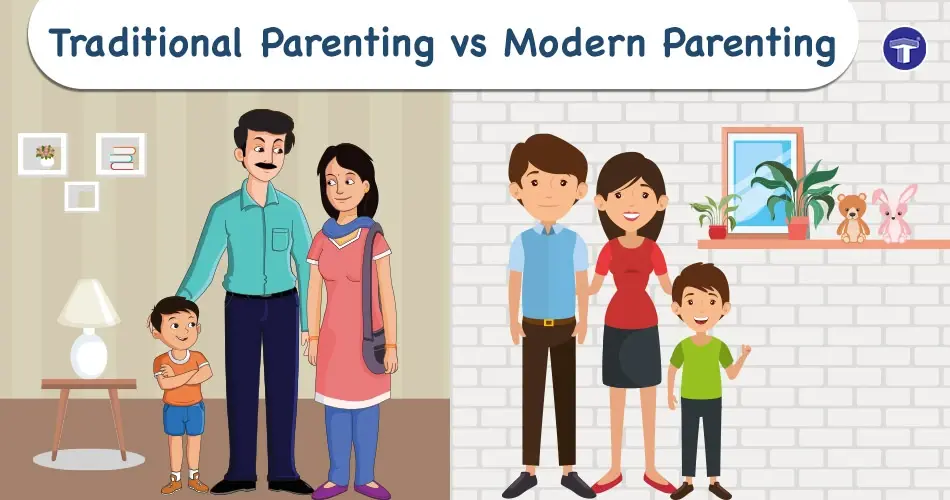
Another key difference in understanding modern parenting and traditional parenting lies in how discipline is approached. Traditional parenting often relies on rules and consequences to correct behavior, while modern parenting uses explanation, guidance, and positive reinforcement. Traditional parenting believes discipline builds character, whereas modern parenting believes understanding builds confidence. Both approaches aim to shape good behavior, but they take different paths to reach the same goal.
It is important to recognize that modern parenting and traditional parenting are not opposites or enemies. Instead, they represent two perspectives on raising children. Traditional parenting provides structure, stability, and moral grounding, while modern parenting supports emotional awareness, independence, and adaptability. In real life, most parents naturally combine elements of both styles, adjusting their approach based on the child’s age, situation, and emotional needs.
By clearly understanding modern parenting and traditional parenting, parents can move beyond confusion and guilt about “right” or “wrong” methods. This understanding allows parents to choose what works best for their child while maintaining discipline, emotional connection, and long-term developmental goals.
What Is Traditional Parenting?
Traditional Parenting
Traditional parenting is the style most people used to follow generations ago. It’s more strict, structured, and authority-based.
Key Features:
- Parents are the boss — kids are expected to obey without question.
- Discipline is strict — punishment is used to correct behavior.
- Children are taught to respect elders and follow rules.
- Family roles are fixed — usually father as the decision-maker and mother as caregiver.
- Less focus on emotions — feelings and mental health are not discussed openly.

Pros:
✔️ Kids grow up disciplined
✔️ Clear boundaries and respect
✔️ Strong family values
Cons:
❌ Less emotional connection
❌ Kids may feel afraid to speak
❌ Less creativity and independence
What Is Modern Parenting?
Modern Parenting
Modern parenting is more flexible, child-centered, and emotional. It focuses on understanding the child rather than controlling them.
Key Features:
- Child’s feelings matter — parents listen and communicate.
- Discipline is positive — rules are explained, not forced.
- Parents guide, not control — children are encouraged to think independently.
- Family roles are shared — both parents share responsibilities.
- Focus on mental health — emotions, stress, and happiness are considered important.
Pros:
✔️ Strong emotional bond
✔️ Child learns independence
✔️ Better communication
✔️ Encourages creativity
Cons:
❌ Sometimes boundaries become weak
❌ Kids may become more demanding
❌ Parenting becomes more challenging
Modern Parenting vs Traditional Parenting: Why Parents Feel Confused
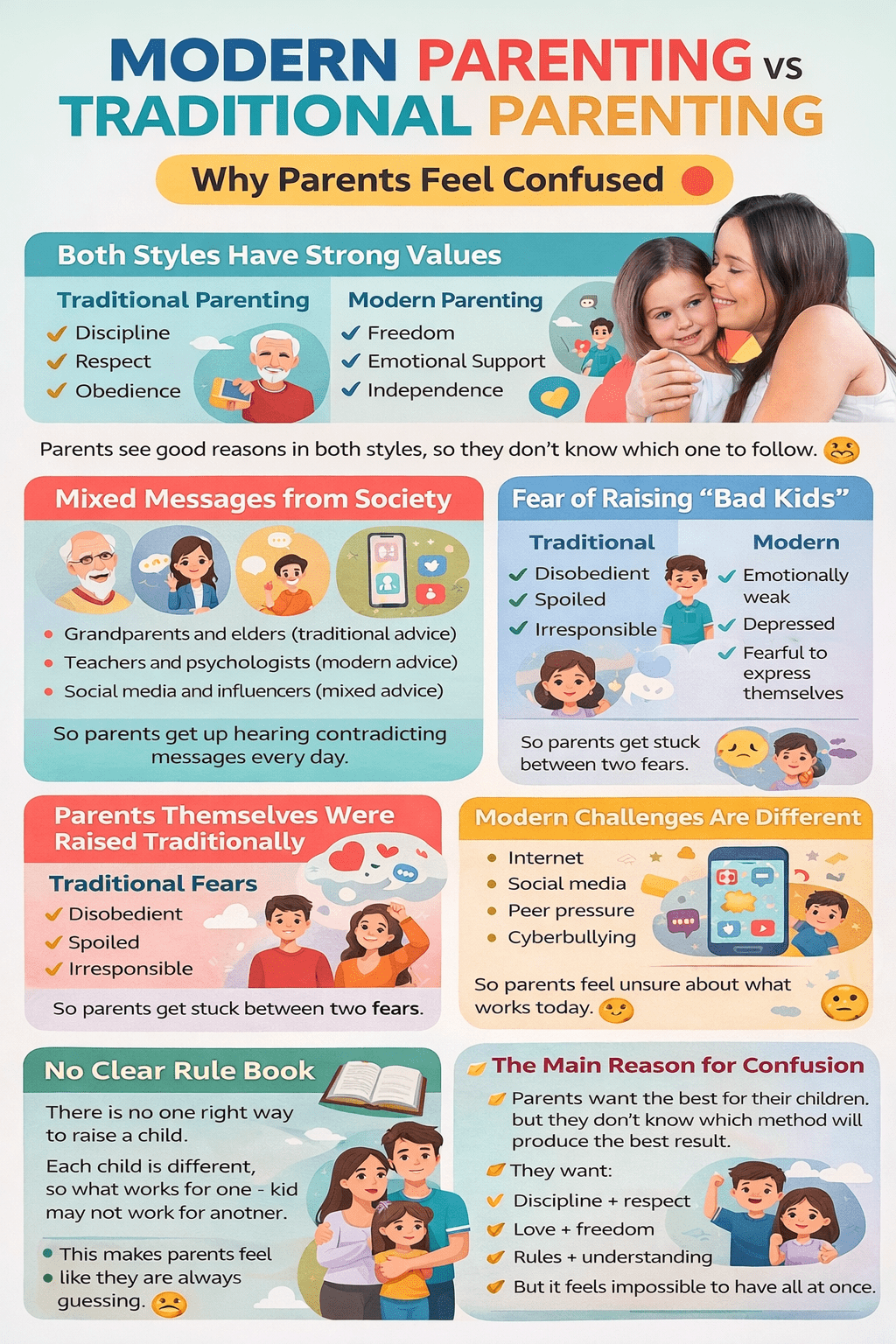
Both Styles Have Strong Values
Traditional parenting values discipline, respect, and obedience.
Modern parenting values freedom, emotional support, and independence.
Parents see good reasons in both styles, so they don’t know which one to follow.
Mixed Messages from Society
Parents get advice from many places:
- Grandparents and elders (traditional advice)
- Teachers and psychologists (modern advice)
- Social media and influencers (mixed advice)
So parents end up hearing contradicting messages every day.
Fear of Raising “Bad Kids”
Traditional parenting fears that if rules are not strict, kids will become:
- Disobedient
- Spoiled
- Irresponsible
Modern parenting fears that if kids are not understood emotionally, they will become:
- Emotionally weak
- Depressed
- Fearful to express themselves
So parents get stuck between two fears.
Parents Themselves Were Raised Traditionally
Many parents were raised with traditional methods. So:
- Their instinct says: “Be strict”
- Their heart says: “Be gentle”
This conflict creates confusion.
Modern Challenges Are Different
Today’s world is full of:
- Internet
- Social media
- Peer pressure
- Cyberbullying
These new challenges make traditional parenting seem outdated, and modern parenting seem too soft.
So parents feel unsure about what works today.
No Clear Rule Book
There is no one right way to raise a child.
Each child is different, so what works for one kid may not work for another.
This makes parents feel like they are always guessing.
The Main Reason for Confusion
👉 Parents want the best for their children, but they don’t know which method will produce the best result.
They want:
- Discipline + respect
- Love + freedom
- Rules + understanding
But it feels impossible to have all at once.
🎯 The Best Solution
Most experts suggest a balanced approach:
Traditional + Modern = Best Parenting
✔️ Set rules and boundaries
✔️ Explain the reason behind rules
✔️ Listen to your child
✔️ Give freedom with responsibility
✔️ Respect emotions but stay firm
Improvised Understanding of Modern Parenting and Traditional Parenting
Parenting has never been a fixed rulebook. What parents call modern or traditional parenting are actually responses to the world children are growing up in. Understanding this removes most of the confusion.

Traditional Parenting: Why It Worked Then
Traditional parenting developed in a time when society needed:
- Obedience for survival
- Respect for hierarchy
- Discipline for social order
Core Philosophy
“Children must learn to follow rules first, emotions later.”
What Traditional Parenting Does Well
- Builds discipline and self-control
- Creates clear boundaries
- Teaches respect for elders and authority
- Gives children structure and routine
Where It Struggles Today
- Emotional needs are often ignored
- Fear-based obedience can reduce confidence
- Less room for creativity and questioning
Traditional parenting was effective in a simpler, slower, community-driven world.
Modern Parenting: Why It Emerged
Modern parenting emerged because today’s world demands:
- Critical thinking
- Emotional intelligence
- Adaptability
- Mental health awareness
Core Philosophy
“Children are individuals who need guidance, not control.”
What Modern Parenting Does Well
- Builds emotional security
- Encourages independent thinking
- Improves parent–child communication
- Helps children handle stress and social pressure
Where It Can Fail
- Lack of firm boundaries
- Over-negotiation with children
- Children may struggle with authority and limits
Modern parenting fits a fast, complex, emotionally demanding world, but can become ineffective without structure.
Why Parents Feel Caught in the Middle
Parents today are raising children in a modern world using traditional instincts.
- Their upbringing taught discipline through fear
- Current knowledge promotes discipline through understanding
This creates internal conflict:
“If I’m strict, I feel guilty.
If I’m gentle, I feel scared.”
The Real Shift: Control → Connection
The biggest difference isn’t old vs new—it’s control vs connection.
The Improved Parenting Perspective (Best of Both)
The healthiest approach is authoritative parenting, which blends both styles.
How It Looks in Practice
- Rules exist → but reasons are explained
- Respect is expected → but feelings are acknowledged
- Parents lead → but children are heard
- Discipline teaches → not humiliates
Firm boundaries + warm connection = confident children
Modern Parenting: Philosophy and Core Ideas
Modern parenting believes that children grow best when they feel emotionally safe and understood.
Core Principles of Modern Parenting
Modern parenting is based on the idea that:
- Children are individuals, not extensions of parents
- Emotions are natural and should be expressed
- Mistakes are learning opportunities
- Communication builds trust
- Independence builds confidence
In modern parenting and traditional parenting, modern parenting focuses on nurturing emotional strength alongside learning.
Advantages of Modern Parenting
Modern parenting offers several benefits that align well with today’s fast-changing world.
1. Emotional Intelligence Development
One of the biggest advantages of modern parenting is emotional intelligence. Children learn to understand their emotions and manage them effectively.
In the comparison of modern parenting and traditional parenting, modern parenting helps children:
- Express feelings clearly
- Develop empathy
- Handle stress better
- Build healthy relationships
2. Strong Parent–Child Bond
Modern parenting encourages trust and openness. Children feel comfortable sharing fears, failures, and opinions without fear of punishment.
This strong emotional bond is a defining feature of modern parenting and traditional parenting differences.
3. Encouragement of Independence
Modern parenting allows children to make age-appropriate decisions. This builds confidence and problem-solving skills.
Children raised with modern parenting often grow into self-reliant adults.
4. Focus on Mental Health
Modern parenting recognizes anxiety, stress, and emotional struggles in children. Parents actively support mental well-being instead of ignoring emotional issues.
This awareness makes modern parenting highly relevant in modern parenting and traditional parenting discussions.
5. Creativity and Critical Thinking
Modern parenting encourages questioning, creativity, and exploration. Children are not afraid to think differently or express ideas.
Limitations of Modern Parenting
Despite its benefits, modern parenting also has limitations.
1. Risk of Over-Permissiveness
Without firm boundaries, children may struggle with discipline and self-control. Too much freedom can lead to confusion about rules.
In modern parenting and traditional parenting, this is a common concern with modern parenting.
2. Parental Stress and Burnout
Modern parenting requires constant emotional involvement, which can be exhausting for parents.
3. Difficulty Adapting to Strict Environments
Children raised only with modern parenting may struggle in environments that demand discipline, such as strict schools or workplaces.
Traditional Parenting: Philosophy and Core Ideas
Traditional parenting is based on the belief that structure, rules, and discipline prepare children for future responsibilities.
Core Principles of Traditional Parenting
Traditional parenting emphasizes:
- Obedience and respect
- Discipline and routine
- Clear authority
- Cultural and moral values
- Social responsibility
In modern parenting and traditional parenting, traditional parenting focuses on stability and order.
Advantages of Traditional Parenting
Traditional parenting continues to offer valuable strengths.
1. Strong Discipline and Structure
Children raised with traditional parenting clearly understand rules and expectations. This reduces behavioral problems.
In modern parenting and traditional parenting, discipline is a key strength of traditional parenting.
2. Respect for Elders and Authority
Traditional parenting teaches respect for teachers, elders, and social systems, which helps children function well in society.
3. Sense of Responsibility and Accountability
Children often develop a strong work ethic and accountability from an early age.
4. Preservation of Culture and Values
Traditional parenting helps pass down cultural traditions, moral values, and family identity.
Limitations of Traditional Parenting
Traditional parenting also has limitations that parents should consider.
1. Limited Emotional Expression
Children may suppress emotions due to fear of punishment or judgment.
In modern parenting and traditional parenting, emotional restriction is a major limitation of traditional parenting.
2. Fear-Based Obedience
Strict discipline can lead to obedience driven by fear rather than understanding.
3. Reduced Independence
Children may rely heavily on authority figures and struggle with independent decision-making later in life.
Modern Parenting and Traditional Parenting: A Practical Comparison
| Aspect | Modern Parenting | Traditional Parenting |
| Discipline | Gentle guidance | Strict rules |
| Communication | Two-way | One-way |
| Emotional focus | High | Limited |
| Independence | Encouraged | Controlled |
| Authority | Shared | Parent-centered |
This comparison clearly shows how modern parenting and traditional parenting differ in practice.
Role of Play and Learning in Modern Parenting and Traditional Parenting
Play is essential in both parenting styles, but modern parenting places greater emphasis on learning through play.
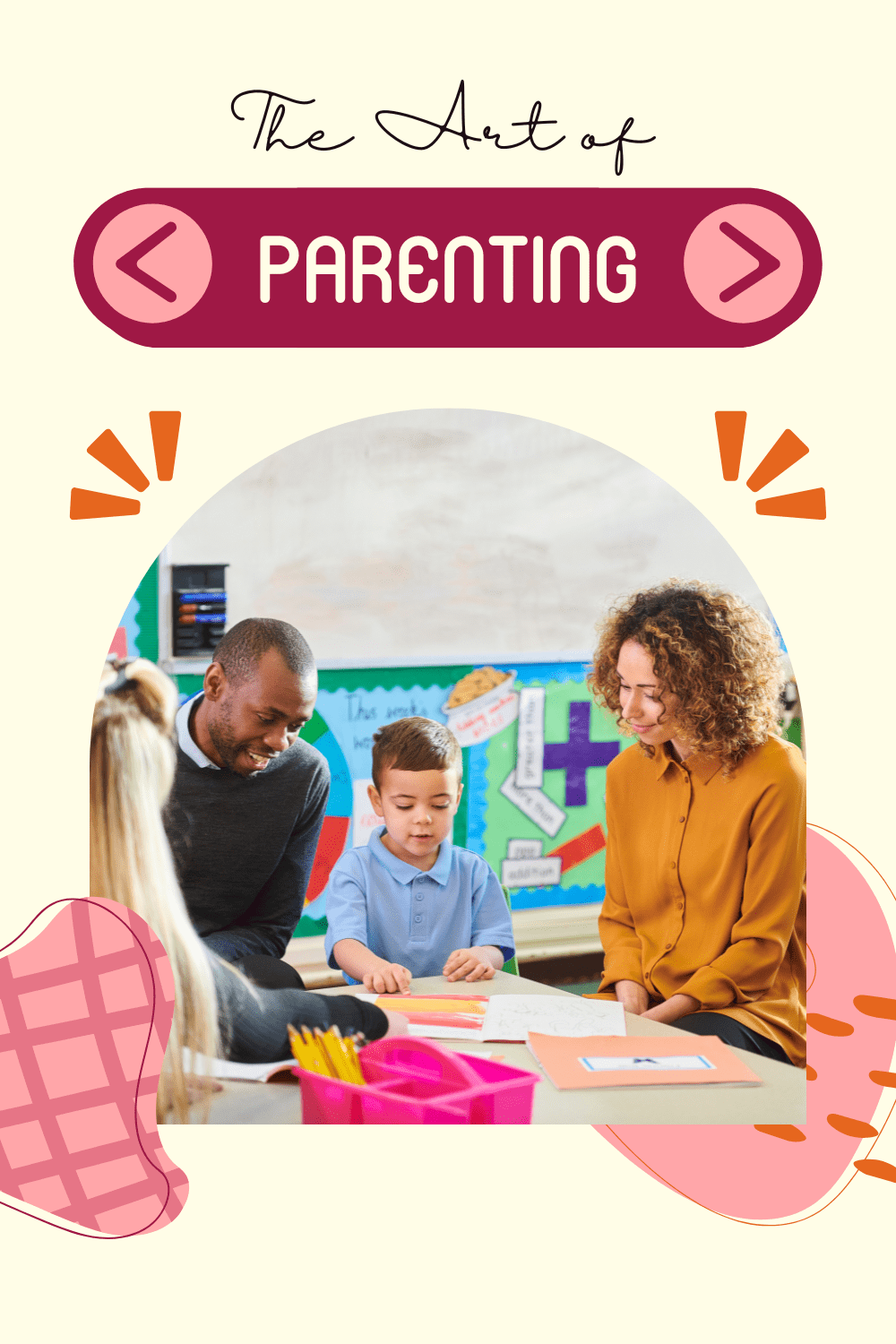
Educational toys, creative games, and hands-on activities support:
- Cognitive development
- Emotional expression
- Problem-solving skills
- Social interaction
Play-based learning connects modern parenting and traditional parenting by combining discipline with creativity.
How Parenting Styles Shape Child Development
The approach parents choose influences:
- Self-esteem
- Emotional resilience
- Social behavior
- Academic performance
Understanding modern parenting and traditional parenting helps parents adapt their methods to a child’s unique needs.
Finding Balance Between Modern Parenting and Traditional Parenting
The most effective parenting approach today is a balanced one.
A Balanced Parenting Approach
- Set clear rules with empathy
- Encourage emotional expression with boundaries
- Teach respect without fear
- Allow independence with guidance
Children thrive when modern parenting and traditional parenting are blended thoughtfully.
Real-Life Parenting in Today’s World
Today’s parents face challenges such as:
- Screen time and digital addiction
- Academic pressure
- Peer comparison
- Mental health concerns
Using a balanced mix of Modern Parenting vs Traditional Parenting helps children navigate these challenges confidently.
Which Is Better: Modern Parenting or Traditional Parenting?
There is no single correct answer in the debate of Modern parenting vs Traditional parenting.
The best parenting style:
- Evolves with the child’s age
- Respects individuality
- Maintains discipline
- Supports emotional well-being
Final Thoughts on Modern Parenting vs Traditional Parenting
Modern parenting vs Traditional parenting both have good values. Traditional parenting teaches discipline and respect, while modern parenting focuses on understanding, communication, and emotional support. Parents often feel confused because they want to follow both.
The best approach is balance. Children need clear rules, but they also need love and understanding. When parents combine discipline with empathy, children grow up confident, respectful, and emotionally strong.
About the Author
This article is published by ZaminoToys Parenting Research Team, a platform dedicated to helping Indian parents make smarter toy and parenting decisions. Our content is created after reviewing child-development research, pediatric recommendations, and real parenting experiences to ensure accuracy, safety, and practical usefulness for families.
🔹 Educational purpose only — not a substitute for professional medical or psychological advice.