

From “Good News” to “Guthli”: The Ultimate Desi Myth-Buster!
In India, you don’t just “get pregnant.” You become the project manager of a massive, family-run startup! The moment the “good news” breaks, your pregnancy care journey begins with a whirlwind of shagun, sweets, and a never-ending stream of advice. During the pregnancy care first month, it feels like a 24/7 briefing from the “Dadi-Nani Council.”
Suddenly, everyone has a pregnancy care plan for you. By the time you hit pregnancy care first 3 months, you’ve probably been told to eat for two, avoid papayas like the plague, and drink enough Kesar milk to turn the baby into a gold bar! Navigating pregnancy care for first trimester needs can feel like walking through a minefield of “Gharelu Nuskhe.” And just when you think you’ve mastered the art of pregnancy care, the baby arrives, and a whole new chapter of baby care drama begins—featuring Kajal battles and the great Janam Ghutti debate.
But let’s get real for a second. We love our traditions, but we also love our 2026 science. At Zamino Toys, we’re here to help you filter the “noise” in both pregnancy care and baby care. Which pregnancy care tips are actually genius, and which ones are just old-school fairytales? Grab a cup of (decaf) chai, and let’s dive into the facts of pregnancy care and the safest way to handle baby care in those first blurry weeks.
🤰 The Womb Journey: A Month-by-Month Myth-Buster
In India, pregnancy care is a family festival. But between the Laddoos and the Loris, science often gets buried. Let’s look at the “Guthli” growing inside you and separate the wisdom from the whispers to refine your pregnancy care strategy.
Phase 1: The First Trimester (0–3 Months)
During your pregnancy care first month, the focus is often on “what not to do.” You’ll hear that you must stay in bed or eat double portions. This is also when the “complexion obsession” enters your pregnancy care plan.
-
The Kesar (Saffron) & Fairness Myth:
- The Tradition: Drink Kesar Doodh every night to ensure a “Gora” (fair) baby. In our Sanskriti, fair skin was often mistakenly linked to health.
- The Science: Complexion is determined by Melanin and inherited DNA. By the time you realize you’re pregnant in the pregnancy care first month, the genetic code is already locked in.
- The Fact: Kesar is a fantastic “Mood Medicine.” It helps with the anxiety and sleep issues common in pregnancy care for first trimester symptoms.
- Expert Quote: “I observe expectant mothers worrying about taking saffron as part of their Pregnancy carte regime Saffron is for antioxidants and sleep, not for changing skin color.” — Dr. Amrita Basu, ENT Surgeon.
- The “Eating for Two” Trap: In the pregnancy care first 3 months, your baby is roughly the size of a green pea. They don’t need a second paratha; they need Folic Acid (Vitamin B9). Overeating early on leads to excessive weight gain and increases the risk of Gestational Diabetes later in the pregnancy care plan.

Phase 2: The Second Trimester (4–6 Months)
The Golden Period
This is when you start following pregnancy care tips for the “glow.” But it’s also when “hot” and “cold” food myths peak.
The Papaya & Pineapple “Abortion” Scare
- The Tradition: Avoid these fruits entirely as they are “garam” (hot) and cause miscarriage.
- The Science: 2026 nutrition science confirms that only unripe or semi-ripe papaya contains Latex and Papain, which can cause uterine contractions. A fully ripe, yellow papaya is safe and excellent for curing pregnancy-induced constipation.
- The Fact: Pineapple contains Bromelain, but it’s concentrated in the core. You’d need to eat roughly 10 whole pineapples in one sitting for it to affect your cervix. A few slices in your pregnancy care first 3 months or later is perfectly healthy.
Expert Quote: “Restricting fruits like papaya and pineapple often deprives Indian women of essential Vitamin C and Fiber. Unless the papaya is raw/green, it is perfectly safe. We need to move away from ‘food fears’ and toward ‘balanced nutrition’.” — Dr. Manisha Singh, Senior Gynecologist & Fertility Specialist.
Phase 3: The Third Trimester (7–9 Months)
The Home Stretch
As you prepare for the baby’s arrival, the advice becomes about “opening the path” for delivery.
The Ghee “Lubricant” Theory
- The Tradition: Drink Ghee in warm milk or water to “grease” the birth canal.
- The Science Check: Your digestive tract and your vaginal canal are two separate systems. Ghee goes to the stomach to be broken down into fatty acids; it doesn’t “leak” into the uterus to help the baby slide out.
- The Fact: While Ghee is great for the pregnancy care plan as a healthy fat for the baby’s brain, excessive amounts lead to severe acidity and high cholesterol.
The “Eclipse” (Grahan) Lockdown
- The Tradition: During an eclipse, a pregnant woman shouldn’t use knives, needles, or even move, or the baby will have a “cleft lip” or birthmark.
- The Science: Birthmarks and cleft lips are developmental issues that occur in the pregnancy care for first trimester (weeks 4–8). They have zero connection to planetary shadows.
- The Fact: Stay inside if it makes the family happy, but feel free to eat, sleep, and use your phone! Stressing the mother is worse than the eclipse.
Expert Quote: “There is no medical evidence linking celestial events to fetal anomalies. The ‘Grahan’ myth often causes unnecessary panic and dehydration in pregnant women who refuse to drink water during the eclipse. A hydrated, calm mother is the best ‘pregnancy care tip’ I can give.” — Dr. Tanaya Narendra (Dr. Cuterus), Oxford-trained Embryologist.
The Verdict: Trust the Science, Honor the Love
At Zamino Toys, we know that these myths come from a place of deep care. Our elders wanted to protect us when they didn’t have ultrasound machines or 2026 pathology labs.
Your 3-Step Pregnancy Care Plan:
- First Month: Focus on Folic Acid and rest.
- First Trimester: Keep the Kesar for your mood, not for “fairness.”
- Throughout: Move your body! Prenatal yoga is better for delivery than drinking cups of Ghee.
What is the weirdest “Dadi-Nani” advice you’ve received so far? Let us know in the comments!
🍼 The Cradle Journey: Fact-Checking Indian Baby Care Traditions
Congratulations! Your little one is here. Now comes the phase where every auntie has a “nuskha” and every neighbor has a “warning.” Let’s look at the baby care tips that are passed down through generations and see what the pediatricians have to say.
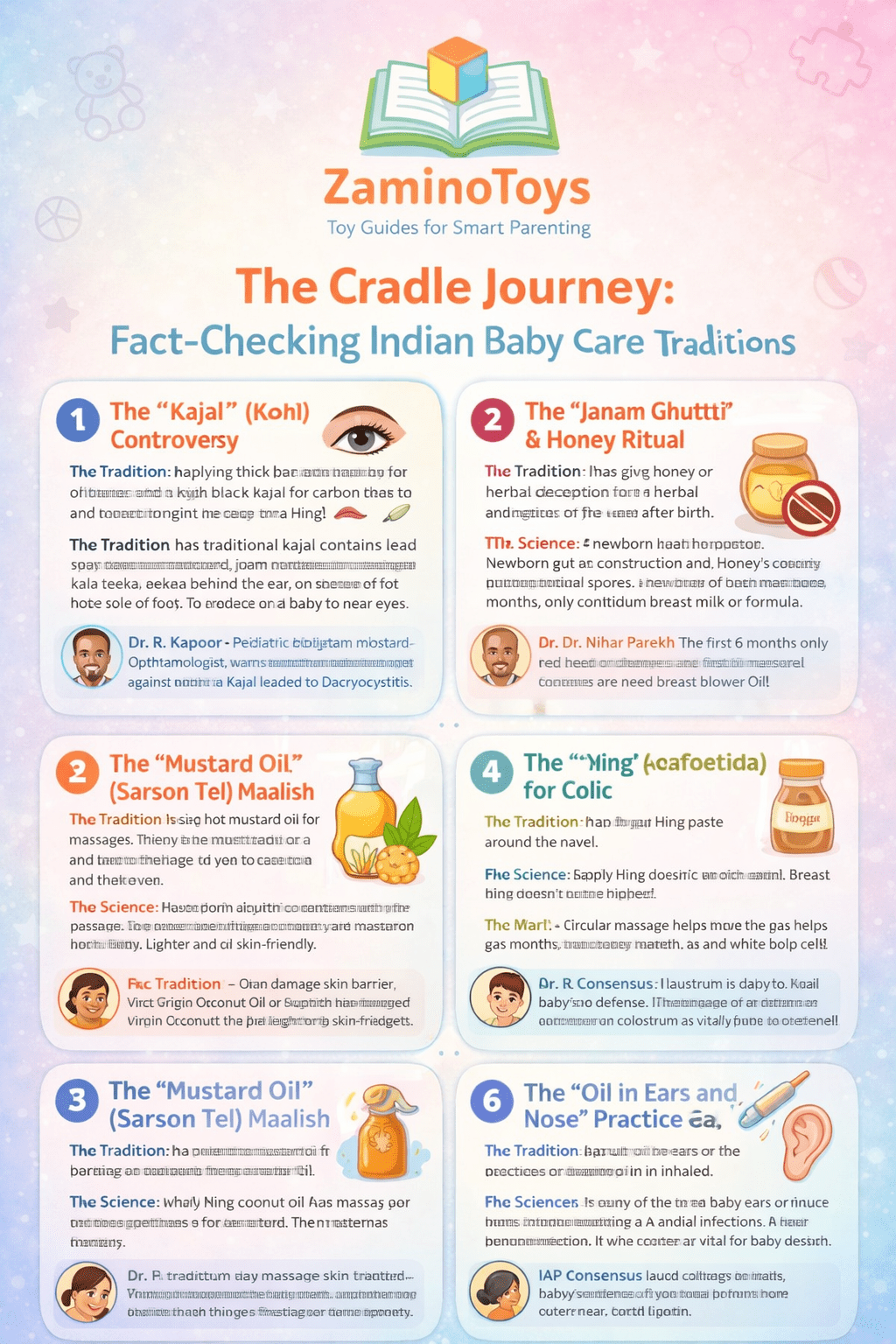
1. The “Kajal” (Kohl) Controversy 👁️🖤
- The Tradition: Applying a thick stroke of black Kajal to the baby’s eyes to make them “big and bright” and to ward off the Nazar (Evil Eye).
- The Science: Most traditional Kajal contains Lead (Pb), which is a neurotoxin. Even homemade soot can contain carbon particles that block the tiny, delicate tear ducts of a newborn, leading to chronic watering and infections.
- The Fact: Eyesight is determined by genetics and health, not Kohl. To protect your baby from Nazar, put a small “Kala Teeka” on the forehead, behind the ear, or on the sole of the foot—keep it away from the eyes!
Expert Quote: “We frequently see newborns with ‘Dacryocystitis’ (blocked tear ducts) because of Kajal. A baby’s eyes are self-cleaning; adding external substances increases the risk of chemical conjunctivitis. Keep the eyes natural and clean.” — Dr. R. Kapoor, Pediatric Ophthalmologist.
2. The “Janam Ghutti” & Honey Ritual 🍯🚫
- The Tradition: Giving the baby a drop of honey or a herbal decoction (Ghutti) right after birth to “cleanse the stomach” or ensure a sweet voice.
- The Science: A newborn’s gut is “under construction.” Honey contains spores of Clostridium botulinum, which can lead to Infant Botulism—a rare but serious form of food poisoning that causes muscle weakness.
- The Fact: For the first 6 months, a baby needs nothing but breast milk or formula. Not even water!
Expert Quote: “The infant gut cannot handle the complex bacteria in honey or the unregulated herbs in Ghutti. I tell all parents: Breast milk is the only ‘Janam Ghutti’ your baby needs—it’s their first vaccine.” — Dr. Nihar Parekh, Pediatrician.
3. The “Mustard Oil” (Sarson Tel) Maalish 💆♂️🔥
- The Tradition: Using “hot” mustard oil for massages to make bones “stronger.”
- The Science: 2026 research into the skin microbiome shows that mustard oil can be quite abrasive. It has a high erucic acid content that can damage the skin barrier and cause rashes or “cradle cap.”
- The Fact: Virgin Coconut Oil or Sunflower Oil are much lighter, anti-fungal, and skin-friendly. They protect the baby’s delicate skin without the risk of irritation.
4. The “Hing” (Asafoetida) for Colic 🍛💨
- The Tradition: Applying a paste of Hing around the navel to relieve gas and colic pain.
- The Science: While Hing is great in dal, it doesn’t actually penetrate the skin to reach the intestines.
- The Fact: It’s the circular massage you do while applying the paste that helps the gas move! The warmth of your hand and the motion are the real heroes here.
5. The “Discarding Colostrum” Myth 🤱💛
- The Tradition: In some cultures, the thick, yellowish “first milk” is considered “dirty” or “stale” and is thrown away.
- The Science: This is a huge mistake! Colostrum is liquid gold.
- The Fact: It is packed with secretory Immunoglobulin A (IgA) and white blood cells. It coats the baby’s gut and provides the first line of defense against the Indian environment.
Expert Quote: “Colostrum is nature’s most perfect medicine. Discarding it is like throwing away the baby’s first shield against infections. It is the most vital part of early baby care.” — Consensus from the Indian Academy of Pediatrics (IAP).
6. The “Oil in Ears and Nose” Practice 👂🛢️
- The Tradition: Putting a few drops of oil into the baby’s ears or nose to “keep them soft/clear.”
- The Science: This is one of the most dangerous myths. It can lead to fungal infections in the ear or, worse, the oil can be inhaled into the lungs, causing Lipoid Pneumonia.
- The Fact: Ears are self-cleaning. Just wipe the outer ear with a soft cloth.
🌏 The Great Indian Baby Map: Local Traditions meets 2026 Science
When we talk about baby care, a “one size fits all” approach doesn’t work in India. Every state has its own secret nuskha. Let’s travel across the map to see which regional traditions are hidden gems and which ones need a modern “update.”
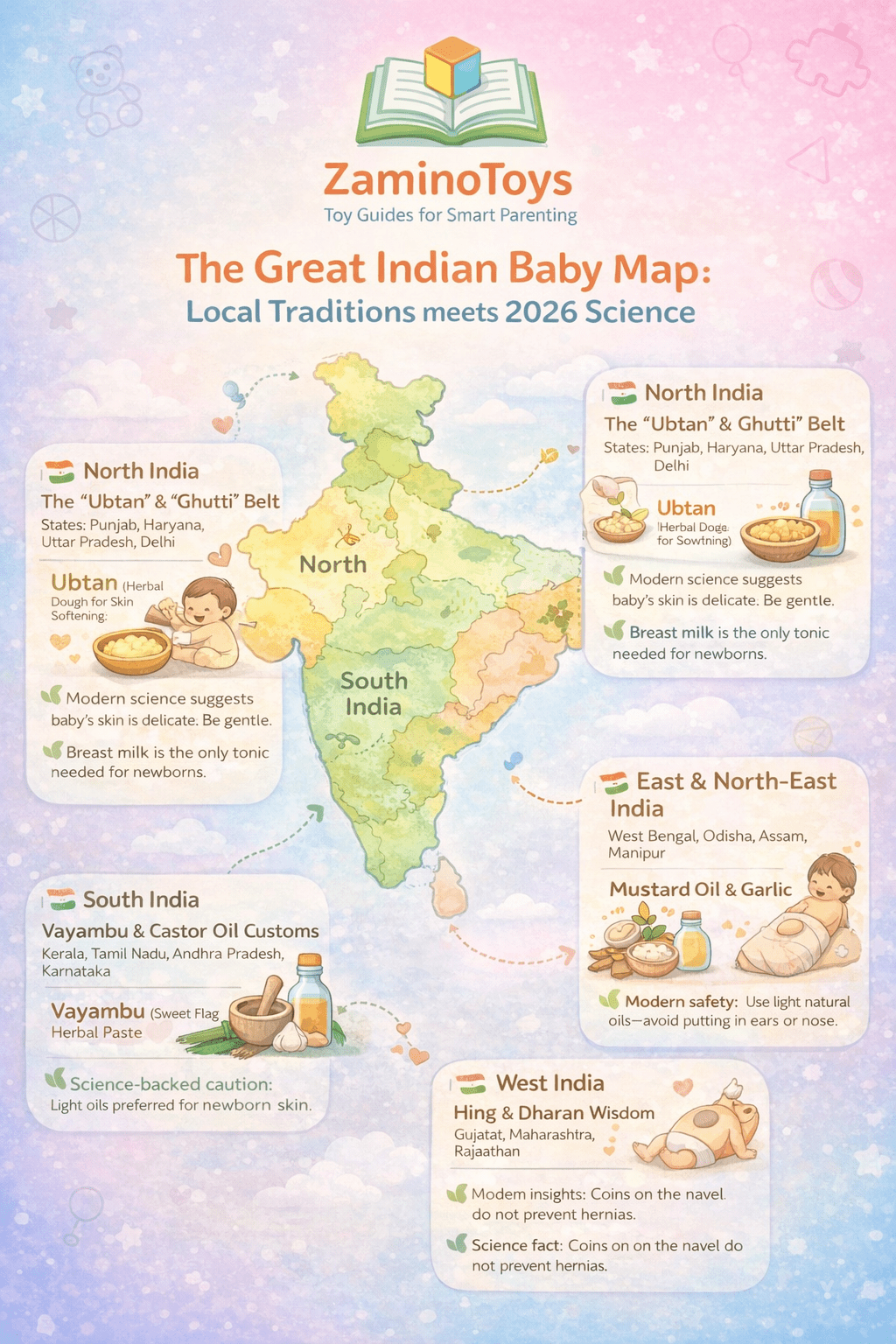
1. North India: The “Ubtan” & “Ghutti” Belt
States: Punjab, Haryana, Uttar Pradesh, Delhi.
- The Tradition (Ubtan/Peethi): In Punjab and UP, babies are often rubbed with a dough made of Atta (flour), Besan, Haldi, and Oil to remove body hair (Rom) and soften the skin.
- The Science Check: A newborn’s skin is 30% thinner than ours. Vigorous rubbing with coarse flour can cause micro-tears and skin rashes.
- The Fact: Body hair on a newborn is natural (Lanugo) and falls off on its own by month 4. If you love the ritual, keep the paste very liquid and the touch very light.
- The Tradition (Ghutti): In the Hindi heartland, “Janam Ghutti” is a staple.
- The Fact: Dr. Parimal Swamy (@DrParimalSwamy) often highlights that unregulated Ghuttis can contain traces of opium or heavy metals to make the baby sleep. Stick to exclusive breastfeeding for 6 months—it’s the only “tonic” they need!
2.South India: “Vayambu” and “Castor Oil” Customs
States: Kerala, Tamil Nadu, Andhra Pradesh, Karnataka.
- The Tradition (Vayambu/Sweet Flag): In Kerala household s, a paste of Vayambu (Acorus calamus) is often given to newborns to improve speech and intellect.
- The Science Check: The US FDA and many Indian pediatricians warn that Vayambu can be toxic to the liver and may cause seizures in high doses.
- The Fact: Speech development is a result of early communication and reading to your baby—not herbal pastes.
- The Tradition (Castor Oil Bath): In Tamil Nadu, a heavy Castor Oil head-to-toe bath is a Sunday ritual.
- The Fact: While Castor Oil is traditional, it is very thick and can block sweat glands, leading to “Prickly Heat” (Heat rashes) in the humid South Indian climate. Virgin Coconut Oil (the pride of the South!) is scientifically better for the skin barrier.
3. West India: The “Hing” & “Dhara” Wisdom
States: Gujarat, Maharashtra, Rajasthan.
- The Tradition (Hing Paste): In Gujarat and Rajasthan, applying a Hing (Asafoetida) paste around the navel for colic is the go-to move.
- The Fact: As we mentioned before, it’s the circular massage (the Vayu-Mudra motion) that moves the gas, not the spice.
- The Tradition (The “Sikka”/Coin Placement): In some rural districts of Rajasthan, a copper coin is tied over the navel to prevent a “protruding” belly button.
- The Science Check: This is a myth. Umbilical hernias usually heal on their own, and a coin can actually trap bacteria, leading to a nasty infection.
4. East & North-East India: “Mustard Oil” and “Sek”
States: West Bengal, Odisha, Assam, Manipur.
- The Tradition (Mustard Oil & Garlic): In Bengal and Odisha, mustard oil is heated and mixed with garlic cloves before being massaged to “warm the chest” and prevent colds.
- The Science Check: Mustard oil contains allyl isothiocyanate, which is a known skin irritant. In 2026, we know that putting pungent oil in a baby’s nose or ears can lead to Lipoid Pneumonia.
- The Fact: Keep the oil for the body (if your baby isn’t sensitive), but never put it in the nose or ears.
- The Tradition (Sek/Heat Therapy): In the North-East, new mothers and babies are often given “heat therapy” using warm stones or cloths after a bath.
- The Fact: While warmth is soothing, a baby’s internal thermostat isn’t fully developed. Overheating (Hyperthermia) is a risk. Keep it “lukewarm,” never “hot.”
The “Eye-Opening” Specialist Quote
“Diversity is indias strength ,but when it comes to baby care,its very challenging. We see many cases of ‘Chemical Conjunctivitis’ in the North due to Kajal, and ‘Liver Toxicity’ in the South due to traditional herbal pastes. My advice to the Zamino community: If it goes IN the body (food/drops) or IN the eyes, always check with a pediatrician first. If it’s just a ritual of love (like a song or a light touch), embrace it!” > — Dr. Nihar Parekh, Pediatric Expert.
The Bottom Line: How to be a “Smart Parent” in a Land of 1,000 Myths
Let’s be real. When your mother-in-law is standing there with a jar of honey or your neighbor is insisting on Kajal, it’s hard to say no. But being a “parent with a brain” in 2026 isn’t about being rude or acting like a know-it-all.
It’s about being the CEO of your baby’s health. Lets check how to be a smart parent here:
1. Use the “In or On” Rule
This is the simplest trick in the book.
- Is it going ON the baby? (Like a gentle massage, a soft song, or a black dot on the foot). Usually, it’s fine! Embrace the love.
- Is it going IN the baby? (Like honey, Ghutti, or oil in the ears/nose). Stop right there. Unless your doctor said yes, the answer is a hard no.
2. The phrase “We’ve typically done it this way” is a trap.
Our elders raised us with love, but they didn’t have the research we have in 2026. Just because “everyone survived” doesn’t mean it was the safest way. A smart parent knows that science updates itself, and they aren’t afraid to update their habits too.
3. Don’t Argue, Just Redirect
You don’t need to give a lecture on biology. If Dadi wants to protect the baby from the “evil eye,” don’t fight her. Just say, “Ma, let’s put the Teeka on the baby’s heel rather than the eye.” That way the eye stays clean, but the Nazar is still gone!” It’s a win-win.
4. Focus on the Stuff That Actually Matters
Don’t lose sleep over whether you ate a piece of pineapple. Instead, focus your brainpower on:
- Breastfeeding (or the right formula).
- Vaccines (don’t skip them!).
- Cleanliness (washing hands before touching the baby).
- Safe Toys (playing with things that won’t choke them or leak toxic chemicals).
A Quick Word from the Experts: “The best tool a parent has isn’t a book—it’s common sense. If a tradition feels risky or unhygienic, trust your gut. Your job is to protect the baby, not the tradition.”
The Zamino Wisdom: Respecting the Heart, Updating the Hand
We’ve traveled a long way in this guide! From the very first month of pregnancy care and those tricky first trimester myths, to the deep dive into regional baby care traditions across the North, South, East, and West of India.
At ZaminoToys, we truly believe that our traditions come from a place of deep, pure love. Our grandmothers were the original “health experts” who wanted to protect us long before 2026 healthcare was just a click away. We aren’t here to tell you to stop the traditions; we are here to help you upgrade them.
Keep the rituals of love—the soothing massages, the sweet Loris, the family bonding, and the Sanskriti. But when it comes to the methods—like what goes in the eyes or in the stomach—let’s swap the risky old-school ways for doctor-approved science.
A Little Note from Us…
India is a beautiful, massive puzzle of cultures. We know that “Nani Maa ke Nuskhe” change every few kilometers, from the high mountains of the North to the tropical coasts of the South.
In this blog, we’ve covered:
- Pregnancy Care: The truth about Kesar, Ghee, and those first-trimester cravings.
- Baby Care Essentials: The real deal on Kajal, Honey, and Janam Ghutti.
- Regional Secrets: Local myths from Punjab to Kerala and Bengal to Gujarat.
- The Smart Parent Guide: How to use your brain to filter advice.
But we are certain we’ve only scratched the surface! Did we miss a myth or a piece of traditional wisdom that is famous in your specific state or district? Whether it’s a unique “Gharelu Nuskha” from your village or a ritual your family swears by, we want to know!
Drop a comment below and let’s keep this “Science & Sanskriti” conversation growing. Let’s build a community where our heritage and our baby’s safety go hand-in-hand. 👇
🩺 Content Medical & Parenting Review
Reviewed & Published by Zamino Toys Research Team
Zamino Toys is a parenting education and child development awareness platform focused on helping Indian parents make safe, research-based decisions for pregnancy care, baby care, and early childhood development.
👨👩👧 Experience & Research Background
Our content is developed after reviewing:
- Indian pediatric care guidelines
• Maternal health awareness resources
• Modern parenting research
• Cultural childcare traditions across India
• Parent experience case studies
• Child development behaviour research
We focus on simplifying complex medical awareness into easy-to-understand parenting guidance.
🧬 Medical Reference Standards
This article follows awareness and safety guidance aligned with:
- Indian Academy of Pediatrics (IAP) recommendations
• WHO infant care safety awareness guidelines
• Maternal nutrition and newborn safety research
• Pediatric skin and infant feeding safety studies
⚠️ Medical Disclaimer
This post is just intended to educate and raise awareness.
It is not a substitute for professional medical diagnosis, treatment, or consultation. Always consult a qualified pediatrician, gynecologist, or healthcare professional before following pregnancy or baby care advice.
💛 Zamino Parenting Philosophy
Zamino Toys promotes parenting decisions that balance:
✔ Cultural traditions
✔ Scientific safety
✔ Emotional family bonding
✔ Child development awareness
Our mission is to help parents raise confident, safe, and happy children using trusted knowledge.
🌐 About Zamino Toys
Zamino Toys provides:
- Age-wise toy selection guidance
• Brain development play education
• Safe parenting awareness
• Research-based child development blogs
Visit: https://zaminotoys.in/